


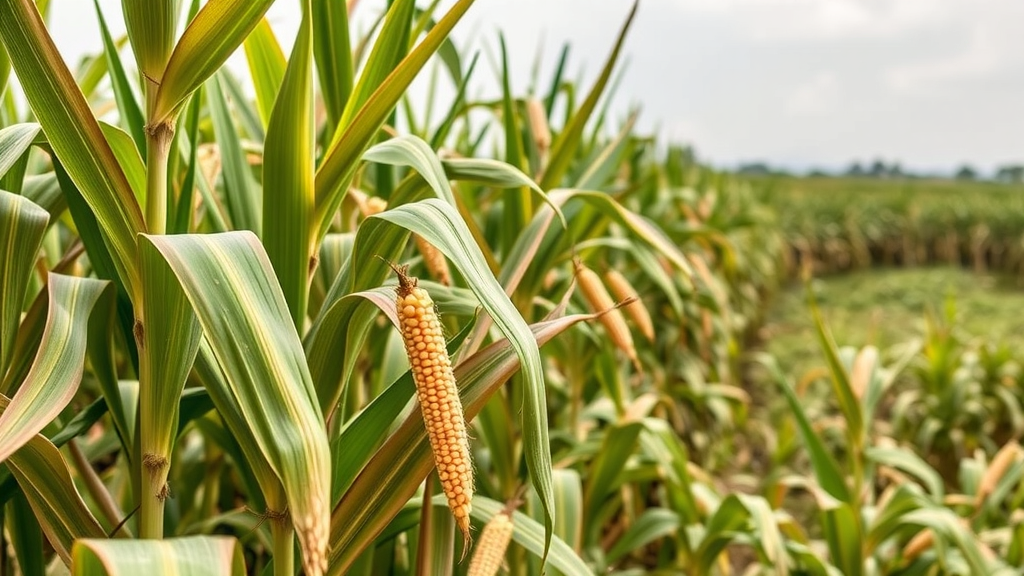
Maize is the backbone of Uganda’s food economy, feeding millions of people every day and supplying millers, traders and regional export markets with one of East Africa’s most important staple grains. Yet a new study from northern Uganda suggests that the very farmers who produce the bulk of the country’s maize often know surprisingly little about the quality grades and standards that govern its trade. Drawing on survey data from 270 smallholder farmers in the districts of Amuru and Nwoya, researchers found that fewer than half of the farmers surveyed were aware of the recommended maize grading system, and fewer still actually used it when selling their harvest. The findings, published in BMC Agriculture, offer a detailed statistical portrait of why compliance with grain standards remains so weak in a region that has become a critical hub for commercial maize production.
The research team, led by scientists at Gulu University and Kabale University, set out to answer three linked questions: what determines whether a farmer is aware of the maize grades and standards promoted by the East African Grain Council and the Uganda National Bureau of Standards; what determines whether an aware farmer actually adopts them; and what determines how intensively an adopter applies them to the harvest. Because these are sequential decisions rather than a single choice, the researchers needed a statistical framework that could account for the fact that only a subset of farmers ever reaches the adoption stage. Their solution was a two-pronged econometric approach combining probit regression with the Heckman two-stage selection model, a technique designed to correct for the bias that arises when the sample of adopters is not randomly drawn from the population.
The study area was deliberately chosen for its commercial importance. Amuru and Nwoya districts, located in the Acholi subregion along the Gulu–Arua road, are among Uganda’s most productive maize zones, with Amuru contributing an estimated 45,000 to 55,000 metric tons of maize annually and Nwoya producing between 50,000 and 60,000 metric tons. Both districts sit near the South Sudan border, a gateway for agricultural exports, and both are dominated by small-scale farming despite their considerable potential for large-scale production. Using multistage sampling, the researchers purposively selected the two districts, randomly chose Amuru and Alero sub-counties, and then drew a random sample of 270 maize farmers from lists supplied by district agricultural officers. The sample size was calculated with the Cochran formula, and data were collected between April and May 2023 through a pretested questionnaire administered by trained enumerators.
The headline numbers are striking. Only 40.4 percent of the farmers surveyed were aware of the recommended maize grades and standards, and just 31.1 percent actually used them. Among the farmers who did adopt grading, the mean proportion of their total maize output that was graded stood at 0.86, but the range was enormous, stretching from a minimum of 0.02 to a maximum of 4.41, reflecting wide variability in how extensively individual adopters engaged with the practice. Awareness was measured using eight Likert-type items capturing farmers’ knowledge of the grades recommended by the East African Community, with a composite score threshold used to classify farmers as aware or unaware. The internal consistency of the awareness scale, assessed with Cronbach’s alpha, was 0.71, indicating adequate reliability for the composite measure.
To unpack awareness, the researchers ran a probit regression in which the dependent variable was binary and the explanatory variables included education, age, gender, market access, extension contact, credit access and farmer-group membership. The results showed that each additional year of schooling raised the probability of awareness by 1.6 percent, a modest but statistically significant effect that echoes a large body of literature linking formal education to the uptake of agricultural innovations. Far more powerful was access to extension services: farmers with extension contact were 24.4 percent more likely to be aware of maize standards than farmers without it. Gender also mattered, with male farmers 12.2 percent more likely to know about the standards than female farmers, and access to credit raised awareness by 13.2 percent, presumably because financial resources allow farmers to explore practices that can enhance productivity. Membership in farmers’ associations was positively associated with awareness as well, confirming the role of collective institutions as channels for information diffusion.
The second stage of the analysis examined utilization. Farmers who were aware of the grading system were significantly more likely to apply it, underscoring the intuitive but policy-relevant point that knowledge is a precondition for adoption. Access to extension services again increased the likelihood of utilization, reinforcing the central role of advisory agents in translating standards into practice. Somewhat counterintuitively, the study found a negative and significant relationship between membership in farmers’ associations and adoption. The authors suggest that group dynamics, divergent member interests, limited collective knowledge or weak market demand for graded maize may discourage adoption within associations. Distance to the nearest maize market was also a significant factor, with farmers located closer to markets more likely to grade their maize, likely because reduced transport costs and easier buyer contact make compliance more attractive. Notably, distance to market, credit access and extension access were included only in the selection equation and excluded from the intensity equation, satisfying the exclusion restriction that allows the Heckman model to be identified beyond functional form.
The third stage modeled intensity of use among adopters, defined as the share of total maize output that was graded rather than the absolute quantity, a refinement the researchers adopted to avoid overstating intensity for larger producers. Here the significant and negative inverse Mills ratio confirmed that unobserved factors influencing the decision to adopt are correlated with those influencing intensity, validating the Heckman framework over alternatives such as the Tobit or double-hurdle models. The Tobit approach treats zero outcomes as corner solutions of a continuous process, but in this setting a zero means genuine non-utilization, a qualitatively different state. The double-hurdle model typically assumes independent error terms across the two decisions, whereas the Heckman model explicitly allows unobserved factors to be correlated and tests this through the Mills ratio. The intensity results showed that household size, land size under maize production and awareness were all positively associated with the share of output graded, while the effect of age was negative, meaning younger farmers graded a larger share of their harvest. Larger households supply the labor needed for the time-consuming sorting process, while larger landholdings allow fixed grading costs to be spread over greater volumes and signal more commercially oriented producers facing stronger market incentives.
The stakes of this knowledge gap are not abstract. Uganda exports roughly 22 percent of its annual maize harvest, with the rest consumed domestically, about 60 percent processed into flour, 37 percent used for animal feed and 3 percent for brewing. The trade is organized around informal buyers with no quality controls, large local traders who supply millers, Kenyan large-scale traders offering competitive prices, and institutional buyers such as the World Food Programme. Regional standards, harmonized by the East African Community with particular emphasis on aflatoxin monitoring, are meant to ensure consistency and food safety, but compliance in domestic markets remains inadequate. The consequences have been concrete and costly: in 2018, Kenya rejected more than 600,000 metric tons of Ugandan maize over high aflatoxin levels, and a further import ban affecting Ugandan and Tanzanian maize followed in 2021 for similar reasons. Such rejections depress farmer incomes, choke off export earnings and generate significant postharvest losses, making the low awareness and utilization documented in this study a matter of national economic concern rather than a narrow technical problem.
The authors are candid about the limitations of their work. The cross-sectional design, with data collected at a single point in time, restricts causal inference, and the focus on Amuru and Nwoya may limit how far the findings generalize to regions with different agricultural practices or economic contexts. They call for comparative analyses across diverse regions of Uganda and similar settings to capture regional variation and inform more tailored policy. Still, the practical implications are clear. The study recommends integrating maize-grading training into agricultural advisory programs, prioritizing younger farmers and larger-scale producers as early adopters and demonstration sites to accelerate diffusion through peer networks, scaling up tailored credit schemes so farmers can invest in the equipment and practices needed to meet standards, and establishing grading stations closer to farming communities to mitigate the logistical barriers associated with market distance. Given that association membership boosted awareness but not adoption, the authors also urge capacity building within farmer groups to address internal challenges and stimulate real demand for graded maize.
What emerges from the analysis is a coherent picture of a sequential decision pipeline in which information, institutions and economics each gate the next step. Education, extension, credit and gender equity determine who even knows the standards exist; awareness and proximity to buyers determine who acts on that knowledge; and household labor, land size and age determine how thoroughly adopters grade their grain. Breaking the pipeline at any stage suppresses quality compliance downstream, and the study suggests that fixing it requires coordinated interventions across all three stages rather than any single lever. For a country whose maize competes in regional markets where a single aflatoxin rejection can erase hundreds of thousands of tons of sales, helping smallholder farmers climb this decision ladder may be one of the most economically consequential investments agricultural policy can make.
Subject of Research: Determinants of smallholder farmers' awareness, adoption and intensity of use of maize grades and standards in northern Uganda, analyzed with a Heckman two-stage model.
Article Title: Determinants of awareness and intensity of use of maize grades and standards among smallholder farmers in Northern Uganda: a heckman two-stage model approach
Article References: Kalu, O. N., Adewale, C. I., Okello, D. M., & Mugonola, B. (2026). Determinants of awareness and intensity of use of maize grades and standards among smallholder farmers in Northern Uganda: a heckman two-stage model approach. BMC Agriculture, 2(1), Article 13. https://doi.org/10.1186/s44399-026-00035-z
Image Credits: AI Generated
DOI: 10.1186/s44399-026-00035-z
Keywords: maize, smallholder farmers, Uganda, grades and standards, Heckman two-stage model, adoption, awareness, intensity of use, extension services, market access, aflatoxin, agricultural economics
Cite Scienmag News
Alan Morgan. (September 22, 2026). Most Ugandan Maize Farmers Remain Unaware of Grading Standards, Study Finds. Scienmag. https://scienmag.com/most-ugandan-maize-farmers-remain-unaware-of-grading-standards-study-finds/
Alan Morgan. "Most Ugandan Maize Farmers Remain Unaware of Grading Standards, Study Finds." Scienmag, 22 September 2026, https://scienmag.com/most-ugandan-maize-farmers-remain-unaware-of-grading-standards-study-finds/. Accessed 5 October 2026.
Alan Morgan. "Most Ugandan Maize Farmers Remain Unaware of Grading Standards, Study Finds." Scienmag. September 22, 2026. https://scienmag.com/most-ugandan-maize-farmers-remain-unaware-of-grading-standards-study-finds/


