


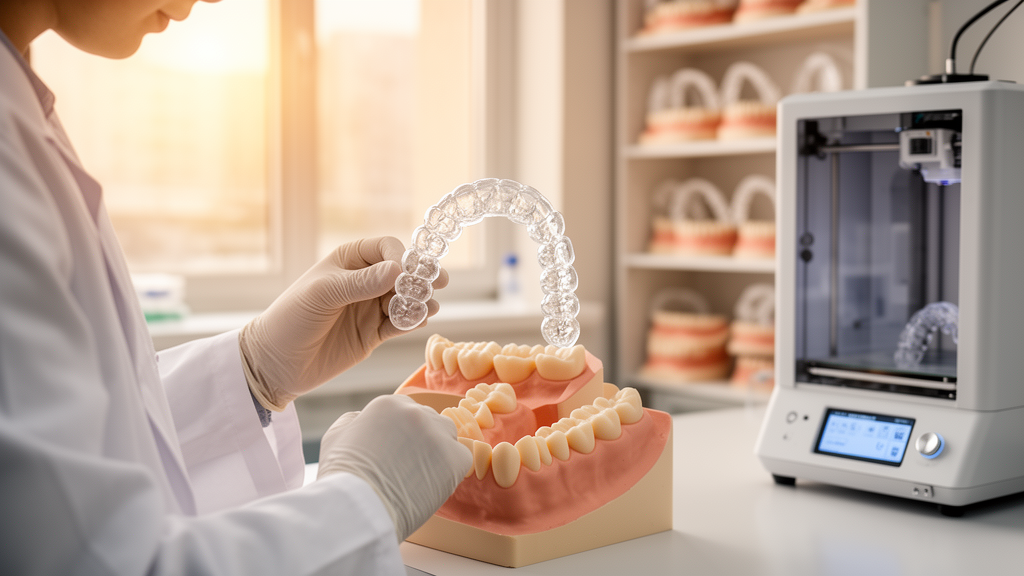
Direct 3D printing of clear orthodontic aligners and retainers is technically feasible, but the evidence supporting it remains dominated by laboratory studies rather than patient-level clinical research, according to a scoping review and evidence map published in the journal Digital and Aligner Orthodontics. The review, reported on 3 September 2026, mapped 22 verified sources comparing directly printed appliances with conventional thermoformed ones and found that only a small fraction of the literature actually measures clinical outcomes in patients.
The authors, Stefan Abela, Tommaso Castroflorio and Marco Migliorati, followed Joanna Briggs Institute guidance for scoping reviews and reported their work using the PRISMA extension for Scoping Reviews. They searched PubMed/MEDLINE, Embase, CENTRAL, Web of Science and Scopus from inception to 31 March 2026, also screening reference lists and grey literature via OpenGrey and Google Scholar, with no language restriction at the search stage. From 2934 records identified, 2003 were screened by title and abstract after duplicate removal, 157 full texts were assessed, and 22 verified sources met the eligibility criteria for the evidence map.
The central problem the reviewers identified was not a lack of interest in direct printing but a lack of evidence-hierarchy clarity. Patient-level clinical studies, in vivo appliance retrieval studies, laboratory trueness experiments, finite-element models, cytotoxicity assays, technical reports and reviews are often discussed together, creating a risk that laboratory performance is interpreted as clinical superiority. Because the available outcomes—such as predicted-versus-achieved tooth movement, retainer stability, force decay, elastic modulus, cytotoxicity and patient comfort—do not measure the same construct, the authors deliberately avoided meta-analysis and pooled treatment-effect estimation.
Instead, each source was classified into one of four a priori evidence tiers: Tier 1, patient-level clinical outcome studies; Tier 2, in vivo appliance retrieval or ageing studies; Tier 3, laboratory dimensional, mechanical or optical studies; and Tier 4, safety, leaching, cytotoxicity or post-processing studies. Descriptive proportions were calculated with Wilson score 95% confidence intervals, a method chosen because the mapped cells were sparse and the review’s objective was to describe the composition of the evidence base rather than to test hypotheses or estimate treatment effects.
The resulting map showed a strongly preclinical literature. Tier 1 patient-level clinical studies represented 13.6% of mapped sources (3 of 22; 95% CI 4.7–33.3), and Tier 2 in vivo ageing studies represented 9.1% (2 of 22; 95% CI 2.5–27.8). Laboratory dimensional, mechanical or optical studies accounted for 59.1% (13 of 22; 95% CI 38.7–76.7), while safety or biological-response studies accounted for 18.2% (4 of 22; 95% CI 7.3–38.5). Combining the two clinically or intraorally anchored tiers, such evidence represented 22.7% of sources (5 of 22; 95% CI 10.1–43.4), against 77.3% preclinical and safety evidence (17 of 22; 95% CI 56.6–89.9).
Only two patient-level studies directly compared directly printed and thermoformed appliances. Migliorati and colleagues, in a retrospective cohort, reported no statistically significant differences in the accuracy of rotation, tip and torque movements between directly printed and thermoformed aligners. Boo and colleagues, in a randomised trial, reported no statistically significant differences in six-month retention stability and patient satisfaction between 3D-printed and thermoformed retainers. The review concluded that comparative clinical evidence did not demonstrate statistically significant superiority of directly printed appliances over thermoformed comparators, and that these studies do not establish broad interchangeability across resins, printers, post-curing protocols, malocclusions, staging protocols or retention scenarios.
The strongest preclinical signal concerned dimensional accuracy. Studies by Cole, Edelmann, Koenig, McCarty, Naeem, Park and Bandić collectively indicated that accuracy is achievable but not automatic, with direct printing potentially avoiding distortions associated with thermoforming over a model, including localised thinning and elastic recovery. Two limitations remain central: there is no universally accepted clinical threshold linking submillimetric dimensional deviations to tooth-movement accuracy or retainer stability, and many studies are performed immediately after fabrication under ideal laboratory conditions without intraoral simulation.
Mechanical and ageing evidence similarly cautions against simple superiority claims. Sayahpour and colleagues reported that directly printed and thermoformed aligners may differ in mechanical response after intraoral service, and the review noted that directly printed materials may differ from thermoformed PETG and polyurethane-based materials in stiffness, stress relaxation and elastic recovery. Orthodontic tooth movement, the authors emphasise, is not governed by force magnitude alone; direction, point of application, moment-to-force ratio, staging, periodontal response, compliance and biological variability all matter, so a mechanical advantage observed in a test jig does not automatically translate into more efficient or biologically favourable tooth movement.
Safety emerged as a domain requiring prospective monitoring. Residual monomer and photoinitiator-related leachables are particular concerns for printed appliances because they depend on resin formulation and post-processing. Findings from Pratsinis, Willi, Iodice and Manoukakis collectively indicate that resin chemistry, leaching and post-curing should be treated as clinical-relevance variables. The reviewers call on future studies to report resin brand and batch where possible, printer model, layer thickness, wash protocol, post-curing unit, curing duration and temperature, energy dose when available, finishing protocol and adverse events, without which reproducibility and regulatory interpretation remain weak.
The review has limitations the authors acknowledge: the evidence map prioritised verified records and may have missed recently published or non-indexed work; several included studies originated from overlapping research groups, including publications co-authored by members of the author group, which may limit generalisability; clinical follow-up was short, with the longest comparative trial reporting at six months; and manufacturing protocols were inconsistently reported across studies. For clinicians, the authors support cautious implementation with validated manufacturing protocols and material-specific quality control rather than routine replacement of thermoforming. For researchers, they recommend adequately powered clinical comparisons, long-term retention outcomes, standardised mechanical and dimensional endpoints, transparent manufacturing protocols, safety monitoring, cost-effectiveness analyses, environmental sustainability assessments, patient-reported outcome measures and evaluation of AI-assisted workflows as the priorities that would make the evidence base clinically interpretable.
Subject of Research: Evidence mapping of direct 3D printing versus thermoforming for clear orthodontic aligners and retainers
Article Title: Direct 3D printing versus thermoforming for clear aligners and retainers: a scoping review and evidence map
Article References: Abela, S., Castroflorio, T., & Migliorati, M. (2026). Direct 3D printing versus thermoforming for clear aligners and retainers: a scoping review and evidence map. Digital and Aligner Orthodontics, 1(1), Article 9. https://doi.org/10.1007/s44525-026-00009-1
Image Credits: AI Generated
DOI: 10.1007/s44525-026-00009-1
Keywords: 3D printing, clear aligners, orthodontic retainers, thermoforming, scoping review, evidence map, dimensional accuracy, biocompatibility, post-curing, digital orthodontics, clinical evidence, resin leaching
Cite Scienmag News
Ophelia Keating. (October 28, 2026). Most Evidence on 3D-Printed Aligners Is Lab-Based, Scoping Review Finds. Scienmag. https://scienmag.com/most-evidence-on-3d-printed-aligners-is-lab-based-scoping-review-finds/
Ophelia Keating. "Most Evidence on 3D-Printed Aligners Is Lab-Based, Scoping Review Finds." Scienmag, 28 October 2026, https://scienmag.com/most-evidence-on-3d-printed-aligners-is-lab-based-scoping-review-finds/. Accessed 28 October 2026.
Ophelia Keating. "Most Evidence on 3D-Printed Aligners Is Lab-Based, Scoping Review Finds." Scienmag. October 28, 2026. https://scienmag.com/most-evidence-on-3d-printed-aligners-is-lab-based-scoping-review-finds/









