


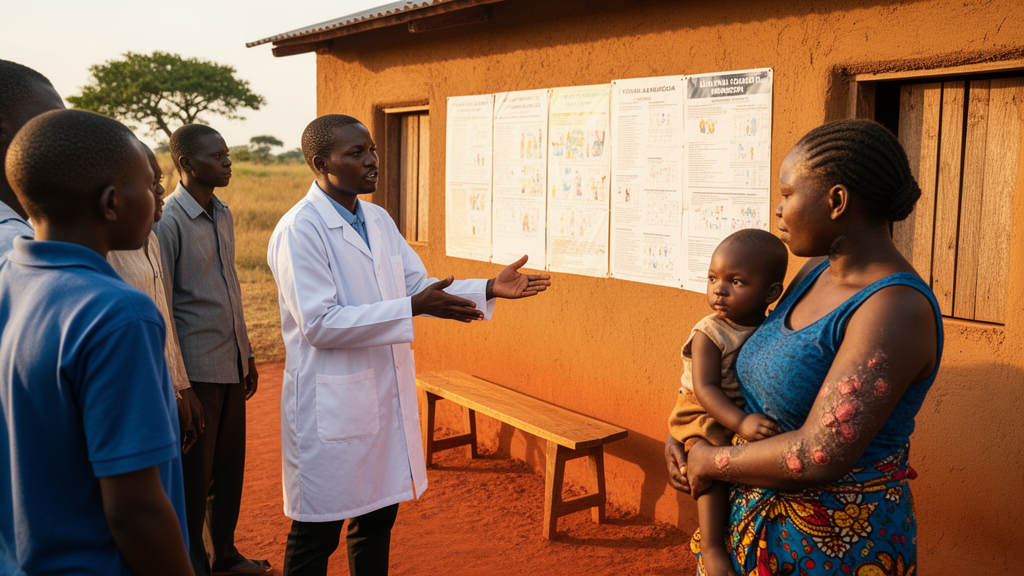
A nationwide cross-sectional survey in Burundi has found that while nearly all respondents had heard of mpox, substantial gaps persist in understanding what causes the disease, and most people did not know a vaccine exists. The nationwide cross-sectional survey interviewed 5,177 participants aged 15 years and older across five provinces of Burundi between March and December 2025.
The survey used a structured questionnaire adapted from the Africa CDC behavioural and social sciences framework for mpox. Overall, 94.7 percent of participants had heard about mpox. Recognition of symptoms was strong: 94.4 percent correctly identified skin rash and 84.3 percent identified fever as common symptoms, and 86.6 percent recognized direct contact as a mode of transmission.
Knowledge of the causative agent was markedly weaker. Some 21.4 percent of participants incorrectly identified bacteria as the cause of mpox, which is caused by a virus, and 24.5 percent did not know the causative agent at all. Taken together, nearly half of those surveyed held an incorrect view or no view on what causes the disease.
Radio emerged as the dominant channel for health information, cited as the main source of mpox information by 82.0 percent of participants and as the most trusted source by 87.0 percent.
The researchers analysed factors associated with knowledge and with prevention and control practices using bivariate and multivariable analyses, applying modified Poisson regression models with generalized estimating equations. Higher income was associated with better mpox knowledge, while prevention and control practices varied by knowledge level, income, marital status, and HIV status.
Vaccine awareness was low despite apparent readiness to accept immunization. Although 86.1 percent of participants were unaware that an mpox vaccine is available, 76.5 percent reported willingness to accept vaccination if it were offered to them.
The survey’s context matters. Mpox remains an important public health concern in Africa, particularly following the spread of clade Ib in several countries, and limited information had previously been available on Burundian population knowledge, risk perception, preventive behaviours, and willingness to accept mpox vaccination. The study was designed to assess social and behavioural factors associated with mpox preparedness among the general population.
The authors caution that sampling weights were not applied, so the findings should be interpreted as estimates among surveyed participants rather than nationally weighted population estimates. Univariate analyses were used to describe key variables, and the cross-sectional design captures a snapshot rather than changes over time.
The overall picture is one of high awareness paired with incomplete understanding. Most people surveyed knew the disease, its main symptoms, and its principal route of transmission, yet misconceptions about the causative agent were widespread, and knowledge was unevenly distributed across income groups.
The researchers conclude that, despite high awareness and willingness to accept vaccination, important gaps in mpox knowledge remain, particularly among lower-income groups, and that strengthening accessible and targeted risk communication strategies will be essential to improve mpox preparedness in Burundi.
Subject of Research: Community knowledge, risk perceptions and vaccination willingness for mpox in Burundi
Article Title: Community knowledge and perceptions of social, ecological, and behavioural risk factors for mpox in Burundi: A nationwide cross-sectional survey
Article References: Nzoyikorera, N., Mukama, E., Ngendakumana, J., Nsengimana, F., Ciza, R., Uwineza, M. N., Yombouno, A. T., Matovu, D. K., Ayebare, R. R., Tabaro, C. A., Nkeshimana, A., Diawara, I., Fallah, M. P., & Nyandwi, J. (2026). Community knowledge and perceptions of social, ecological, and behavioural risk factors for mpox in Burundi: A nationwide cross-sectional survey. PLOS Global Public Health, 6(10), e0007383. https://doi.org/10.1371/journal.pgph.0007383
Image Credits: AI Generated
DOI: 10.1371/journal.pgph.0007383
Keywords: mpox, Burundi, cross-sectional survey, public health, risk communication, vaccine acceptance, health knowledge, Africa CDC, clade Ib, radio, prevention practices, Community
Cite Scienmag News
Kristina Jarvis. (October 27, 2026). Most Burundians know mpox, but many still mistake its cause, survey finds. Scienmag. https://scienmag.com/most-burundians-know-mpox-but-many-still-mistake-its-cause-survey-finds/
Kristina Jarvis. "Most Burundians know mpox, but many still mistake its cause, survey finds." Scienmag, 27 October 2026, https://scienmag.com/most-burundians-know-mpox-but-many-still-mistake-its-cause-survey-finds/. Accessed 27 October 2026.
Kristina Jarvis. "Most Burundians know mpox, but many still mistake its cause, survey finds." Scienmag. October 27, 2026. https://scienmag.com/most-burundians-know-mpox-but-many-still-mistake-its-cause-survey-finds/


