


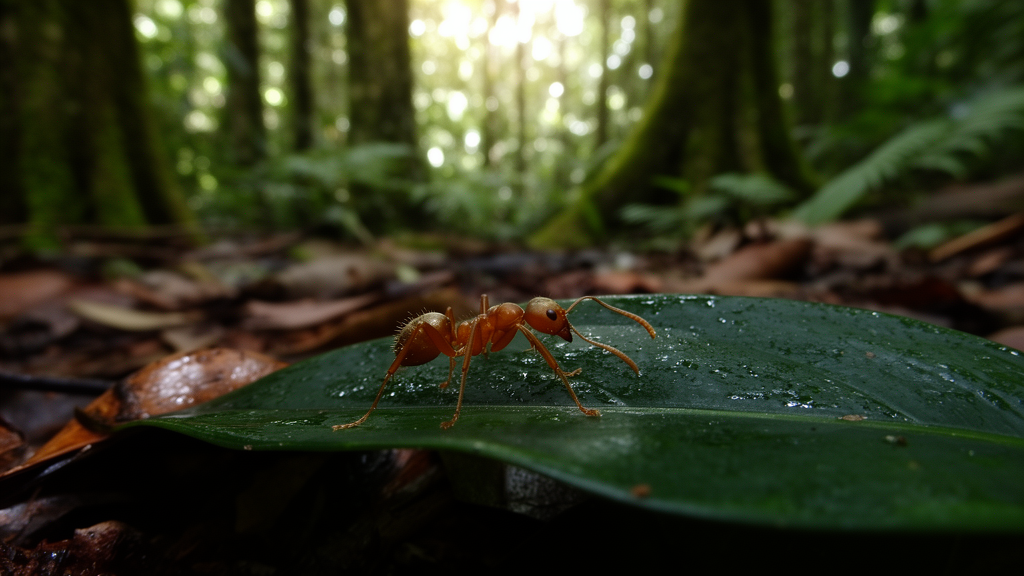
A morphological study of museum specimens and newly collected leaf-litter ants has identified Ishakidris hastifera as a new species and expanded the documented range of the previously monotypic ant genus Ishakidris. The study is based on worker morphology because reproductive individuals of the genus remain unknown, and it does not provide molecular evidence for the genus’s evolutionary placement.
The new species is represented by a holotype worker collected in the Cameron Highlands, Pahang, Malaysia, in March 1993 and deposited in the Natural History Museum, London. A second worker from the same collection event was excluded from the type series because it had been disarticulated, making it difficult to study and measure. A further specimen photographed in the collection was examined only through digital images and was likewise excluded from the type series.
Researchers combined light microscopy with micro-computed tomography, or micro-CT, to examine the holotype of I. hastifera and a non-type worker of I. ascitaspis. The CT scans produced three-dimensional surface models and virtual sections of internal structures. The resulting cybertype datasets include volumetric raw data, three-dimensional models, surface-rendering images and stacked color images, all deposited in a public repository with interactive models also available through Sketchfab.
Ishakidris hastifera can be distinguished from I. ascitaspis by several worker characters. It has a large dorsal spine at the anterior margin of the propodeum, preceded by two smaller tubercles, whereas I. ascitaspis has a very small, sometimes inconspicuous spine. The occipital carina is raised and distinct in the new species but flat and indistinct in I. ascitaspis. The new species also has a shallowly concave occipital margin, a smooth and shiny gena, reduced sculpture on the frontal lobes and a subgenal carina restricted to the anterior third of the head.
Measurements showed some overlap between the species. The I. hastifera holotype had a head length of 1.13 mm, head width of 1.11 mm, scape length of 0.54 mm, pronotal width of 0.52 mm and Weber’s length of the mesosoma of 1.06 mm. Its cephalic, scape and dorsal mesosomal indices were 98.2, 47.8 and 49.1, respectively. For four measured I. ascitaspis workers, the corresponding ranges were 1.14–1.19, 1.06–1.12, 0.52–0.56, 0.48–0.50 and 1.00–1.09 mm, with index ranges of 93.0–95.4, 45.1–48.7 and 44.0–50.0.
Virtual dissection revealed that the propodeum of both species invaginates anteriorly into the mesosomal cavity, forming a shelf-like internal structure. The authors report that this modification increases the surface area available for attachment of the petiole levator muscles and has not previously been reported in ants. Its functional significance remains uncertain. The authors infer that it may accommodate larger muscles within the reduced worker mesosoma, but the study did not test that proposed function or the trait’s biomechanical consequences.
Six additional workers of I. ascitaspis were collected in March 2025 from leaf litter and top soil in a lowland mature forest at the Serinsim Substation of Kinabalu Park, Sabah, Malaysia. The sampling used a standardized 1-square-metre quadrat and mini-Winkler extractors for 72 hours. These records extend the known Malaysian distribution of I. ascitaspis from Gunung Mulu National Park in Sarawak to Sabah. By contrast, I. hastifera is known only from the single 1993 collection event at 1,400 metres in the Cameron Highlands.
Because every recorded I. ascitaspis specimen has been collected from forest leaf litter, the authors consider Ishakidris likely to be a leaf-litter dweller. They also infer from similarities to Tatuidris and Strumigenys that the ants may prey on other invertebrates, but direct observations of feeding or predation were not reported. The study’s records suggest that the genus may be less rare in nature than its sparse museum record suggests, while also underscoring the limits of the available evidence: the new species is based on one type specimen, the known distribution of each species is restricted to a few collection localities, and the phylogenetic position of Ishakidris remains unresolved pending molecular data.
Subject of Research: Morphological description and distribution of two worker species in the ant genus Ishakidris
Article Title: Breaking the monotypy: Insights into an enigmatic ant genus with the discovery of Ishakidris hastifera sp. nov. in Peninsular Malaysia
Article References: Baptista, M., Keller, R. A., Hamer, M. T., Guénard, B., & Hita Garcia, F. (2026). Breaking the monotypy: Insights into an enigmatic ant genus with the discovery of Ishakidris hastifera sp. nov. in Peninsular Malaysia. Journal of Hymenoptera Research, 99, 101-124. https://doi.org/10.3897/jhr.99.166509
Image Credits: AI Generated
Keywords: Ishakidris, ant taxonomy, new species, Peninsular Malaysia, micro-CT imaging, morphology, Sabah, leaf-litter sampling, cypertype, Indomalayan ants, Breaking, monotypy
Cite Scienmag News
Gavin Prescott. (October 20, 2026). Morphological study describes second Ishakidris ant species from Peninsular Malaysia. Scienmag. https://scienmag.com/morphological-study-describes-second-ishakidris-ant-species-from-peninsular-malaysia/
Gavin Prescott. "Morphological study describes second Ishakidris ant species from Peninsular Malaysia." Scienmag, 20 October 2026, https://scienmag.com/morphological-study-describes-second-ishakidris-ant-species-from-peninsular-malaysia/. Accessed 20 October 2026.
Gavin Prescott. "Morphological study describes second Ishakidris ant species from Peninsular Malaysia." Scienmag. October 20, 2026. https://scienmag.com/morphological-study-describes-second-ishakidris-ant-species-from-peninsular-malaysia/


