


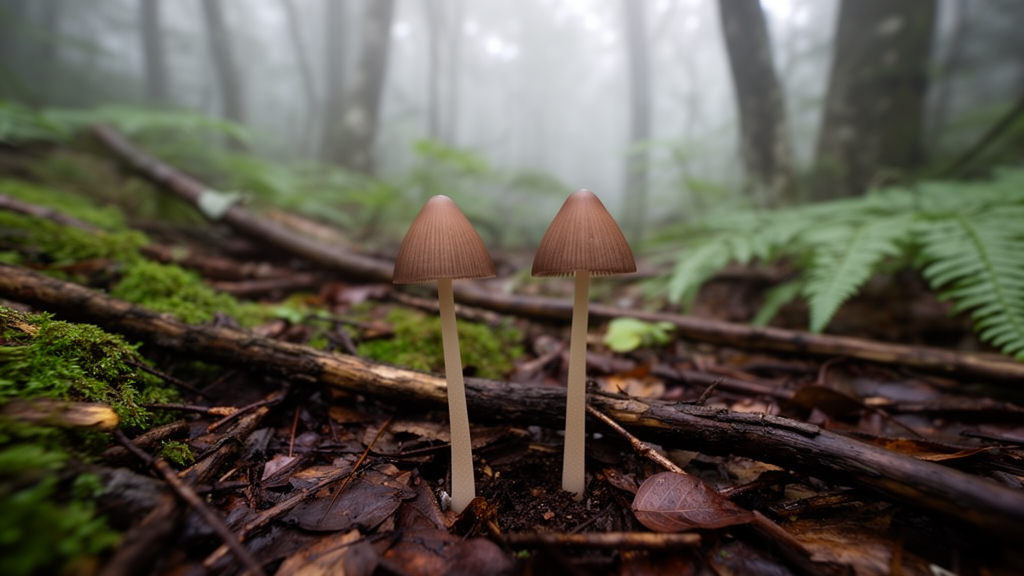
A taxonomic study combining microscopy, DNA sequencing and phylogenetic analysis identified two new species in the mushroom genus Conocybe from China: Conocybe maculatostriata and Conocybe lidaensis. The authors also characterized Chinese specimens assigned to a Conocybe mesospora operational taxonomic unit, although the species’ identity remains unresolved without DNA data from its type material.
Specimens examined in the study were collected from Jilin, Fujian and Yunnan provinces and the Xizang Autonomous Region between 2023 and 2025. Researchers conducted macroscopic and microscopic examinations, using 5% potassium hydroxide, distilled water, occasional Congo red and ammonia for lamellar reactions. Measurements followed established protocols, and the dried specimens were deposited in the Fungarium of Jilin Agricultural University.
For phylogenetic reconstruction, the researchers amplified and sequenced the ITS, 28S and tef1-α regions, adding 18 sequences to data obtained from GenBank. Multiple alignments were combined in a 3,242-position matrix, with maximum-likelihood and Bayesian analyses producing the same topology. Species of Psathyrella and Candolleomyces served as outgroups.
Conocybe formed a strongly supported monophyletic clade, while section Conocybe contained two highly supported sister clades. C. maculatostriata was represented by specimens FJAU78852 and FJAU78853 and was sister to C. yadongensis, with full support in both analyses. C. lidaensis, represented by FJAU78854 and FJAU78855, was sister to C. alkovii, with support of 0.92 posterior probability and 93% maximum-likelihood bootstrap.
C. maculatostriata was described from a holotype collected in Chomo County at an elevation of 3,607 metres. Its distinguishing features include a hygrophanous pileus with maculate stripes when moist, basidiospores measuring 9.7–12.8 micrometres in length, and exclusively lecythiform caulocystidia. The species grew scattered on plateau grassland, and its lamellae reacted weakly to ammonia, forming needle-shaped crystals.
C. lidaensis was described from a holotype collected at Dali University in Yunnan at an elevation of 2,177 metres. It had mixed-type caulocystidia and pileocystidia, with lecythiform forms accounting for less than 40% of the caulocystidia, and produced a negative ammonia reaction. Additional material came from Yunnan and Fujian, where it was recorded in mossy grassland within bamboo forest.
The study placed C. lidaensis at the base of section Conocybe, near C. alkovii, although its mixed cystidia also resemble species in section Mixtae. The authors therefore described it as a possible transitional taxon. They stated that the present material from the second lineage was insufficient to establish stable diagnostic characters for the entire clade.
The authors also described Chinese specimens identified as C. mesospora OTU 21, including pileus, lamella, basidiospore and cystidium measurements and a negative ammonia reaction. However, available non-type sequences assigned to C. mesospora occur in at least three clades, and the taxon lacks a characterized type sequence, so the study did not make taxonomic changes to C. mesospora.
Overall, the findings add two formally described species to the documented diversity of Conocybe section Conocybe in China. The authors emphasized that caulocystidia can change during fungal development and remain valuable when interpreted alongside spore morphology, pileipellis structure, pileocystidia, ecology and molecular evidence. They also noted that DNA data from type material are needed to resolve the placement of C. mesospora and clarify the boundaries among sections Conocybe, Mixtae and Heterocystidiae.
Subject of Research: Taxonomic description of two new Conocybe mushroom species using morphology and multi-gene phylogeny
Article Title: Taxonomy of Conocybe I: Conocybe maculatostriata and C. lidaensis – two new species of Conocybe section Conocybe ( Bolbitiaceae , Agaricales ) from southwestern China
Article References: Song, H.-B., Tang, L.-Y., Fang, Q., Tang, S.-M., & Luo, Z.-L. (2026). Taxonomy of Conocybe I: Conocybe maculatostriata and C. lidaensis – two new species of Conocybe section Conocybe (Bolbitiaceae, Agaricales) from southwestern China. MycoKeys, 139, 157-181. https://doi.org/10.3897/mycokeys.139.192477
Image Credits: AI Generated
DOI: 10.3897/mycokeys.139.192477
Keywords: Conocybe, fungal taxonomy, new species, Bolbitiaceae, phylogenetics, morphology, ITS, 28S, tef1-alpha, China, Taxonomy, maculatostriata
Cite Scienmag News
Juliet Wilcox. (October 21, 2026). Morphological and phylogenetic study identifies two new Conocybe species in China. Scienmag. https://scienmag.com/morphological-and-phylogenetic-study-identifies-two-new-conocybe-species-in-china/
Juliet Wilcox. "Morphological and phylogenetic study identifies two new Conocybe species in China." Scienmag, 21 October 2026, https://scienmag.com/morphological-and-phylogenetic-study-identifies-two-new-conocybe-species-in-china/. Accessed 21 October 2026.
Juliet Wilcox. "Morphological and phylogenetic study identifies two new Conocybe species in China." Scienmag. October 21, 2026. https://scienmag.com/morphological-and-phylogenetic-study-identifies-two-new-conocybe-species-in-china/


