


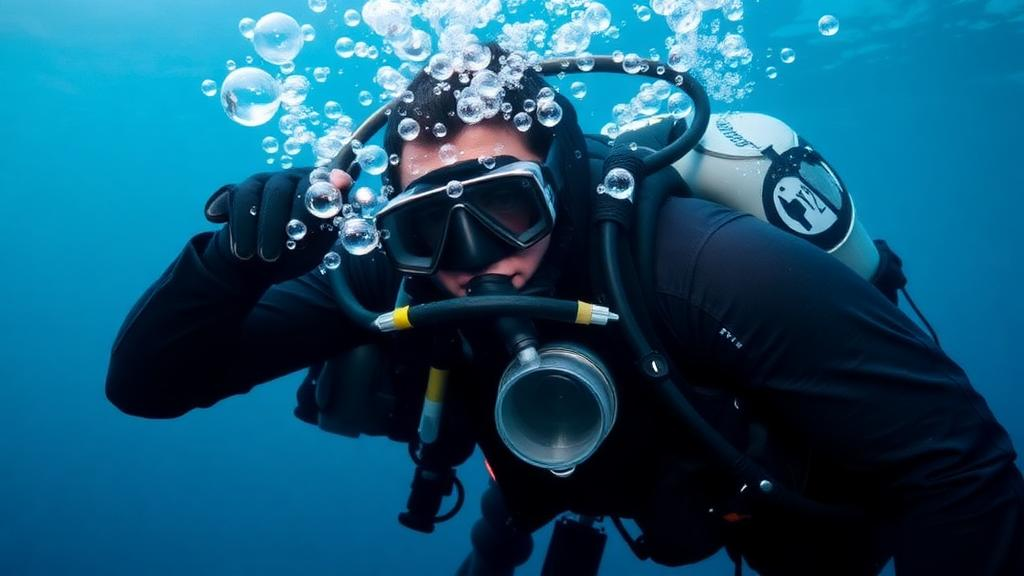
For decades, technical divers have treated helium as the gold-standard ingredient in deep diving gas mixtures. The second-lightest element in the universe dilutes oxygen and nitrogen, tames the narcotic fog of depth, and thins the breathing gas so that a diver’s lungs do not have to pump a heavy, syrupy medium under crushing ambient pressure. But a new field study from the Bay of Brest in France suggests that the picture is more complicated than the diving community has long assumed. When experienced closed-circuit rebreather divers breathed a helium-rich heliox mixture instead of a conventional trimix blend, they surfaced with significantly more vascular gas emboli, the microscopic bubbles widely considered the primary mechanism behind decompression sickness, and with subtle signs of a more pronounced inflammatory response.
The study, published in Physiological Reports, enrolled twenty experienced male mixed-gas divers, nineteen of whom completed the protocol after one was excluded because of a leaking drysuit and severe cold stress. All were veterans of the sport, averaging around twenty-two years of diving experience and roughly 1,800 lifetime dives, with a median of 150 trimix dives each. Working in water at 15.5 degrees Celsius, buddy teams of two performed identical open-water dives to a mean maximum depth of about 50 metres of seawater, with total dive durations of roughly 147 minutes. Each team paired one diver breathing heliox, composed of 16 percent oxygen and 84 percent helium, with a partner breathing trimix, composed of 16 percent oxygen, 32 percent helium and 52 percent nitrogen. Both used closed-circuit rebreathers, which recycle exhaled gas, scrub carbon dioxide and deliver a warm, humidified mixture at a constant oxygen partial pressure.
The experimental design was elegant in its simplicity. Because each buddy team followed the same profile, with the same depth, bottom time, water temperature, equipment class and oxygen exposure, any differences between the groups could plausibly be attributed to the composition of the inert gas itself. Decompression was managed by the Bühlmann ZHL-16C algorithm built into each diver’s computer, with conservative gradient factor settings, and the ascent schedule was anchored to the heliox diver’s obligations, which ran longer. Oxygen toxicity exposure, tracked by the central nervous system clock, was nearly identical between groups at around 86 to 88 percent of the allowable limit. The researchers hypothesized that the higher helium content, by slashing gas density from 5.8 grams per litre in the trimix group to just 2.7 grams per litre at maximum depth, would ease the work of breathing and improve decompression kinetics, thereby reducing overall physiological stress.
The bubble data told an unexpected story. Using two-dimensional echocardiography at 45 and 90 minutes after surfacing, with an operator blinded to the gas mixture counting bubbles frame by frame across ten cardiac cycles, the team found that vascular gas emboli were detected in every one of the nine heliox divers but in only five of the ten trimix divers. At the 45-minute mark, heliox divers carried a median of 12 bubbles per ten cardiac cycles, compared with zero in the trimix group, a statistically significant difference that vanished by 90 minutes. The timing fits the physics: helium’s low solubility coefficient means it both forms bubbles faster during ascent and washes out faster once the diver is back on the surface. Previous work has suggested that bubble peaks occur around 45 minutes after helium-rich dives, whereas nitrogen-based mixtures tend to peak later, so the true divergence between the groups may have been even sharper than the two sampling points captured.
Crucially, no diver in either group developed symptoms of decompression sickness, and the absolute bubble grades remained low, with few divers reaching the high grades associated with elevated risk. The authors caution that the trimix divers, whose computers prescribed shorter decompression than the shared ascent schedule actually delivered, effectively enjoyed a longer in-water decompression than their algorithms demanded, which could itself have suppressed bubble formation. Commercial dive computers, the researchers note, impose a decompression penalty for helium that is not physiologically well grounded, and comparisons by the US Navy Experimental Diving Unit have even hinted at increased risk with trimix under some conditions. Both groups, in other words, likely dove conservatively, and a more aggressive profile might have amplified the differences.
The lung function results were largely reassuring. Whole-body plethysmography performed within 150 minutes of surfacing showed no significant changes in lung volumes or flow rates, with the exception of a slight decrease in mid-expiratory flow at 50 percent of vital capacity confined to the heliox group, possibly reflecting cold-induced small airway reactivity driven by helium’s high thermal conductivity. Lung diffusion capacity for carbon monoxide declined modestly after the dive, by about 6 to 7 percent, a well-recognized and clinically insignificant finding linked to oxygen exposure and bubble formation, and it did not differ between gases. Lung ultrasound B-lines, transient markers of extravascular lung water, showed a temporal trend in the heliox group but no statistically significant post-dive increase at specific time points. One trimix diver experienced a brief post-dive cough; otherwise respiratory complaints were absent.
The biological readouts added a layer of intrigue. Both groups lost roughly two litres of fluid during their dives, yet hematocrit remained stable, indicating compensatory fluid shifts that preserved intravascular volume. Heart rate variability, a window into cardiac autonomic regulation, was remarkably stable, which the authors attribute to the exceptional experience of their participants and the moderate decompression stress. In the blood, both groups showed a neutrophil-driven leukocytosis and a rise in the neutrophil-derived inflammatory mediator MRP8/14, hallmarks of a dive-induced inflammatory response. But the heliox divers stood out in two respects: their platelet counts rose significantly, the opposite of the platelet consumption typically reported after air dives, and their total hemolytic complement activity and C3c levels dropped, a pattern consistent with complement activation at the gas-liquid interface of circulating bubbles.
These findings challenge the long-standing assumption that helium is inherently gentler on the body. Experimental work outside the hyperbaric setting has suggested helium may have organ-protective, anti-inflammatory properties, reducing platelet activation and vascular injury in animal models. Yet recent human data, and now this field study, hint that helium exposure can promote a more pro-inflammatory profile, possibly by increasing membrane microparticle release under prolonged exposure. The paradox, the authors propose, is that the higher transient bubble burden in heliox divers may have driven a more pronounced thrombo-inflammatory activation that overwhelmed any protective effect of the gas itself, a hypothesis supported by the complement changes and the CCL2 chemokine decline seen only in the heliox group.
The study has honest limitations. The sample was small, gas assignment was not randomized, and each diver performed only one condition, leaving room for unmeasured confounding, particularly given the notorious inter-individual variability in bubble production. No air-diluent control was tested, and bubble measurements at only two time points may have missed the true peak. Still, the real-world conditions, matched buddy teams and blinded bubble counting give the findings unusual ecological validity. For the growing community of rebreather divers pushing into deeper water, the message is nuanced rather than alarming: within conservative limits, both helium-based mixtures were tolerated with minimal subclinical stress, but more helium is not automatically better. The relationship between helium, bubble dynamics, inflammation and the actual risk of decompression sickness remains unresolved, and the authors call for further research to untangle whether the extra bubbles of a heliox dive carry any meaningful clinical cost.
Subject of Research: Comparative physiological effects of heliox and trimix breathing gases on pulmonary function and decompression stress in closed-circuit rebreather diving
Article Title: Heliox versus trimix in closed‐circuit rebreather diving: A comparative study of pulmonary and decompression stress in male divers
Article References: Gouin, E., Orsat, J., Dugrenot, E., Brenner, R. J., Leman, G., Bettacchioli, E., Theron, M., Giroux‐Metges, M.-A., L'Her, E., & Guerrero, F. (2026). Heliox versus trimix in closed‐circuit rebreather diving: A comparative study of pulmonary and decompression stress in male divers. Physiological Reports, 14(19), Article e71129. https://doi.org/10.14814/phy2.71129
Image Credits: AI Generated
DOI: 10.14814/phy2.71129
Keywords: heliox, trimix, closed-circuit rebreather, decompression sickness, vascular gas emboli, diving physiology, helium, inflammation, pulmonary function, complement activation, technical diving, gas density
Cite Scienmag News
Ophelia Keating. (October 7, 2026). More Helium, More Bubbles: Rebreather Divers Show Surprising Gas Mixture Trade-Off. Scienmag. https://scienmag.com/more-helium-more-bubbles-rebreather-divers-show-surprising-gas-mixture-trade-off/
Ophelia Keating. "More Helium, More Bubbles: Rebreather Divers Show Surprising Gas Mixture Trade-Off." Scienmag, 7 October 2026, https://scienmag.com/more-helium-more-bubbles-rebreather-divers-show-surprising-gas-mixture-trade-off/. Accessed 7 October 2026.
Ophelia Keating. "More Helium, More Bubbles: Rebreather Divers Show Surprising Gas Mixture Trade-Off." Scienmag. October 7, 2026. https://scienmag.com/more-helium-more-bubbles-rebreather-divers-show-surprising-gas-mixture-trade-off/


