


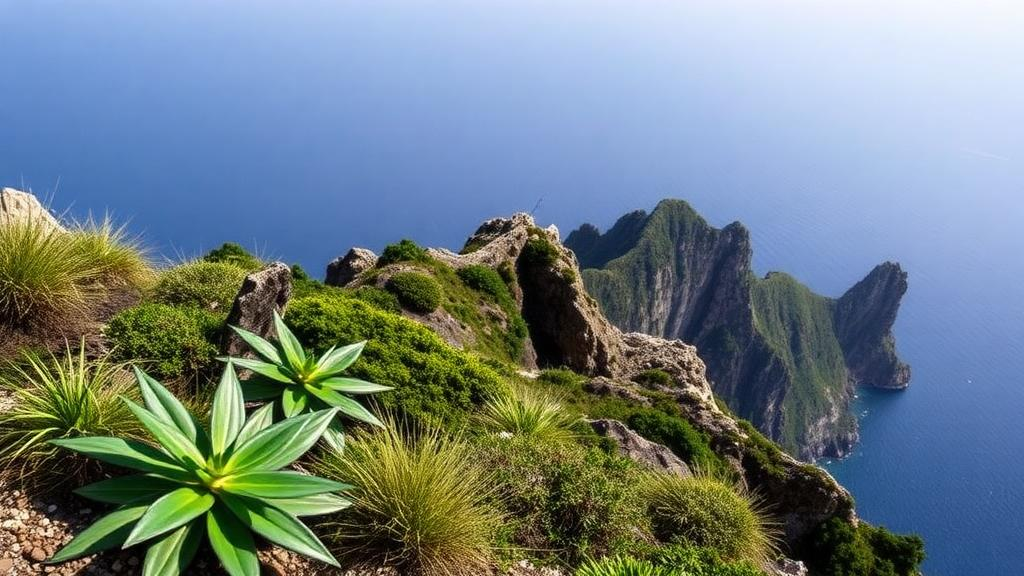
Deep in the Tyrrhenian Sea, roughly 63 kilometres west of the Tuscan coast, lies an island so strictly protected that few Italians will ever set foot on it. Montecristo, the rugged granite outpost that gave Alexandre Dumas his literary treasure, has now yielded a botanical one. A team of botanists led from the Department of Biology at the University of Florence has compiled the most complete inventory ever assembled of the island’s vascular flora, counting 582 specific and subspecific taxa currently present, the highest number ever recorded on Montecristo. The findings, published in the journal Italian Botanist, synthesise more than 190 years of botanical exploration with a decade of intensive field campaigns carried out between 2011 and 2024, and they reveal an island flora that is simultaneously richer than expected and more vulnerable than its protected status might suggest.
The new inventory documents 515 spontaneous taxa alongside 67 cultivated ones, and it represents a dramatic leap in knowledge for an island whose last published flora dated back to 1976. Since 2000, exploratory visits have recorded 45 taxa entirely new to Montecristo and confirmed another 28 species whose most recent records stretched back to 1903 or even 1864. Among the confirmed survivors is Osmunda regalis, the royal fern, last seen on the island in 1864 and rediscovered in 2012, a botanical ghost that had waited a century and a half for verification. Equally striking are the exclusions: 14 species once attributed to the island have been definitively struck from its flora, eight of them the result of painstaking revisions of herbarium specimens preserved in the Tuscan Herbaria of Florence and Siena, where earlier botanists’ identifications proved erroneous or where the material belonged to taxa only recently described.
Perhaps the most compelling case of herbarium detective work concerns Saxifraga montis-christi, a species whose name literally honours the island, Monte Cristo being the Italian for Mount Christ. For generations, specimens collected on Montecristo’s damp shady cliffs were labelled as Saxifraga granulata, a widespread meadow saxifrage. Critical re-examination revealed that the island’s plants belonged to something entirely different: a newly described endemic species occurring nowhere else on Earth. A similar revision transformed the record for Geranium purpureum, whose specimens had long been misattributed to the related Geranium robertianum. In the case of Dactylis glomerata, herbarium study distinguished two subspecies on the island, while other corrections, such as the recognition of Carex microcarpa where Carex pendula had been reported, and Opuntia monacantha where Opuntia ficus-indica had been assumed, show how modern taxonomy keeps rewriting even well-trodden floras.
The island’s botanical history is itself a story worth telling. The earliest known records date to 1832, when Giuseppe Giuli, a botanist from Siena, made a brief excursion and passed his observations to Antonio Bertoloni for inclusion in the monumental Flora Italica. Tragically, the only extant copy of Giuli’s own publication lacks the pages enumerating his plants, so his roughly 24 documented species survive only through Bertoloni’s citations. The first full list, compiled by Theodor Caruel in 1864, counted 343 species. Sommier’s work at the turn of the twentieth century raised the total to 406, and Paoli and Romagnoli’s 1976 flora described 471 units, later supplemented to 489. The new inventory of 582 taxa, of which 501 spontaneous species are considered currently occurring after excluding cultivated plants and the 14 excludendae, therefore represents the culmination of nearly two centuries of accumulating, and correcting, botanical knowledge.
Quantitatively, the team applied a species-area relationship based on the Arrhenius power function, a mathematical model predicting how many species an island of a given surface should harbour. Montecristo covers just 10.4 square kilometres, and the model, calibrated with constants derived from a comprehensive analysis of Tuscan Archipelago data, predicted 465 spontaneous non-cultivated species. The island actually holds 501, a surplus of 7.6 percent. The surplus is far more dramatic for alien species, which exceed the expected value by 19.21 percent, while native species exceed expectations by only 3.56 percent. This asymmetry carries a warning: even on an island protected since 1971 as an integral reserve and included since 1996 in the Tuscan Archipelago Park, the non-native component is expanding faster than the native one.
Statistical analysis of the flora’s structure confirms its thoroughly Mediterranean character. Life forms are far from equally distributed, and the dominant strategy is the therophyte, the annual plant that completes its entire life cycle within a single favourable season, accounting for 54.2 percent of the spontaneous flora with 273 taxa. This prevalence of ephemeral annuals is a classic adaptation to the Mediterranean climate, where scorching summers make perennial foliage a liability. Chorological analysis reveals that the principal geographical elements are Eurosiberian-Mediterranean species at 36.9 percent and strictly Mediterranean species at 31.2 percent. The association between life forms and chorotypes is significant: Mediterranean and Eurosiberian-Mediterranean taxa are overwhelmingly therophytes, while Italian endemics tend instead toward hemicryptophytes and chamaephytes, and alien taxa cluster among therophytes, phanerophytes and geophytes. Among families, Fabaceae lead with 12.15 percent of the flora, followed by Poaceae at 11.35 percent and Asteraceae at 10.36 percent, with the three great families dominated by therophytes and hemicryptophytes.
Montecristo’s true botanical treasure, however, lies in its endemics. Italian endemic taxa collectively account for only 1.8 percent of the flora, yet relative to its surface area the island carries the highest endemism of any island in the Tuscan Archipelago. Saxifraga montis-christi and Hieracium racemosum subsp. amideii occur only on Montecristo. Limonium sommierianum, endemic to the archipelago, grows on Giannutri, Giglio and Montecristo. The island also shares steno-Tyrrhenian endemics of Sardinian-Corsican and Sardinian-Balearic gravitation, including Carduus fasciculiflorus, which occurs in Tuscany only on Montecristo, along with Arenaria balearica, Scrophularia trifoliata, Verbascum conocarpum subsp. conocarpum and Mentha requienii subsp. bistaminata. This Cyrno-Sardinian affinity, shared with Gorgona and Capraia, positions Montecristo as a phytogeographical transition zone between western and central-eastern Mediterranean floristic elements, a living fingerprint of ancient colonisation routes across the western Mediterranean.
The island’s vegetation tells a story of degradation and resilience. The landscape is predominantly a uniform Mediterranean scrub, with tall, often impenetrable stands of Erica arborea and Erica scoparia interspersed with low shrubland of rosemary, Cistus, Teucrium marum and Helichrysum italicum. Open garigue dominated by Cistus covers extensive areas, and temporary ponds fed by meteoric water harbour the endemic Mentha requienii subsp. bistaminata and the quillwort Isoetes durieui. Along the coast, fragmented halophilous vegetation features the endemic Limonium sommierianum. Most remarkably, roughly 200 scattered relic holm oaks persist in the upper valleys of Collo dei Lecci and Collo Fondo, the remnants of an ancient forest whose trees radiocarbon dating places between 430 and 742 years old. There are no true tree formations on the island today, and mosses and lichens cover almost all the rocky outcrops, giving the terrain a cryptogamic veil.
Why is Montecristo, despite its richness, the poorest island in the archipelago in absolute terms? The answer lies in a convergence of limiting factors. The island is the most distant from the mainland, its granite substrate generates siliceous soils poor in calcium and assimilable phosphorus, and its modest altitudinal range, peaking at 645 metres at Cima della Fortezza, cannot sustain mesophilous flora. Its soils are superficial, poorly developed and affected by summer heat. But the most troubling factor may be biological imbalance. Feral goats, a historic population that is itself protected, inflict severe overgrazing that damages soil, prevents vegetation renewal and degrades ecosystems. Black rats were eradicated through the LIFE Project Montecristo 2010, but the invasive tree Ailanthus altissima is expanding, and alien species were the only chorological type to show a significant increase over time. The message is sobering: even strict conservation and minimal tourism cannot render a small isolated island immune to anthropogenic pressure, biological invasions and climate change.
The team notes that some systematic groups still require investigation, including the taxonomic identity of Plantago weldenii and the possibility that Montecristo’s holm oaks show affinities with the Iberian subspecies Quercus ilex subsp. rotundifolia. Yet the updated inventory stands as a fundamental reference for the conservation of an island that, from a floristic point of view, remains one of the Mediterranean’s most distinctive outposts. In an era when Mediterranean island ecosystems face mounting pressure from land-use change, tourism and invasions, Montecristo’s 582 plants, from its cliff-dwelling endemic saxifrage to its centuries-old relic oaks, represent both a triumph of two centuries of botanical dedication and a fragile inheritance that demands vigilant protection.
Subject of Research: Biodiversity
Article Title: An updated inventory of the vascular flora of the Island of Montecristo (Tuscan Archipelago, Italy)
Article References: Siccardi, E., Ferretti, G., Foggi, B., Mugnai, M., Bardaro, M. R. P., Landi, M., Quilghini, G., Zoccola, A., & Lazzaro, L. (2025). An updated inventory of the vascular flora of the Island of Montecristo (Tuscan Archipelago, Italy). Italian Botanist, 19, 87-106. https://doi.org/10.3897/italianbotanist.19.139675
Image Credits: AI Generated
DOI: 10.3897/italianbotanist.19.139675
Keywords: updated, inventory, vascular, flora, Island, Montecristo, Tuscan, Archipelago, Italy, scientific research
Cite Scienmag News
Margaret Porter. (October 18, 2026). Montecristo’s secret flora revealed: 582 plants on Italy’s forbidden island. Scienmag. https://scienmag.com/montecristos-secret-flora-revealed-582-plants-on-italys-forbidden-island/
Margaret Porter. "Montecristo’s secret flora revealed: 582 plants on Italy’s forbidden island." Scienmag, 18 October 2026, https://scienmag.com/montecristos-secret-flora-revealed-582-plants-on-italys-forbidden-island/. Accessed 18 October 2026.
Margaret Porter. "Montecristo’s secret flora revealed: 582 plants on Italy’s forbidden island." Scienmag. October 18, 2026. https://scienmag.com/montecristos-secret-flora-revealed-582-plants-on-italys-forbidden-island/


