


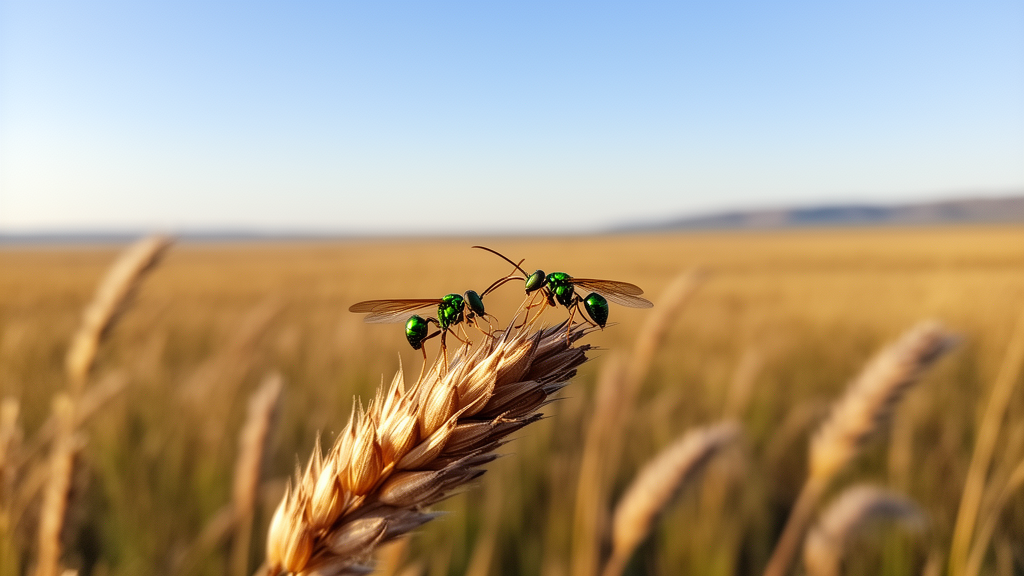
A taxonomic study of encyrtid wasps collected across Mongolia documents two species new to science and reports a first country record for a third. The researchers describe Helegonatopus arkhangaiensis and Trechnites bulgani as new species, while Psyllaephagus tamaricicola is recorded from Mongolia for the first time. Both new species are known from female specimens, and their hosts remain unknown.
The study reports that taxonomic work on Mongolia’s Encyrtidae began in the late 1960s. Subsequent investigations by several researchers have recorded approximately 100 genera and more than 300 species from the country. The authors nevertheless state that many regions remain insufficiently surveyed and that numerous species are likely still undiscovered.
The material examined in the study came from a joint expedition involving the Institute of Zoology at the Chinese Academy of Sciences and the Mongolian Institute of Plant Protection Research. Field surveys were conducted across Mongolia from 2023 to 2025, covering most of the country’s territory. The primary collection methods were sweep netting and yellow pan traps.
Specimens were card-mounted or dissected and mounted on slides, generally following a method described by Noyes in 1982. Observation and measurement used a Nikon SMZ-168 stereomicroscope. Body lengths were recorded in millimetres, while other measurements were relative values obtained from a linear scale in the eyepiece of a stereozoom binocular microscope at 4.7× magnification.
Examined specimens were deposited at the Institute of Zoology at the Chinese Academy of Sciences and the Mongolian Institute of Plant Protection Research. Helegonatopus arkhangaiensis was established from female specimens collected in Tayhar, Arkhangai, on 16 June 2024. The holotype and two paratypes share that collection data, while three additional females were collected in Bulgan, Khovd, on 22 July 2025.
Females have a body length of approximately 1.0–1.3 mm, including the ovipositor, and are generally dark brown with a faint metallic green sheen. Their ocelli form an acute triangle with an angle of about 40 degrees, all funicle segments are longer than broad, and the mid tibia is about as long as the ovipositor. The specific name refers to Arkhangai, where the type specimen was collected.
The authors identify H. arkhangaiensis as morphologically similar to H. rasnitzyni , described by Trjapitzin in 1963. The new species has an antennal clava slightly longer than funicle segments F1–F3 combined, whereas the clava of H. rasnitzyni is about as long as F1–F5 combined. Their ocellar angles also differ: approximately 40 degrees in H. arkhangaiensis and slightly less than 90 degrees in H. rasnitzyni .
The paper reports the new species from Arkhangai and Khovd, with Tayhar as its type locality. Males and hosts are unknown, leaving its biology and broader distribution unresolved. Trechnites bulgani was also described from females.
Its holotype and four paratypes were collected in Bulgan, Khovd, on 22 July 2025, and the material was divided between the two institutional collections. Females measure approximately 1.0–1.1 mm in body length, including the ovipositor. They are generally dark brown, with metallic blue reflections on the scutellum contrasting with the darker mesoscutum.
Their ocelli form an obtuse triangle with an angle of approximately 110 degrees, the notaular lines are absent, and the ovipositor is nearly as long as the mid tibia and slightly exserted. The species name refers to Bulgan, the type locality. According to the authors, T. bulgani closely resembles Trechnites alni , described by Erdös in 1957.
The two can be distinguished by the pale apices of the scape and pedicel in the new species, compared with completely dark antennae in T. alni . Another distinction is the absence of notauli in T. bulgani , while the notauli in T. alni extend about one-third across the mesoscutum. As with the other new species, no male or host is known for T. bulgani .
The available evidence concerns the morphology, collection localities and reported distribution of the female specimens, not its biological interactions. The third species examined, Psyllaephagus tamaricicola , was first described by Myartseva in 1979 from Turkmenistan and had previously been recorded from Armenia and Kazakhstan. Two females collected in Mankhan, Khovd, on 17 June 2025 established a new record for Mongolia.
These females measure approximately 1.2–1.4 mm in body length, including the ovipositor, and are dark brown with metallic green, blue-violet and golden-green sheens on different body regions. Their ocelli form an obtuse triangle with an angle of about 80 degrees. The fore coxae and fore legs are yellow, while the mid and hind coxae and hind femora are dark brown; the ovipositor is not exserted and is about 1.3 times as long as the mid tibia.
The host of P. tamaricicola remains unknown in the study. The paper therefore provides a taxonomic account of three Mongolian encyrtid species, supported by collected female specimens, morphological comparisons, measurements and images.
Subject of Research: Taxonomic identification of three Encyrtidae species collected in Mongolia, including two new species and one first country record.
Article Title: Three species of Encyrtidae ( Hymenoptera , Chalcidoidea ) from Mongolia, with descriptions of two new species
Article References: Zou, B., Liu, H., Mijidsuren, B., & Zhang, Y. (2026). Three species of Encyrtidae (Hymenoptera, Chalcidoidea) from Mongolia, with descriptions of two new species. ZooKeys, 1292, 373-383. https://doi.org/10.3897/zookeys.1292.187191
Image Credits: AI Generated
DOI: 10.3897/zookeys.1292.187191
Keywords: Encyrtidae, Mongolia, taxonomy, new species, wasp morphology, field survey, parasitic wasps, Helegonatopus, Trechnites, Psyllaephagus, Three, species
Cite Scienmag News
Margaret Porter. (October 20, 2026). Mongolian field survey identifies two new encyrtid wasp species and a first national record. Scienmag. https://scienmag.com/mongolian-field-survey-identifies-two-new-encyrtid-wasp-species-and-a-first-national-record/
Margaret Porter. "Mongolian field survey identifies two new encyrtid wasp species and a first national record." Scienmag, 20 October 2026, https://scienmag.com/mongolian-field-survey-identifies-two-new-encyrtid-wasp-species-and-a-first-national-record/. Accessed 20 October 2026.
Margaret Porter. "Mongolian field survey identifies two new encyrtid wasp species and a first national record." Scienmag. October 20, 2026. https://scienmag.com/mongolian-field-survey-identifies-two-new-encyrtid-wasp-species-and-a-first-national-record/


