

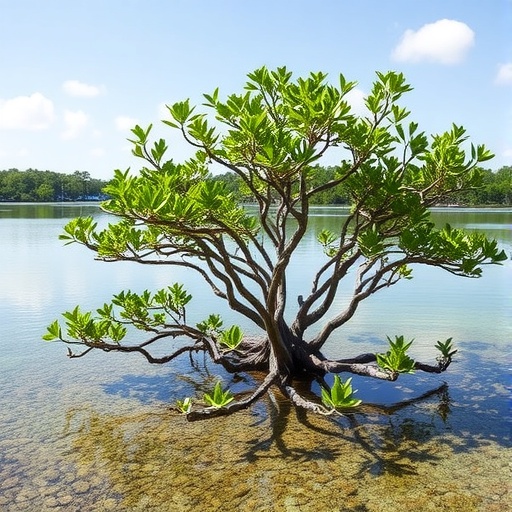
Mangrove forests have long been revered for their ecological significance and biodiversity, yet their role in coastal protection is gaining unprecedented attention in the context of escalating climate threats. These dense, salt-tolerant woodlands, predominantly located in tropical and subtropical tidal zones, function as natural bulwarks against coastal hazards by dissipating wave energy and mitigating flood impacts. Recent groundbreaking research spearheaded by Kyoto University’s Disaster Prevention Research Institute is now unraveling the intricate dynamics of wave attenuation by mangrove forests, illuminating their potential as cost-effective, nature-based solutions for coastal resilience.
At the core of this pioneering work is the meticulous study of the mangrove species Rhizophora apiculata, a dominant tree in Southeast Asia and the western Pacific. Its extensive prop-root system, characterized by complex three-dimensional structures, forms a unique interface between terrestrial and marine environments. These roots operate like finely tuned hydrodynamic filters, reducing the momentum of incoming waves and thus safeguarding vulnerable coastal settlements. However, the effectiveness of such natural defenses has been challenging to quantify, primarily due to the complex interplay of root morphology, water depth, and wave characteristics.
To address these challenges, the research team developed a sophisticated numerical modeling framework, coupling detailed laboratory experiments with Boussinesq-type wave modeling. This approach integrates principles of fluid dynamics with botanical morphology to simulate how waves interact with the submerged roots. Their model incorporates both drag and inertia forces, enabling precise estimation of the energy dissipation caused by the intricate root matrices under varying tidal and storm conditions. The team drew on extensive field surveys and controlled wave flume experiments to calibrate and validate their simulations, setting a new standard for evaluating mangrove ecosystem services.
The results underscore the critical influence of vertical root structure and submergence depth on wave attenuation. Notably, variations in root morphology and water depth introduce significant discrepancies—ranging from 20% to 50%—in predicted wave reduction levels. This variability accentuates the necessity of accounting for realistic root geometries and dynamic tidal scenarios in coastal protection assessments. Simplistic models that treat mangroves as uniform barriers risk underestimating or overestimating their protective capacity, potentially leading to insufficient coastal planning.
One of the striking revelations of the study is the adaptability of mangrove wave attenuation mechanisms based on hydrodynamic conditions. During high tide or storm surges, deeper submergence of prop roots modulates their interaction with waves differently compared to low tide scenarios. This dynamic behavior implies that mangroves do not merely serve as passive barriers; rather, their effectiveness fluctuates in response to natural environmental changes, emphasizing the need for flexible and adaptive coastal management strategies.
The implications of this research extend far beyond academic curiosity. As climate change intensifies storm frequencies and magnitudes, many coastal communities face unprecedented risks of inundation, erosion, and habitat loss. Incorporating mangrove conservation and restoration into disaster risk reduction frameworks offers a dual benefit: it enhances human safety while promoting biodiversity and carbon sequestration. The numerical model developed by Kyoto University’s team can inform policymakers and engineers on designing smart infrastructure that synergizes ecological integrity with disaster resilience.
Historically, Japan has leveraged forestry knowledge to bolster coastal defenses, notably with pine tree plantations designed to dampen wave forces. Drawing from this rich heritage, the research team envisions applying similar engineering principles to mangrove ecosystems. Such nature-inspired designs could revolutionize how civil engineering collaborates with environmental stewardship, fostering sustainable, low-cost approaches to safeguard coastal populations.
The team’s commitment to practical application is evident in their future plans. By developing user-friendly manuals and guidelines, they aim to empower local stakeholders, especially in regions like Southeast Asia and the Pacific Islands where mangroves are integral to coastal landscapes. These resources will facilitate informed mangrove reforestation initiatives and optimized deployment of natural buffers, enhancing community resilience against climate-induced hazards.
Moreover, the study highlights a paradigm shift in scientific understanding—from oversimplified, idealized representations of mangroves to nuanced, morphologically accurate modeling. This precision is crucial in tackling the complex mechanics of wave-vegetation interactions, enabling a comprehensive grasp of ecosystem services provided by mangroves under real-world conditions.
Environmental scientists and coastal engineers alike stand to benefit from these insights. By bridging the gap between ecological processes and hydrodynamic modeling, this research provides a blueprint for integrating biological complexity into engineering design. Such interdisciplinary innovation is essential in confronting the multifaceted challenges posed by climate change and urban expansion in coastal zones.
This pioneering investigation also underscores the indispensable role of experimental rigor combined with computational advancements. Through iterative laboratory experiments and high-fidelity numerical simulations, the authors achieved robust, empirically grounded predictions of mangrove-mediated wave attenuation. The methodology exemplifies how modern scientific tools can unlock the functional potential of natural ecosystems in risk mitigation.
Beyond technical achievements, the researchers express profound appreciation for the natural environments that inspired their work. The frequent fieldwork conducted amidst the serene beauty of mangrove forests not only informed their scientific inquiry but also reinforced the ethical imperative to conserve these vital habitats. Their holistic approach intertwines scientific rigor with environmental reverence.
In an era marked by escalating coastal challenges, this comprehensive study heralds a promising avenue for merging nature-based solutions with disaster risk management. By elucidating the physical mechanisms through which Rhizophora apiculata mangroves attenuate waves, the Kyoto University team has laid the groundwork for innovative, sustainable coastal protection strategies. Their contributions offer a clarion call to harness the power of ecosystems as frontline defenders against climate-induced threats.
Subject of Research: Not applicable
Article Title: Investigation of Wave Attenuation by Rhizophora apiculata Mangroves: Coupled Laboratory Experiments and Boussinesq Modeling
News Publication Date: 5-Mar-2026
Web References: http://dx.doi.org/10.1029/2025JC022836
References: The paper “Investigation of Wave Attenuation by Rhizophora apiculata Mangroves: Coupled Laboratory Experiments and Boussinesq Modeling,” Journal of Geophysical Research: Oceans, March 2026.
Image Credits: KyotoU / Nobuhito Mori
Keywords: Mangroves, Disaster management, Natural disasters, Flood control, Ecosystem management, Climate change adaptation


