


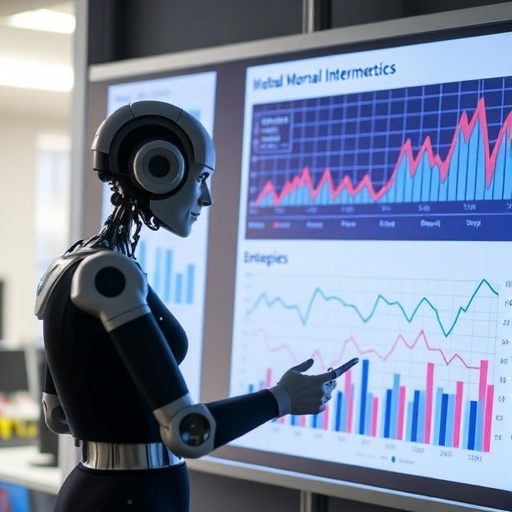
In the dynamic landscape of artificial intelligence, the ability to accurately interpret and understand complex visual data is paramount, especially when it comes to charts that pervade financial reports and market summaries. Researchers at MIT, in collaboration with the MIT-IBM Computing Research Lab, have unveiled ChartNet, an advanced multimodal dataset comprising over a million high-quality charts, designed to empower vision-language models (VLMs) with the capability to robustly comprehend and analyze chart-based data. This breakthrough addresses a critical bottleneck in AI development, overcoming previous limitations posed by insufficient and non-diverse training data.
Traditional generative AI models have excelled at processing natural language and interpreting straightforward images; however, the multifaceted nature of charts requires a sophisticated integration of visual recognition, numerical extraction, and linguistic interpretation. Charts are not just images; they encode intricate data relationships expressed visually through lines, bars, colors, and annotations. The challenge lies in training AI systems to decode these multimodal signals accurately, a task that demands extensive, well-annotated datasets that had been lacking until now.
ChartNet’s foundation rests on a novel synthetic data generation approach. Rather than rely solely on limited real-world chart images scraped from the web, which often suffer from quality and diversity shortcomings, the researchers developed an automated system that translates existing charts into code. This code then undergoes iterative augmentation, systematically varying aspects such as chart types, color schemes, data values, and thematic topics to produce an expansive and diverse catalog of charts. This scalable method enabled the synthesis of a dataset that is not only vast but statistically representative of real-world chart variations.
Beyond mere image generation, ChartNet integrates multiple complementary data modalities essential for deep chart understanding. Each chart entry within the dataset is paired with its generation code, a textual description, a data table reflecting the numerical values represented visually, and curated question-and-answer pairs. These Q&A pairs are instrumental in teaching models to reason about chart data contextually, enabling more nuanced interpretations and allowing models to answer complex queries about trends, comparisons, or statistical details encoded in charts.
Quality assurance was a primary consideration throughout the dataset’s development. An automated validation process ensures that every generated chart is both functionally executable and visually accurate, maintaining fidelity between the underlying data and its graphical representation. Furthermore, a subset of charts received expert human annotation, extending the dataset to include rare or complex chart types, which provide a robust benchmark and further ground truths for model evaluation and fine-tuning.
The practical impact of ChartNet was demonstrated by training several open-source vision-language models, including IBM’s Granite Vision series, on chart interpretation tasks such as data extraction, summarization, question answering, and chart reconstruction. Remarkably, the smaller, open-source models fine-tuned on ChartNet significantly outperformed large-scale commercial counterparts, highlighting the power of diverse, high-quality data over brute computational scale.
This advancement holds transformative potential for industries reliant on rapid and accurate chart analysis, notably the financial sector. With the ability to decode complex visual data reliably, vision-language models trained on ChartNet can automate the extraction of key insights from market trends, enhancing decision-making processes and operational workflows. Moreover, the open-source nature of ChartNet democratizes access to high-performance AI capabilities, enabling smaller firms and independent researchers to leverage top-tier models without prohibitive costs.
ChartNet represents a step-change in chart understanding research, moving beyond simplistic question-answering datasets to a comprehensive resource that addresses the full breadth of challenges in chart interpretation. This holistic approach encourages the AI community to rethink data curation and model training strategies, focusing on multimodal integration and robust reasoning capabilities.
Looking ahead, the MIT-IBM team envisions expanding ChartNet to incorporate even more complex chart structures and datasets derived from additional domains. By involving community feedback and real-world usage scenarios, they aim to continuously refine the dataset’s scope and relevance, ensuring it remains a cutting-edge tool for AI practitioners pushing the boundaries of machine perception and understanding.
This research underscores the symbiotic relationship between data quality and AI model performance. It reaffirms that carefully crafted, multimodal datasets are as crucial as architectural innovations in achieving breakthroughs in artificial intelligence. ChartNet not only bridges a significant gap in training resources but also paves the way for more scalable, interpretable, and accessible AI systems across various sectors.
As the demand for AI-driven insights intensifies in an information-rich global economy, innovations like ChartNet provide a vital foundation for future technologies. By equipping machines to decode visual data with greater fidelity, the pathways to automation, enhanced analytics, and smarter decision frameworks become increasingly tangible and accessible.
The collaborative effort between MIT and IBM’s research entities exemplifies the power of cross-disciplinary innovation, combining expertise from computer vision, natural language processing, and domain-specific knowledge to tackle real-world challenges. The upcoming presentation of this work at the IEEE Computer Vision and Pattern Recognition Conference will undoubtedly catalyze further advancements and industry uptake of chart understanding technologies.
Cite Scienmag News
Courtney Benton. (June 4, 2026). MIT Researchers Develop AI Models Capable of Interpreting Charts. Scienmag. https://scienmag.com/mit-researchers-develop-ai-models-capable-of-interpreting-charts/
Courtney Benton. "MIT Researchers Develop AI Models Capable of Interpreting Charts." Scienmag, 4 June 2026, https://scienmag.com/mit-researchers-develop-ai-models-capable-of-interpreting-charts/. Accessed 3 September 2026.
Courtney Benton. "MIT Researchers Develop AI Models Capable of Interpreting Charts." Scienmag. June 4, 2026. https://scienmag.com/mit-researchers-develop-ai-models-capable-of-interpreting-charts/


