


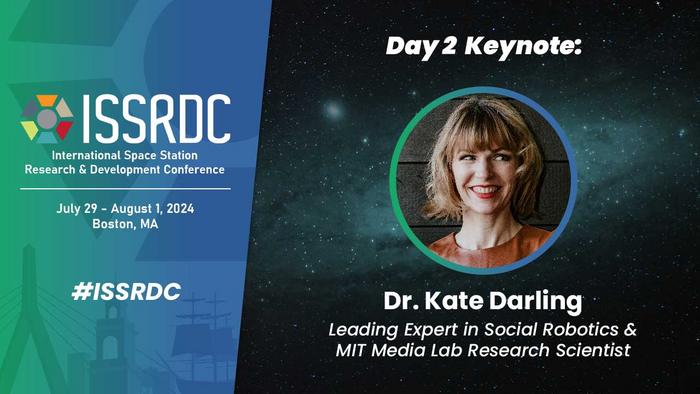
BOSTON (MA), June 4, 2024 – Kate Darling, a leader in exploring the intersection of robotics and society, will discuss intelligent machines in a keynote address on Wednesday, July 31, 2024, during the International Space Station Research and Development Conference (ISSRDC).

Credit: Kate Darling
BOSTON (MA), June 4, 2024 – Kate Darling, a leader in exploring the intersection of robotics and society, will discuss intelligent machines in a keynote address on Wednesday, July 31, 2024, during the International Space Station Research and Development Conference (ISSRDC).
Darling, dubbed the “Mistress of Machines,” studies ethical questions related to the development of intelligent robots at the Massachusetts Institute of Technology (MIT). She also heads the Boston Dynamics Artificial Intelligence (AI) Institute’s study of ethics and societal impact. In addition, Darling co-taught a robot ethics course at Harvard Law School and studied the application of law and robotics, focusing on legal and social issues.
In her keynote address, Darling will discuss how her passion for technology and robots has led her to study the relationship between robots and humans.
Artificial intelligence is playing an increasing role on the International Space Station (ISS), as robots and smart machines assist crew members with tasks and data analysis. Robotic helpers can free up astronauts to conduct more hands-on investigations on the orbiting laboratory and carry out more complex tasks as humans expand their footprint in space.
One example of an AI-based robotic assistant on station is the Crew Interactive MObile companioN, or CIMON, developed in collaboration with Airbus, IBM, and the German Aerospace Center. The free-flying robot serves as a hands-free database with a computer and camera that responds to voice commands and processes data. NASA’s Astrobees are another example of free-flying robots on station that help astronauts validate new technology and inspire the next generation through educational programs like MIT’s Zero Robotics.
“Robotics and AI have a long and successful history of application in space exploration, but recent advances at the interface of humans and intelligent machines promise to enhance our ability to fully utilize the space station now and expand the capabilities of future destinations in low Earth orbit (LEO),” said Michael Roberts, chief scientific officer for the ISS National Laboratory®. “It is equally important to understand how these rapidly developing technologies will accelerate the growth of ecosystems off the Earth. We look forward to Kate Darling sharing her expertise and experience as we work to assimilate intelligent machines into human space to make our work safer and more efficient.”
ISSRDC 2024 will be held from July 29 to August 1, 2024, at the Marriott Copley Place in Boston. Darling’s keynote address will take place Wednesday, July 31, alongside a variety of other sessions focused on technology development and innovation in space.
The annual conference brings together leaders from the commercial sector, U.S. government agencies, and academic communities to foster innovation and discovery onboard the space station. This year’s sessions and panels will showcase the orbiting laboratory’s continued value as a platform for research and technology development that benefits humanity and enables a robust and sustainable market in LEO.
ISSRDC is hosted by the ISS National Lab, managed by the Center for the Advancement of Science in Space™ (CASIS™); NASA; and the American Astronautical Society (AAS). Additional announcements on keynote speakers and other conference sessions will be forthcoming.
To learn more about ISSRDC, including how to register, exhibit, or become a conference sponsor, please visit the conference website.
Download a high-resolution photo: Kate Darling Keynotes at ISSRDC 2024
Cite Scienmag News
Denise Maddox. (June 4, 2024). ‘Mistress of Machines’ Kate Darling to deliver ISSRDC keynote address focused on robotics and society. Scienmag. https://scienmag.com/mistress-of-machines-kate-darling-to-deliver-issrdc-keynote-address-focused-on-robotics-and-society/
Denise Maddox. "‘Mistress of Machines’ Kate Darling to deliver ISSRDC keynote address focused on robotics and society." Scienmag, 4 June 2024, https://scienmag.com/mistress-of-machines-kate-darling-to-deliver-issrdc-keynote-address-focused-on-robotics-and-society/. Accessed 4 September 2026.
Denise Maddox. "‘Mistress of Machines’ Kate Darling to deliver ISSRDC keynote address focused on robotics and society." Scienmag. June 4, 2024. https://scienmag.com/mistress-of-machines-kate-darling-to-deliver-issrdc-keynote-address-focused-on-robotics-and-society/

