

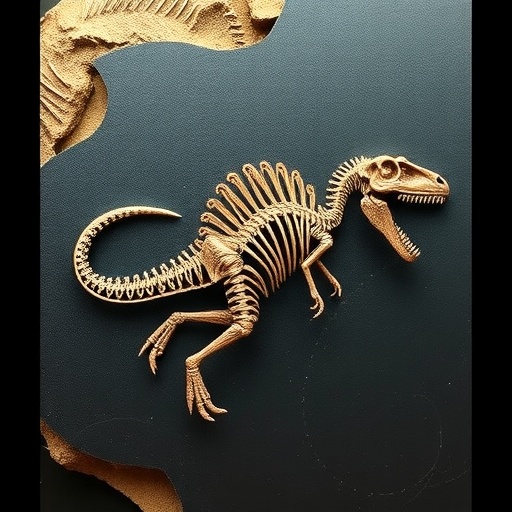
In a groundbreaking discovery that unravels longstanding mysteries surrounding a perplexing dinosaur clade, an international research team has uncovered a remarkably complete fossil that sheds new light on the evolutionary trajectory and biogeographic history of alvarezsaurs. This enigmatic group of bird-like theropods, previously known chiefly through fragmented remains predominantly from Asia, has long baffled paleontologists due to their distinctive anatomy and scant fossil records in other continents. The recent find, dating back approximately 90 million years and originating from northern Patagonia in Argentina, fills a pivotal gap and provides an unprecedented window into the morphology, development, and dispersion patterns of these diminutive dinosaurs.
The centerpiece of this research is the exceptional skeleton of Alnashetri cerropoliciensis, a species that had been known only from sparse and incomplete remains prior to this excavation. Unlike its later relatives, this specimen exhibits notably longer arms and larger teeth, challenging prior assumptions that characterized alvarezsaurs by their highly reduced forelimbs and minute dentition adapted for a specialized diet, likely insectivorous in nature. The detailed analyses of the skeletal structure reveal that smaller body size was established much earlier in this lineage, indicating an evolutionary trend toward miniaturization that predated other morphological specializations.
Decades before this discovery, most insights into alvarezsaurs depended mainly on fossil fragments discovered in Asia, shaping an incomplete and somewhat misleading image of their evolutionary biology. The near-complete Alnashetri skeleton unearthed in the La Buitrera fossil site stands as a paleontological Rosetta Stone, as described by lead author Professor Peter Makovicky of the University of Minnesota Twin Cities. This specimen allows researchers to calibrate and reinterpret previous partial finds with greater precision, facilitating a more comprehensive phylogenetic and anatomical framework.
The team devoted over ten years to meticulous preparation and reconstruction of the fossil. Given the delicate nature of the small bones, painstaking techniques were employed to preserve anatomical integrity while enabling detailed examination. Subsequent microscopic bone analysis not only confirmed the fossil belonged to an adult individual but also revealed that Alnashetri never attained sizes beyond a few pounds. This reflects a consistent evolutionary adaptation toward diminutive body forms within the entire alvarezsaur lineage, distinguishing them sharply from larger theropod dinosaurs contemporaneous at the time.
This research also challenges earlier hypotheses about alvarezsaur biogeography. By reexamining fossil specimens held in museum collections across North America and Europe and comparing them with the newly discovered Argentine specimen, the researchers concluded that alvarezsaurs originated much earlier than formerly thought. Their geographic distribution aligns with the breakup of the supercontinent Pangaea rather than oceanic dispersal, emphasizing the profound influence of plate tectonics and continental drift on dinosaur evolution and migration.
The La Buitrera fossil area, where Alnashetri was excavated, continues to demonstrate its scientific significance as a hotspot for exceptionally well-preserved Cretaceous vertebrate fossils. Alongside dinosaur remains, this site has produced primitive snakes and tiny saber-toothed mammals, enriching our understanding of ecosystem dynamics during this era. The unique fossil assemblage provides pivotal context for interpreting evolutionary patterns within various vertebrate groups.
Co-researcher Sebastián Apesteguía of Universidad Maimónides highlights the collaborative and ongoing nature of the work in La Buitrera. More fossils are currently under preparation that promise to unveil further chapters of alvarezsaur evolutionary history. This continuous research effort signifies that the current findings are but one step toward fully resolving the complex story of these elusive dinosaurs.
The functional morphology of Alnashetri offers fresh perspectives on the evolutionary pressures shaping alvarezsaur features. The presence of elongated arms and larger teeth indicates that the archetypal traits observed in later alvarezsaurs—such as reduced forelimbs and highly specialized dentition—were indeed derived adaptations rather than ancestral conditions. This insight reconfigures how scientists interpret evolutionary processes like niche specialization and morphological innovation within this clade.
The diminutive size of Alnashetri and other alvarezsaurs raises intriguing questions about how miniaturization may relate to ecological roles and survival strategies in Mesozoic terrestrial environments. Their small stature, possibly comparable to modern small mammals, could suggest enhanced agility or specialist feeding strategies, potentially including insectivory aided by the signature enlarged thumb claw. Understanding these adaptations provides a richer picture of the diversity within theropod dinosaurs beyond apex predators.
Furthermore, the cross-continental distribution of alvarezsaurs during the Cretaceous implies that faunal exchanges occurred under geological regimes very different from today’s. This study reinforces the notion that continental fragmentation played a major role in distributing dinosaur clades and that their evolutionary pathways were tightly coupled to earth’s shifting lithospheric plates and climatic zones.
The implications of this discovery extend beyond paleoecology and evolutionary biology, impacting broader narratives about how prehistoric life evolved in response to environmental and geographic upheavals. By recontextualizing when and where alvarezsaurs appeared and how they morphologically diversified, this research contributes critical data to models of dinosaur evolution and extinction patterns.
As preparation continues on newly excavated specimens from La Buitrera, researchers anticipate further revelations that could refine current taxonomic classifications and elucidate evolutionary linkages among small theropods. The depth of data emerging from this site exemplifies the potential for regional fossil repositories to revolutionize our understanding of dinosaur biodiversity and adaptability.
This transformative study exemplifies the power of integrating detailed fossil analysis, advanced microscopic techniques, and comparative anatomy to answer fundamental questions about dinosaur origins and evolution. The find not only rewrites the evolutionary history of a baffling dinosaur group but also highlights the importance of international scientific collaboration and long-term commitment to uncovering the planet’s deep past.
Subject of Research: Alvarezsaurs dinosaur lineage evolution, particularly focusing on Alnashetri cerropoliciensis specimens and their biogeographic history.
Article Title: Argentine fossil rewrites evolutionary history of a baffling dinosaur clade
News Publication Date: 25-Feb-2026
Web References:
- Nature journal article
- DOI: 10.1038/s41586-026-10194-3
Image Credits: Gabriel Díaz Yantén, Universidad Nacional de Río Negro.
Keywords: Dinosaur fossils, Paleontology, Animal fossils, Fossils, Fossil records


