

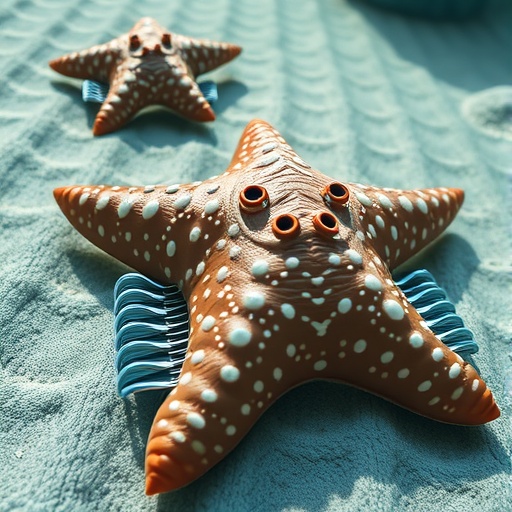
In the intricate world of marine biology, few creatures captivate our attention quite like sea stars, or starfish. These enigmatic echinoderms inhabit the world’s oceans, showcasing a remarkable ability to navigate complex environments with extraordinary grace. What’s particularly fascinating about sea stars is their unique locomotion mechanism, which operates without a central brain. Instead, they utilize hundreds of tiny tube feet, all functioning in a beautifully coordinated dance that raises questions about the nature of intelligence and movement in the animal kingdom.
A recent study from the Kanso Bioinspired Motion Lab at the USC Viterbi School of Engineering dives deep into the mechanics behind sea star locomotion. The lab, renowned for its interdisciplinary approach, fuses biology with engineering in an effort to decode the fluid dynamics of living organisms. This research exemplifies how marine creatures, despite their simplicity, can provide invaluable insights that may one day revolutionize robotics.
The essence of the latest findings hinges on the decentralized locomotion exhibited by these creatures. Each tube foot, akin to an autonomous unit, communicates locally with its immediate environment, adjusting its adhesion based on the mechanical strain it encounters. This decentralized approach could have profound implications for the design and functionality of future robotic systems, particularly in settings where centralized control is impractical or impossible.
In the paper titled “Tube Feet Dynamics Drive Adaptation in Sea Star Locomotion,” published in the Proceedings of the National Academy of Sciences, researchers reveal that the movement of sea stars is not dictated by a singular governing force but rather by individual responses from each tube foot. This groundbreaking understanding stemmed from collaborative efforts between USC and research institutions across the globe, including the McHenry Lab at UC Irvine and the University of Mons in Belgium.
As the research unfolded, the scientists discovered that each tube foot reacts independently to varying loads and environmental conditions. For instance, by utilizing a 3D-printed “backpack” designed specifically for these sea stars, the team could observe real-time adjustments in the behavior of each foot. This experimental setup allowed for a thorough testing of their hypothesis surrounding the sea star’s distributed control strategy, leading to profound revelations about how they adapt to changes in their surroundings.
The experiments demonstrated that even when subjected to unusual stressors—such as additional weight—the sea stars remained capable of movement. This independence of action suggests a sophisticated level of local decision-making that enables one foot to respond to local conditions while simultaneously contributing to the overall locomotion of the sea star as a whole. This serves as a reminder that intelligence does not have to be centralized to be effective and effective communication can occur at a local level.
What makes this research particularly compelling is its application potential. The principles derived from studying the locomotion of sea stars may be applicable not only in marine robotics but also in terrestrial and extraterrestrial environments. The adaptability of these creatures inspires designs for robots that could traverse variable terrains—be it rocky surfaces on Earth, the depths of the ocean, or even the lunar surface. The future of robotics could very well be modeled on biological systems that demonstrate successful adaptations to harsh and ever-changing environments.
One of the most striking aspects of sea star physiology is how they remain unaffected by being misplaced in orientation. The Kanso Lab’s studies showed that even when flipped upside down, sea stars could still navigate effectively. This highlights the resilience built into their locomotion system, which operates on local information collected by each foot as it experiences gravitational forces differently. Without a central brain directing their movements, they show that even the most complex behaviors can emerge from simple rules of interaction.
In a world where many organisms, such as insects and fast-moving mammals, rely on sophisticated central pattern generators processed through a central nervous system, sea stars present an alternative narrative. They defy the notion that higher intelligence equates to superior movement. Their evolutionary success lies in their robustness, providing valuable lessons in resilience and adaptation that robotics engineers can draw from.
This ground-breaking research garners attention not just for its implications in the field of robotics but also for the philosophical discussions it invites—challenging our understanding of intelligence, control, and the nature of life itself. As scientists continue to unlock the secrets of the natural world, the Kanso Lab’s endeavors remind us that nature often holds the blueprint for the technologies of tomorrow.
As we broaden our understanding of decentralized movement, we begin to realize that emulating biological systems can lead to innovations that we have yet to imagine. The unique capabilities of sea stars might inform the design of soft robotics that can handle extreme environments with ease and adaptability. The real-world applications of this research could facilitate exploration in unexplored territories—underwater through vast oceans, traversing rugged landscapes, and even navigating the surfaces of other planets.
Ultimately, this deep dive into the world of sea stars opens up new discussions about our relationship with the natural world and our technological pursuits. It illustrates a harmonious interplay between biology and engineering and positions nature as a mentor in the quest for advancement. The sea star’s remarkable adaptability and innovative locomotion strategies provide not just answers, but also spark further inquiry into how we can learn from the myriad forms of life that inhabit our planet.
Subject of Research: Animals
Article Title: Tube Feet Dynamics Drive Adaptation In Sea Star Locomotion
News Publication Date: 13-Jan-2026
Web References: PNAS
References: N/A
Image Credits: McHenry Lab at UC Irvine
Keywords
- Marine Biology
- Robotics
- Decentralized Control
- Locomotion
- Echinoderm Adaptation
- Bioinspired Engineering
- Soft Robotics
- Mechanical Strain
- Autonomous Systems
- Environmental Adaptability
- Comparative Physiology
- Sensorimotor Coordination


