


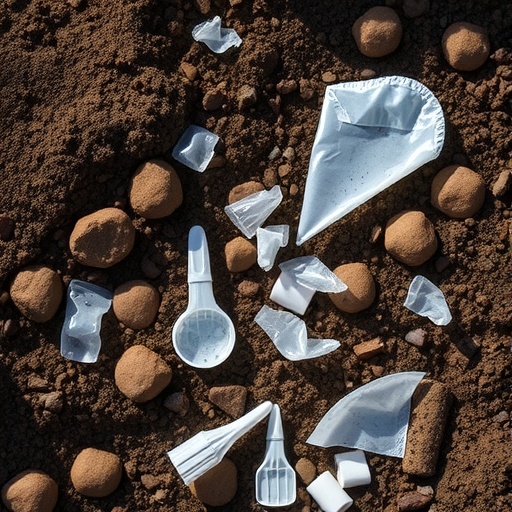
Microplastics and their smaller counterparts—nanoplastics—have emerged as pressing environmental contaminants, infiltrating ecosystems and food sources in ways previously unimagined. Agricultural soils, which are fundamental to food production and environmental health, are no exception. The research conducted by Samani et al. sheds light on the pervasive issue of micro and nano plastics (MNPs) in these critical environments. The findings present a stark reminder of the challenges posed to both food security and the overall health of ecosystems as these pollutants gain a foothold in agricultural contexts.
The rise of plastic pollution has been alarming over the past few decades. With millions of tons of plastic entering landfills and oceans each year, the degradation of plastics into micro and nanoplastic particles is inevitable. These particles, often invisible to the naked eye, measure less than 5 millimeters in size, and their small scale allows them to pervade various environmental matrices, especially soils utilized for agricultural purposes. The research underscores the urgent need to understand how these pollutants interact with soil components, crops, and ultimately human health.
Researchers have identified various pathways through which micro and nanoplastics enter agricultural soils. Among these are irrigation systems, the application of organic fertilizers contaminated with plastics, and atmospheric deposition. Once introduced into the soil environment, these particles can affect soil structure, impact microbial communities, and modify nutrient cycling processes. This disruption raises concerns about the integrity of food systems and the safety of produce meant for human consumption.
One of the critical dimensions of this research is the impact of MNPs on soil microbiomes. Soil health is inherently linked to its microbial communities, which play crucial roles in nutrient cycling, organic matter decomposition, and overall soil fertility. MNPs can alter the composition of soil bacteria and fungi, potentially leading to decreased soil functionality and disrupted ecological balances. As these changes cascade through the food web, the implications for crop yield and food security become increasingly concerning.
Furthermore, micro and nanoplastics can adsorb various agricultural chemicals, including pesticides and fertilizers. This accumulation not only poses a risk to plants but also raises the stakes for human health. The ingestion of contaminated crops or the leaching of chemicals into waterways can lead to far-reaching consequences for communities relying on agriculture as a primary source of sustenance. Understanding the metamorphic relationship between MNPs and chemical pollutants in soil remains critical for developing comprehensive strategies to mitigate risks.
The knowledge gap about the long-term impacts of MNPs on crops and soil health is profound. While the presence of MNPs in agricultural soils is documented, there remains a significant lack of data on their accumulation in plants and how various plant species respond to their presence. Certain studies have indicated that specific crops may absorb nanoplastics, raising alarm bells about the potential for consumer exposure through the food chain. Future research must bridge these gaps to guide soil management practices and safeguard public health.
To address the proliferation of MNPs, legislators and farmers alike must prioritize preventive measures and waste management strategies. Education plays a pivotal role in fostering awareness among agricultural stakeholders about the long-term ramifications of plastic pollution. By adopting sustainable practices and innovative solutions, farmers can mitigate the introduction of MNPs into their fields, thereby ensuring food safety and protecting the environment.
Concurrently, technological advancements in plastic waste recycling and bioplastics offer rays of hope. Scientists and engineers are working relentlessly to develop materials that are biodegradable and less harmful to ecosystems. However, scaling these solutions to meet global demand remains a challenge. Awareness campaigns, incentives for using eco-friendly materials, and stringent policies on plastic usage can catalyze a paradigm shift in agricultural practices.
International cooperation is equally vital in combating plastic pollution. Countries must collaborate on policies and research initiatives that facilitate the sharing of knowledge and best practices. The formation of global standards for plastic use in agriculture can help harmonize efforts across borders, paving the way for healthier soils worldwide.
Ultimately, the findings by Samani et al. provide a clarion call to immediate action. The intersection of micro and nanoplastic pollution with agricultural practices poses threats not only to food security but also to environmental health. As the data emerges, stakeholders from farmers to policymakers must act decisively to safeguard not just our soils, but the future of food systems everywhere.
In conclusion, addressing the challenges posed by micro and nano plastics in agricultural soils requires a multifaceted approach that integrates scientific research, sustainable agricultural practices, and community awareness. The road ahead may be fraught with obstacles, but with concerted effort and innovation, we can work towards reclaiming the health of our soils and ensuring a secure food future for generations to come.
Samani, M., Ahlawat, Y.K., Yadav, S. et al. Micro and nano plastics (MNPs) in agricultural soils: challenges for food security and environmental health. Environ Monit Assess 197, 1369 (2025). https://doi.org/10.1007/s10661-025-14810-z
Cite Scienmag News
Violet Maxwell. (November 25, 2025). Microplastics in Soil: Threats to Food Security. Scienmag. https://scienmag.com/microplastics-in-soil-threats-to-food-security/
Violet Maxwell. "Microplastics in Soil: Threats to Food Security." Scienmag, 25 November 2025, https://scienmag.com/microplastics-in-soil-threats-to-food-security/. Accessed 3 September 2026.
Violet Maxwell. "Microplastics in Soil: Threats to Food Security." Scienmag. November 25, 2025. https://scienmag.com/microplastics-in-soil-threats-to-food-security/


