

Saturday, September 5, 2026
Science
No Result
View All Result
  • Login
  • HOME
  • SCIENCE NEWS
  • CONTACT US
  • HOME
  • SCIENCE NEWS
  • CONTACT US
No Result
View All Result
Scienmag
No Result
View All Result
Home Science News Cancer

Microbiota enterotoxigenic Bacteroides fragilis-secreted BFT-1 promotes breast cancer cell stemness and chemoresistance through its functional receptor NOD1

April 25, 2024
in Cancer
Nathaniel Bowman
By Nathaniel Bowman Scienmag Editorial Profile - Precision Oncology
Reading Time: 2 mins read
0
Microbiota enterotoxigenic Bacteroides fragilis-secreted BFT-1 promotes breast cancer cell stemness
67
SHARES
605
VIEWS
Share on FacebookShare on Twitter
ADVERTISEMENT

Tumor-resident microbiota in breast cancer promotes both the initiation and progression of cancer. However, the potential of targeting microbiota to enhance the efficacy of breast cancer treatment has not been comprehensively explored. In this study, researchers analyzed the microbial composition within breast tumors and identified a notable enrichment of ETBF in patients who exhibited resistance to taxane-based neoadjuvant chemotherapy.

Image

Credit: Wei Ma, Lu Zhang, Weilong Chen, Zhaoxia Chang, Juchuanli Tu, Yuanyuan Qin, Yuwen Yao, Mengxue Dong, Jiajun Ding, Siqin Li, Fengkai Li, Qiaodan Deng, Yifei Yang, Tingting Feng, Fanrong Zhang, Xiying Shao, Xueyan He, Lixing Zhang, Guohong Hu, Quentin Liu, Yi-Zhou Jiang, Shu Zhu, Zhi Xiao, Dan Su, Tong Liu, Suling Liu

Tumor-resident microbiota in breast cancer promotes both the initiation and progression of cancer. However, the potential of targeting microbiota to enhance the efficacy of breast cancer treatment has not been comprehensively explored. In this study, researchers analyzed the microbial composition within breast tumors and identified a notable enrichment of ETBF in patients who exhibited resistance to taxane-based neoadjuvant chemotherapy.

Key findings from the study include:

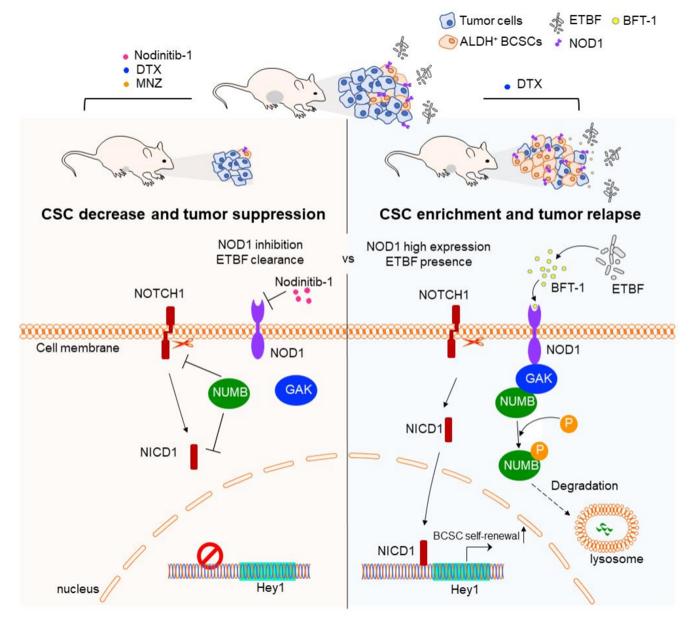
  1. Even at low biomass levels, ETBF secretes a toxic protein, BFT-1, which enhances breast cancer cell stemness and chemoresistance.
  2. Mechanistic investigations revealed that BFT-1 directly binds to the NOD1, a protein highly expressed in the ALDH+ BCSCs. The interaction between BFT-1 and NOD1 leads to the stabilization of NOD1.
  3. NOD1 cooperated with G-associated kinase (GAK) to phosphorylate NUMB, leading to its lysosomal degradation. This process activated the NOTCH1-HEY1 signaling pathway, thereby increasing the number of BCSCs.
  4. Inhibition of NOD1 and clearance of ETBF significantly increase chemotherapy sensitivity by impairing breast cancer stem cells. 

These findings suggest that inhibiting the NOD1 pathway and eliminating ETBF from the tumor microenvironment could potentially sensitize breast cancer cells to chemotherapy by impairing BCSCs. These results highlight the importance of considering the microbiome as a factor in cancer treatment and represent a promising avenue for developing novel therapeutic strategies aimed at enhancing the efficacy of existing breast cancer treatments. The work entitled “Microbiota enterotoxigenic Bacteroides fragilis-secreted BFT-1 promotes breast cancer cell stemness and chemoresistance through its functional receptor NOD1” was published on Protein & Cell (published on Mar 4, 2024).


Journal

Protein & Cell

DOI

10.1093/procel/pwae005

Method of Research

Experimental study

Subject of Research

Animals

Article Title

Microbiota enterotoxigenic Bacteroides fragilis-secreted BFT-1 promotes breast cancer cell stemness and chemoresistance through its functional receptor NOD1

Article Publication Date

4-Mar-2024

Subject of Research: Cancer

Article Title: Microbiota enterotoxigenic Bacteroides fragilis-secreted BFT-1 promotes breast cancer cell stemness and chemoresistance through its functional receptor NOD1

Article References: Ma, W., Zhang, L., Chen, W., Chang, Z., Tu, J., Qin, Y., Yao, Y., Dong, M., Ding, J., Li, S., Li, F., Deng, Q., Yang, Y., Feng, T., Zhang, F., Shao, X., He, X., Zhang, L., Hu, G., ... Liu, S. (2024). Microbiota enterotoxigenic Bacteroides fragilis-secreted BFT-1 promotes breast cancer cell stemness and chemoresistance through its functional receptor NOD1. Protein & Cell, 15(6), 419-440. https://doi.org/10.1093/procel/pwae005

Image Credits: AI Generated

DOI: 10.1093/procel/pwae005

Keywords: Not provided

Cite Scienmag News

Nathaniel Bowman. (April 25, 2024). Microbiota enterotoxigenic Bacteroides fragilis-secreted BFT-1 promotes breast cancer cell stemness and chemoresistance through its functional receptor NOD1. Scienmag. https://scienmag.com/microbiota-enterotoxigenic-bacteroides-fragilis-secreted-bft-1-promotes-breast-cancer-cell-stemness-and-chemoresistance-through-its-functional-receptor-nod1/

Nathaniel Bowman. "Microbiota enterotoxigenic Bacteroides fragilis-secreted BFT-1 promotes breast cancer cell stemness and chemoresistance through its functional receptor NOD1." Scienmag, 25 April 2024, https://scienmag.com/microbiota-enterotoxigenic-bacteroides-fragilis-secreted-bft-1-promotes-breast-cancer-cell-stemness-and-chemoresistance-through-its-functional-receptor-nod1/. Accessed 5 September 2026.

Nathaniel Bowman. "Microbiota enterotoxigenic Bacteroides fragilis-secreted BFT-1 promotes breast cancer cell stemness and chemoresistance through its functional receptor NOD1." Scienmag. April 25, 2024. https://scienmag.com/microbiota-enterotoxigenic-bacteroides-fragilis-secreted-bft-1-promotes-breast-cancer-cell-stemness-and-chemoresistance-through-its-functional-receptor-nod1/

Share27Tweet17
Previous Post

The Lundquist Institute receives $2.6 million grant from U.S. Army Medical Research Acquisition Activity to develop wearable biosensors

Next Post

Revolutionizing men’s sexual health: AI’s pivotal role in erectile dysfunction management

Related Posts

Culturally tailored food vouchers ease food insecurity in Latino cancer patients
Cancer

Culturally tailored food vouchers ease food insecurity in Latino cancer patients

September 5, 2026
Genetically predicted vitamin D levels show no link to head and neck cancer risk
Cancer

Genetically predicted vitamin D levels show no link to head and neck cancer risk

September 5, 2026
Machine learning predicts functional outcomes after vestibular schwannoma surgery: systematic review and meta-analysis
Cancer

Machine learning predicts functional outcomes after vestibular schwannoma surgery: systematic review and meta-analysis

September 5, 2026
Dancing and Diet Boost Health and Gut Microbes in Obese Breast Cancer Survivors
Cancer

Dancing and Diet Boost Health and Gut Microbes in Obese Breast Cancer Survivors

September 4, 2026
New cell-penetrating peptide delivers HPV E6 inhibitor into cervical cancer cells
Cancer

New cell-penetrating peptide delivers HPV E6 inhibitor into cervical cancer cells

September 4, 2026
Vascular adhesion protein-1 offers new targets for cancer diagnosis and therapy
Cancer

Vascular adhesion protein-1 offers new targets for cancer diagnosis and therapy

September 4, 2026
Next Post
Revolutionizing men’s sexual health: AI’s pivotal role in erectile dysfunction

Revolutionizing men's sexual health: AI's pivotal role in erectile dysfunction management

  • Mothers who receive childcare support from maternal grandparents show more optimized

    Mothers who receive childcare support from maternal grandparents show more parental warmth, finds NTU Singapore study

    27656 shares
    Share 11059 Tweet 6912
  • University of Seville Breaks 120-Year-Old Mystery, Revises a Key Einstein Concept

    1061 shares
    Share 424 Tweet 265
  • Bee body mass, pathogens and local climate influence heat tolerance

    682 shares
    Share 273 Tweet 171
  • Researchers record first-ever images and data of a shark experiencing a boat strike

    546 shares
    Share 218 Tweet 137
  • Groundbreaking Clinical Trial Reveals Lubiprostone Enhances Kidney Function

    531 shares
    Share 212 Tweet 133
Science

Embark on a thrilling journey of discovery with Scienmag.com—your ultimate source for cutting-edge breakthroughs. Immerse yourself in a world where curiosity knows no limits and tomorrow’s possibilities become today’s reality!

RECENT NEWS

  • Stable isotopes reveal passive versus active groundwater storage in fluviokarst systems
  • CFOSAT Ocean Wave Measurements Calibrated and Validated Across Multiple Platforms
  • Soil enzyme activity shows little adaptation to long-term geothermal warming
  • Deep Residual Networks Classify Water Potability Using Sum-Product-Difference Feature Matrices

Categories

  • Agriculture
  • Anthropology
  • Archaeology
  • Athmospheric
  • Biology
  • Biotechnology
  • Blog
  • Bussines
  • Cancer
  • Chemistry
  • Climate
  • Earth Science
  • Editorial Policy
  • Marine
  • Mathematics
  • Medicine
  • Pediatry
  • Policy
  • Psychology & Psychiatry
  • Science Education
  • Social Science
  • Space
  • Technology and Engineering

Subscribe to Blog via Email

Enter your email address to subscribe to this blog and receive notifications of new posts by email.

Join 5,151 other subscribers

© 2025 Scienmag - Science Magazine

Welcome Back!

Login to your account below

Forgotten Password?

Retrieve your password

Please enter your username or email address to reset your password.

Log In
No Result
View All Result
  • HOME
  • SCIENCE NEWS
  • CONTACT US

© 2025 Scienmag - Science Magazine

Discover more from Science

Subscribe now to keep reading and get access to the full archive.

Continue reading