


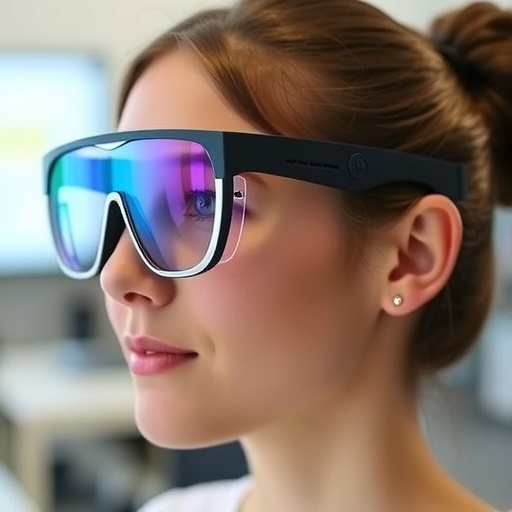
A research team in Italy has unveiled an open-source pair of smart glasses that can measure pupil movements and track gaze for as little as €10 to €17 in basic hardware. Called MEYELens, the wearable platform combines a 3D-printed frame, inexpensive camera modules, infrared illumination and freely available software to perform experiments that normally require specialized eye trackers costing hundreds or thousands of euros. The system is not intended to replace high-end instruments in precision applications, but its creators say it could make eye-based research accessible to underfunded laboratories, classrooms and field studies. In tests reported in Behavior Research Methods, MEYELens detected changes in pupil size caused by light, rhythmic flicker and auditory surprises, while also estimating where participants were looking in both screen-based and natural environments.
The appeal of the device lies in what the eye can reveal beyond vision itself. The pupil changes size in response not only to brightness, but also to signals linked to arousal, mental effort and emotional state. When a person encounters a bright flash, muscles in the iris constrict the pupil through the autonomic nervous system, producing the pupillary light reflex. When a task demands attention or working memory, pupil dilation can reflect activity in brain systems that regulate alertness. Gaze, meanwhile, provides a behavioral record of visual attention: the sequence of fixations, rapid eye movements and shifts toward objects can indicate how people explore a scene or respond to a decision. These measures are used in neuroscience, psychology, human-computer interaction and clinical research involving conditions such as traumatic brain injury, stroke, autism and attention-deficit/hyperactivity disorder.
Commercial systems have made such measurements easier, but often at a substantial financial and technical cost. Many use proprietary cameras, calibration procedures and analysis software, making it difficult for researchers to modify the hardware or understand every step between image acquisition and final result. MEYELens was designed as the opposite: its frame can be printed from publicly available files, its components can be replaced or repositioned, and its acquisition and analysis code is released as open-source software. The printed frame includes adjustable temple arms, movable ear supports, a vertically adjustable nose rest and a camera arm that can slide toward or away from the eye. A ball joint allows the eye-facing camera to be rotated across multiple axes, helping align the lens with users who have different facial geometries.
The researchers printed the frame in matte-black polylactic acid, a common thermoplastic used in consumer 3D printing. Their standard print used about 55 grams of filament, took roughly three hours and employed a 50 percent gyroid infill for mechanical strength. A lower 15 percent infill reduced the estimated printing time to approximately two and a half hours, although with a less robust structure. Assembly required ordinary metric fasteners, including M3 screws and nuts, while dedicated channels in the frame guided USB cables away from the wearer’s face. The design supports either one camera or two. A single eye-facing camera can record pupil size and estimate gaze when the user’s head is stabilized with a chin rest. A second, world-facing camera allows the wearer to move more freely by recording the surrounding scene and linking eye movements to objects in view.
The cameras used in the study recorded images at 640 by 480 pixels. Although their nominal frame rate was 30 frames per second, preliminary tests showed that acquisition often fell to about 20 frames per second, so the investigators limited recordings to 20 hertz for consistency. In a portable version operated by a Raspberry Pi, two simultaneous video streams ran at 10 hertz. For pupillometry, infrared light makes the dark pupil easier to distinguish from the surrounding iris without visibly distracting the participant. One camera required removal of its infrared-cut filter and an external 850-nanometer, 96-LED illuminator; another included infrared LEDs but sometimes needed an additional LED array to produce even illumination. The team measured irradiance under the tested configurations and found it below the relevant ICNIRP exposure limit for a 10-minute exposure, while emphasizing that these measurements were a safety check rather than formal photobiological certification.
MEYELens processes video using the open-source MEYE deep-learning pipeline. For every frame, the software estimates the pupil’s area and center coordinates and assigns a probability that the image contains an eye or a blink. Blink frames are discarded and missing samples are linearly interpolated, producing a time-stamped data file that can be analyzed with standard scientific software. The team also released a dedicated Python package, available through the Python Package Index, with both a programming interface and a graphical interface. Users can draw a region of interest around the eye, choose a segmentation model, adjust thresholds and morphological image-processing settings, and immediately view an overlay showing the predicted pupil mask. This transparency allows investigators to inspect, tune and reproduce the processing rather than accepting an opaque output from a proprietary system.
In one test, the researchers presented flashes at four luminance levels to measure the pupillary light reflex. Every flash produced a measurable constriction, and brighter flashes generally caused larger reductions in pupil area. The relationship between luminance and average constriction amplitude was strong and inverse, with a Pearson correlation of –0.98 and an r² value of 0.96 under the tested conditions. In a separate frequency-tagging experiment, participants viewed a black-and-white square flickering at frequencies from 1 to 5 hertz. The pupil oscillated in synchrony with the visual stimulus, creating a spectral peak at the driving frequency when the recordings were analyzed with a fast Fourier transform. This method is useful because it can distinguish a stimulus-related signal from slower fluctuations and noise. The target-frequency amplitude was significantly greater than neighboring frequency bins, particularly across much of the 1-to-2.5-hertz range.
The device also detected pupil responses to sound. Five participants heard frequent standard tones, rare distractor tones and rare target tones, while pressing a key only when they recognized the target. Pupil responses differed significantly among the three conditions, with the strongest differences associated with the task-relevant oddball tones. Because auditory oddball paradigms probe attention and cognitive evaluation, the result suggests that the inexpensive glasses can record more than automatic light reflexes. In another demonstration, two participants wore MEYELens systems while viewing the same light stimuli. Their pupil responses followed similar trajectories across intensity levels, with a correlation of 0.86 between constriction measures. The experiment was a small feasibility test, but it showed that multiple wearable units could record simultaneously without obvious signal degradation.
Gaze tracking was more mixed, as the researchers openly acknowledged. For a screen-based configuration, the system was calibrated with five AprilTags placed at the center and near the four corners of a display. A second-degree polynomial regression mapped pupil-center coordinates from the eye camera onto screen coordinates. When tested on 20 new, pseudorandomly selected positions—1,200 held-out samples in total—the mean angular error was 1.20 degrees, the median was 1.11 degrees and the root-mean-square error was 1.32 degrees. That level of accuracy can be useful for coarse gaze regions or relative changes in attention, but it is not equivalent to the precision required for microsaccades or detailed reading analyses. In a direct comparison involving one participant, MEYELens followed a sinusoidally moving target with a significantly higher error than a Gazepoint GP3 commercial tracker. Yet during pupil frequency tagging, MEYELens produced a stronger 1-hertz signal and a higher signal-to-noise ratio, showing that a cheaper system may still perform well when the scientific question depends primarily on pupil dynamics rather than exact gaze position.
The most visually striking demonstration took the glasses out of the laboratory. Three participants stood in front of four boxes, each marked with a machine-readable AprilTag, while a hidden smartphone rang from behind one of them. The dual-camera system tracked the eye and the surrounding scene as participants turned toward the sound source. More gaze samples fell within the region containing the phone than within any of the three distractor regions, indicating that the platform could capture stimulus-driven orienting while people moved freely. The authors stress that MEYELens remains a feasibility platform, not a clinically validated diagnostic device. Its 10-to-20-hertz sampling rate is too slow for rapid eye movements such as microsaccades, and the experiments involved small numbers of participants, including single-person tests. Future studies will need to examine reliability across repeated sessions, independently printed frames, ages, facial anatomies, glasses, eyelashes, iris colors and clinical populations. Still, by placing adjustable hardware, analysis code and manufacturing files in the public domain, MEYELens could turn eye tracking from an expensive specialist technology into an adaptable scientific tool that researchers can build, inspect and improve themselves.
Cite Scienmag News
Glenn Wilkins. (August 26, 2026). MEYELens Makes Affordable 3D-Printed Eyewear for Pupil and Gaze Tracking. Scienmag. https://scienmag.com/meyelens-makes-affordable-3d-printed-eyewear-for-pupil-and-gaze-tracking/
Glenn Wilkins. "MEYELens Makes Affordable 3D-Printed Eyewear for Pupil and Gaze Tracking." Scienmag, 26 August 2026, https://scienmag.com/meyelens-makes-affordable-3d-printed-eyewear-for-pupil-and-gaze-tracking/. Accessed 3 September 2026.
Glenn Wilkins. "MEYELens Makes Affordable 3D-Printed Eyewear for Pupil and Gaze Tracking." Scienmag. August 26, 2026. https://scienmag.com/meyelens-makes-affordable-3d-printed-eyewear-for-pupil-and-gaze-tracking/


