

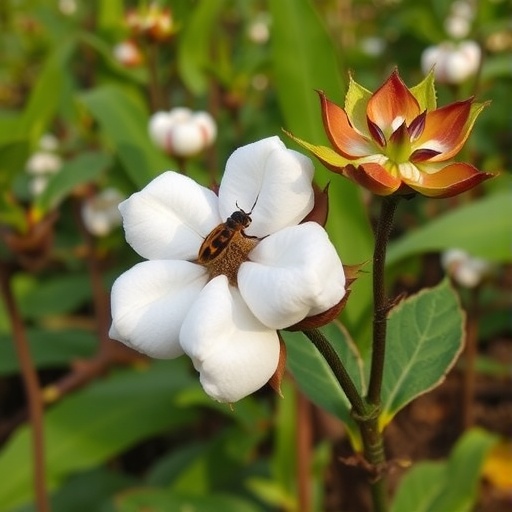
In a groundbreaking study set to redefine the agricultural landscape, researchers have identified crucial meteorological factors affecting the dynamics of major sucking pests and their natural enemies within cotton fields in India. Cotton, a significant crop for both local economies and global markets, finds itself increasingly vulnerable to pest pressures linked closely to environmental conditions. The investigation spearheaded by Kumar, Paul, and Singh delves into the intricate relationships between weather patterns, pest populations, and the efficacy of their natural predators.
As climate change continues to influence weather variability across regions, understanding how these shifts impact pest populations has never been more critical. Cotton fields, particularly those growing the species Gossypium hirsutum, are prone to infestations that can lead to substantial yield losses. The research illuminates how temperature, humidity, and rainfall patterns serve not only as direct influencers of pest populations but also shape the communities of their natural enemies.
Before this study, the knowledge surrounding pest dynamics primarily focused on biological factors or chemical interventions. However, by integrating meteorological data, the researchers present a more holistic perspective that offers farmers and agronomists valuable insights into pest management strategies. They found that variations in temperature, particularly during critical growth stages of the cotton plant, can dramatically alter pest behavior and population densities.
Distinctly, the researchers made a significant observation regarding the role of humidity. High humidity levels were found to bolster the survival rates of certain sucking pests, intensifying infestations and complicating natural control measures. Conversely, decreased humidity coupled with elevated temperatures tended to favor the development and efficacy of biological control agents, thereby providing an ecological balance that could mitigate infestations.
Rainfall patterns emerged as another crucial meteorological factor influencing both pest availability and the response of their natural enemies. For instance, consistent rainfall can disrupt pesticide applications and exacerbate pest problems, while timely rainfall can facilitate the population resurgence of beneficial predatory species that help control pest populations. The study illuminates the delicate interplay between these environmental factors, making a compelling case for incorporating weather forecasting into pest management practices.
Moreover, the research underscores the importance of adaptive agricultural practices. As environmental conditions fluctuate, farmers must adapt their pest management strategies, not only to mitigate existing threats but also to anticipate future pest pressures. Utilizing weather forecasts to inform timing for pesticide applications, or when to deploy biological control agents, enhances the potential for more sustainable farming practices.
The research also emphasizes the necessity for deeper collaboration between meteorologists and agricultural scientists. By creating interdisciplinary strategies that draw knowledge from both fields, more effective pest control measures can be developed that respect ecological balances while ensuring agricultural productivity. This approach moves beyond reactive measures, providing a proactive framework for pest management.
As the findings circulate within the scientific community and the agricultural sector, the potential for real-world applications is enormous. Farmers operating in areas with varying climates are provided with critical data that can guide decision-making. Through strategic planning influenced by weather patterns, the negative impacts of pest infestations can be minimized, leading to increased crop yields and a more stable economic landscape for cotton producers.
Furthermore, this research holds implications beyond the borders of India. As similar pest dynamics are observed in various regions globally, the insights gleaned from this study could inform pest management strategies more widely. The adoption of such methods on an international scale could lead to improved agricultural resilience in the face of ongoing climate changes, enhancing food security worldwide.
In conclusion, this pioneering investigation not only identifies the meteorological factors critical to understanding pest dynamics but also advocates for a transformative shift in how pest management is approached. By acknowledging the role of weather in shaping agricultural practices, researchers are equipping farmers with the tools needed to navigate the complexities of modern pest control, ensuring that the cotton fields of tomorrow remain productive and sustainable.
As the ramifications of climate variability unfold, continued research and innovation in this area will be paramount. The implications of this study pave the way for further investigations into adaptive strategies that can synergistically blend meteorology, biology, and agriculture, fostering an environment where crops can thrive amidst challenges posed by pests and climate alike.
Subject of Research: Meteorological factors influencing pest dynamics in cotton fields.
Article Title: Identifying key meteorological factors influencing density-dependent dynamics of major sucking pests and natural enemies in cotton (Gossypium hirsutum) fields in India.
Article References:
Kumar, R., Paul, D., Singh, S. et al. Identifying key meteorological factors influencing density-dependent dynamics of major sucking pests and natural enemies in cotton (Gossypium hirsutum L.) fields in India. Discov Agric 3, 162 (2025). https://doi.org/10.1007/s44279-025-00310-8
Image Credits: AI Generated
DOI: 10.1007/s44279-025-00310-8
Keywords: meteorological factors, pest dynamics, cotton fields, Gossypium hirsutum, climatic impact, agricultural practices, pest management strategies.


