


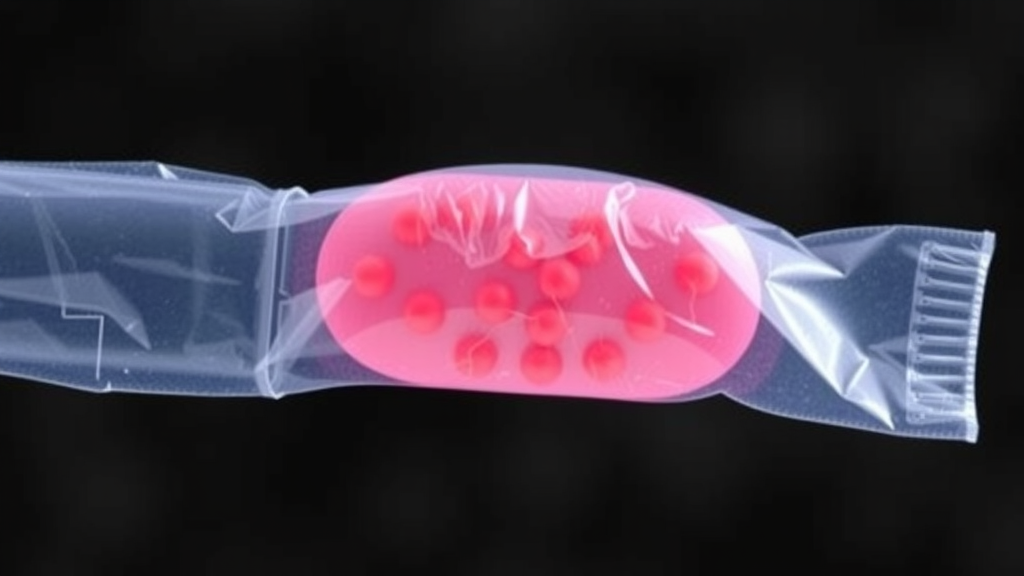
Wound care has long faced an uncomfortable trade-off: dressings that protect the wound often fail to fight infection, while dressings loaded with antimicrobial agents can irritate surrounding tissue or lose their mechanical integrity before the wound has closed. A research team at the University of Tabriz in Iran now reports a way to have both. In a study published in Polymer Bulletin, Amin Hashemi Aghdam, Roghayeh Fathi, Siamak Javanbakht and Reza Mohammadi describe a hydrogel film built from two humble biopolymers, carboxymethylcellulose and alginate, into which they grew nanoparticles of a metal-organic framework known as zeolitic imidazolate framework-8, or ZIF-8, directly inside the polymer matrix. The resulting bio-nanocomposite film combined the moisture-handling and biocompatibility of the polysaccharide base with a striking boost in antibacterial power, and it did so without sacrificing the strength a practical dressing requires.
The choice of starting materials is central to the design. Carboxymethylcellulose, a water-soluble derivative of cellulose, and alginate, a polysaccharide extracted from brown seaweed, are both abundant, inexpensive and well tolerated by living tissue. Alginate in particular has an established record in wound management because its carboxylate groups can bind water and form gels, keeping the wound bed moist, a condition now recognized as essential for efficient healing. On its own, however, a pure CMC/alginate film is mechanically modest and offers essentially no defense against bacteria. The Tabriz group addressed both weaknesses at once by using glycerol as a plasticizer to keep the film supple and citric acid as a crosslinker to knit the polymer chains together, then growing ZIF-8 nanoparticles in situ within this network rather than mixing pre-made particles into it.
That in-situ strategy matters more than it might first appear. ZIF-8 belongs to a family of metal-organic frameworks, crystalline lattices in which zinc ions are coordinated to imidazolate linkers, producing a porous structure with an enormous internal surface area. When such particles are simply blended into a polymer, they tend to clump together, leaving weak spots and uneven performance. Growing them in place, by contrast, encourages a finer, better-distributed population of nanoparticles that interlock with the surrounding polymer chains. Structural characterization carried out by the team confirmed that the ZIF-8 had indeed been incorporated into the matrix, and the mechanical consequences were immediate and measurable.
The numbers tell the story plainly. Tensile strength, the stress a film can withstand before breaking, rose from 36.248 megapascals for the plain CMC/alginate film to 49.651 megapascals once ZIF-8 was present, an improvement of roughly 37 percent. Elongation at break, a measure of how far the material can stretch, dipped only slightly, from 2.591 percent to 2.328 percent, indicating that the reinforcement did not come at the cost of brittleness. For a wound dressing, which must survive handling, movement and the constant flexing of skin, that combination of strength and modest flexibility is exactly what engineers hope to achieve. The citric acid crosslinking and glycerol plasticization appear to have provided a matrix robust enough to accept the nanoscale reinforcement gracefully.
Equally important for real-world use is how the film manages water. A dressing must let water vapor escape at a controlled rate: too impermeable and fluid accumulates under the bandage, macerating the skin; too permeable and the wound dries out, slowing repair. The composite film exhibited a water vapor permeability of 3.71 times ten to the minus four grams per meter per hour per pascal, a value in the range considered suitable for maintaining a moist but not waterlogged wound environment. This parameter, borrowed from membrane science, reflects the interplay between the polymer network and the dispersed porous nanoparticles, and the result suggests the ZIF-8 did not disrupt the film’s ability to breathe.
Biocompatibility was assessed with two complementary methods. In the MTT assay, a standard colorimetric test in which living cells convert a yellow tetrazolium compound into a purple formazan product, the film maintained more than 75 percent cell viability at a concentration of 4 milligrams per milliliter, a threshold commonly used to flag materials as cytocompatible. The team also performed DAPI fluorescence imaging, which stains cell nuclei so that damage to DNA or the nuclear structure becomes visible. No apparent abnormal nuclear morphology was observed, an encouraging sign that the zinc-based framework was not leaching harmful quantities of metal or linker into the surrounding medium at the tested dose.
The antibacterial results are where the design truly pays off. Against both Escherichia coli, a Gram-negative bacterium, and Staphylococcus aureus, a Gram-positive species and a notorious culprit in wound infections, the plain CMC/alginate film produced inhibition zones of only 0.8 and 0.9 centimeters respectively, essentially marginal activity. With ZIF-8 incorporated, those zones expanded to 3.0 plus or minus 0.1 centimeters against both organisms. The mechanism behind this activity is thought to involve the gradual release of zinc ions, which disrupt bacterial membranes and interfere with metal-dependent enzymes, together with possible contributions from the imidazolate linker itself. Because this action relies on metal chemistry rather than conventional antibiotics, it is less vulnerable to the resistance mechanisms that bacteria deploy against standard drugs, a point of growing urgency as antimicrobial resistance spreads.
Hemostasis, the ability to help blood clot, is another property a good dressing should possess, particularly for wounds that bleed. The researchers evaluated the film’s blood-clotting performance and found it comparable to that of commercial gauze, the everyday benchmark in clinical settings. Taken together with the mechanical, permeability and cytotoxicity data, this rounds out a profile that covers most of the practical demands placed on a modern wound dressing: strength, flexibility, moisture balance, safety, clotting support and, crucially, infection control, all in a single film made largely from renewable polysaccharides.
The broader context makes the work timely. Wound infections, including post-surgical and post-cesarean wound complications, impose a heavy burden on health systems, and biofilms formed by bacteria on wound surfaces are notoriously difficult for antibiotics to penetrate. Metal-organic frameworks have attracted intense interest for antimicrobial and drug-delivery applications in recent years, and several groups have explored ZIF-8-containing hydrogels built on chitosan, carragreenan or hyaluronic acid scaffolds. The Tabriz study adds a CMC/alginate platform to that growing family, distinguished by its simple in-situ synthesis, its use of cheap and widely available biopolymers, and its demonstration that the framework can reinforce the film mechanically while delivering potent antibacterial action. The authors acknowledge support from the University of Tabriz and report no competing interests. Before such a film can reach patients, it will need the usual progression of further in vivo testing and scale-up work, but as a proof of concept it is a compelling one: a dressing that is simultaneously stronger, safer and far more hostile to bacteria than the sum of its natural parts.
Subject of Research: ZIF-8 nanoparticle-reinforced carboxymethylcellulose/alginate hydrogel films as antibacterial wound dressings
Article Title: In-situ incorporation of zeolitic imidazolate framework nanoparticles into the carboxymethylcellulose/alginate hydrogel film: a potential antibacterial bio-platform for wound dressing
Article References: Hashemi Aghdam, A., Fathi, R., Javanbakht, S., & Mohammadi, R. (2026). In-situ incorporation of zeolitic imidazolate framework nanoparticles into the carboxymethylcellulose/alginate hydrogel film: a potential antibacterial bio-platform for wound dressing. Polymer Bulletin, 83(12), Article 644. https://doi.org/10.1007/s00289-026-06691-0
Image Credits: AI Generated
DOI: 10.1007/s00289-026-06691-0
Keywords: ZIF-8, metal-organic framework, hydrogel film, wound dressing, carboxymethylcellulose, alginate, antibacterial, biocompatibility, water vapor permeability, tensile strength, nanocomposite, biopolymers
Cite Scienmag News
Bethany Barker. (September 25, 2026). Metal-Organic Framework Nanoparticles Turn Biopolymer Hydrogel into Antibacterial Wound Dressing. Scienmag. https://scienmag.com/metal-organic-framework-nanoparticles-turn-biopolymer-hydrogel-into-antibacterial-wound-dressing/
Bethany Barker. "Metal-Organic Framework Nanoparticles Turn Biopolymer Hydrogel into Antibacterial Wound Dressing." Scienmag, 25 September 2026, https://scienmag.com/metal-organic-framework-nanoparticles-turn-biopolymer-hydrogel-into-antibacterial-wound-dressing/. Accessed 5 October 2026.
Bethany Barker. "Metal-Organic Framework Nanoparticles Turn Biopolymer Hydrogel into Antibacterial Wound Dressing." Scienmag. September 25, 2026. https://scienmag.com/metal-organic-framework-nanoparticles-turn-biopolymer-hydrogel-into-antibacterial-wound-dressing/


