


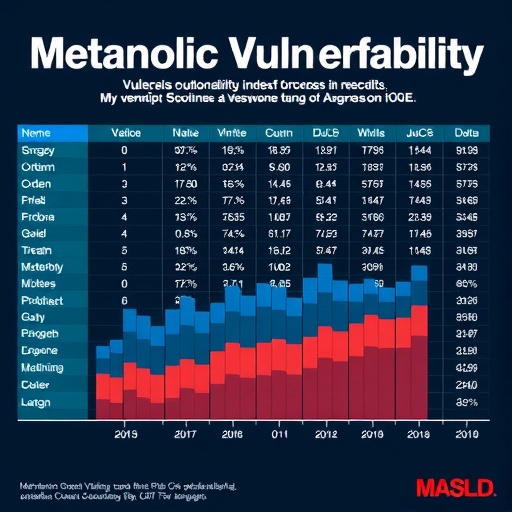
In a groundbreaking advancement for the field of hepatology and metabolic disease management, researchers have unveiled the Metabolic Vulnerability Index (MVI), a novel predictive tool designed to assess clinical outcomes in patients afflicted with Metabolic Dysfunction Associated Steatotic Liver Disease (MASLD). This progressive method emerges from a comprehensive study led by Siddiqui and colleagues, published in Nature Communications in 2026, aiming to bridge the critical gap in prognostication and personalized treatment pathways for this increasingly prevalent condition worldwide.
MASLD, previously known as non-alcoholic fatty liver disease (NAFLD), represents a spectrum of liver pathologies unified by underlying metabolic dysfunction, such as insulin resistance and dyslipidemia. Despite its rising incidence linked to global obesity and diabetes epidemics, stratifying risk and predicting progression to severe liver complications like cirrhosis and hepatocellular carcinoma has remained a formidable challenge. The MVI promises to revolutionize this landscape by integrating metabolic parameters into a quantifiable score that robustly forecasts patient outcomes.
The team’s approach combined sophisticated metabolic profiling with longitudinal clinical data from diverse patient cohorts. Through advanced statistical models and machine learning algorithms, they were able to identify key metabolic derangements that correlate strongly with disease severity and progression rates. This nuanced risk stratification tool captures metabolic vulnerabilities that traditional clinical parameters often overlook, offering a more dynamic and personalized evaluation of liver health risks.
At the heart of the MVI is the concept that metabolic dysfunction extends beyond mere fat accumulation in the liver to systemic alterations affecting mitochondrial function, oxidative stress, and inflammatory pathways. The index encompasses measurements such as insulin sensitivity, lipidomic signatures, and markers of cellular injury, reflecting the multifaceted nature of MASLD pathophysiology. By distilling these complex data points into an accessible scoring system, clinicians are equipped with a powerful instrument for early intervention planning.
An integral finding from the study highlights that patients with elevated MVI scores exhibit significantly higher rates of adverse outcomes, including hepatic decompensation and cardiovascular events. This emphasizes the interconnectedness of metabolic health and liver disease prognosis and underscores the need for holistic management strategies that address the systemic metabolic milieu rather than isolated hepatic pathology.
The implications of this research stretch beyond improved prognostication; the MVI also opens avenues for targeted therapeutic development. Understanding the specific metabolic dysfunctions contributing to an individual’s vulnerability can guide precision medicine approaches, tailoring treatments to correct identified metabolic imbalances and potentially halt or reverse disease progression.
Furthermore, the research team validated the MVI in multiple independent cohorts, demonstrating its reproducibility and generalizability. This validation ensures that the index can be adopted globally across varied demographic and clinical settings, enhancing its utility in routine clinical practice. Such rigorous testing also confirms the robustness of the metabolic markers selected, underscoring their critical role in MASLD pathology.
Importantly, the study draws attention to the limitations of current diagnostic paradigms that mainly rely on liver biopsy or imaging-based steatosis quantification. These methodologies often fail to capture the metabolic dynamics influencing disease trajectory. The MVI fills this gap by integrating metabolic biomarkers, which are less invasive to obtain and may reflect ongoing pathophysiological processes more accurately.
This paradigm shift in evaluating liver disease highlights a broader trend toward incorporating systemic metabolic insights into organ-specific disease management. The MVI exemplifies how harnessing multi-omics technology and computational biology can refine risk assessment tools, fostering a more personalized approach in hepatology.
Additionally, the study discusses potential integration of the MVI into clinical workflows, including routine laboratory testing and electronic health record systems, enabling automated risk stratification with minimal disruption to existing practice. This seamless incorporation could facilitate timely identification of high-risk patients, prompt specialist referrals, and initiation of preventive or therapeutic interventions.
The development of the Metabolic Vulnerability Index also resonates with the urgency to address the global healthcare burden posed by MASLD. With millions affected and limited approved pharmacotherapies available, tools like the MVI could signal a turning point, enabling healthcare providers to allocate resources more efficiently and focus efforts on patients at greatest risk.
Beyond direct clinical care, the MVI may serve as a valuable endpoint in clinical trials for emerging MASLD therapies. By stratifying patients based on metabolic vulnerability, trials can achieve more precise patient selection and outcome evaluation, potentially accelerating drug development timelines and improving study power.
The interdisciplinary collaboration behind this study, melding expertise in hepatology, endocrinology, bioinformatics, and molecular biology, underscores the complexity of metabolic liver disease and the need for integrated research efforts. Their success in operationalizing complex metabolic data into a practical clinical tool serves as a model for future innovations in disease prediction and management.
Looking ahead, the authors emphasize the importance of continuous refinement of the MVI, incorporating emerging biomarkers and expanding validation cohorts to enhance its predictive accuracy and applicability. They also advocate for longitudinal studies to monitor the impact of interventions guided by the MVI on long-term patient outcomes.
In summation, the introduction of the Metabolic Vulnerability Index marks a significant leap in the management of MASLD. By weaving together the intricate metabolic dysregulations with robust clinical prediction, it provides hope for transforming a once enigmatic disease into a tractable condition with defined risk profiles and tailored therapeutic avenues. This pioneering work sets the stage for a new era of precision hepatology, wherein metabolic insights drive clinical decision-making and improve patient lives.
Cite Scienmag News
Ophelia Keating. (June 23, 2026). Metabolic Vulnerability Index Forecasts Outcomes in MASLD. Scienmag. https://scienmag.com/metabolic-vulnerability-index-forecasts-outcomes-in-masld/
Ophelia Keating. "Metabolic Vulnerability Index Forecasts Outcomes in MASLD." Scienmag, 23 June 2026, https://scienmag.com/metabolic-vulnerability-index-forecasts-outcomes-in-masld/. Accessed 4 September 2026.
Ophelia Keating. "Metabolic Vulnerability Index Forecasts Outcomes in MASLD." Scienmag. June 23, 2026. https://scienmag.com/metabolic-vulnerability-index-forecasts-outcomes-in-masld/


