

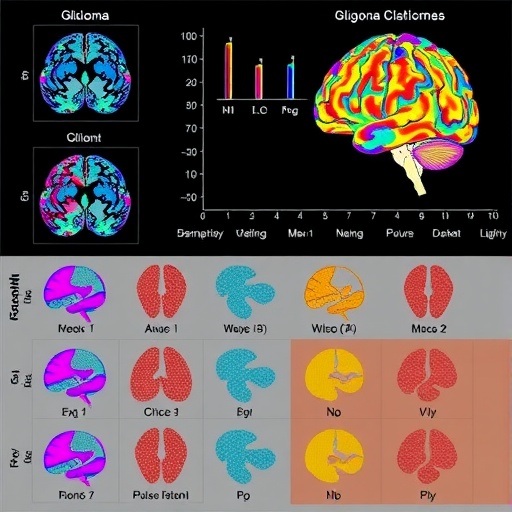
Recent advancements in cancer research have illuminated the complex and often bewildering landscape of gliomas, a type of brain tumor that poses significant challenges for physicians and researchers alike. A groundbreaking study conducted by Zhu and colleagues has offered profound insights into the metabolic characteristics of gliomas, contributing to our understanding of their diverse biological behaviors and potential therapeutic strategies. The importance of this research is underscored by the pressing need to develop more effective treatments for a disease that remains a considerable source of morbidity and mortality.
The study employs integrative multi-omics analysis, a cutting-edge approach that combines data from various biological layers such as genomics, transcriptomics, proteomics, and metabolomics. This multifaceted analysis allows for a more comprehensive view of gliomas, beyond the traditional focus on genetic mutations alone. By examining the interplay between various omics layers, the researchers were able to identify distinct metabolic states within gliomas, revealing the complexity of their biological underpinnings. This innovative methodology positions the research at the forefront of oncological studies, paving the way for novel insights into cancer metabolism.
One of the key findings of this research is the identification of unique metabolic classifications among gliomas. The researchers discovered that gliomas do not exist uniformly; rather, they exhibit a range of metabolic profiles that correlate with their histological types, grades, and patient prognoses. These classifications stem from varying levels of nutrient utilization and energy production pathways, necessitating tailored therapeutic approaches that align with each tumor’s specific metabolic state. This positions metabolic profiling as a critical component in the management of glioma patients, potentially leading to more personalized and effective treatment strategies.
In their analysis, the authors also explored the relationship between the metabolic states of gliomas and their immune microenvironment. Immune infiltration plays a pivotal role in tumor behavior and patient outcomes, and this study sheds light on how different metabolic activities can influence the presence and type of immune cells within the tumor milieu. This aspect of the research underscores the potential for metabolic modulation as a means to alter immune responses, which could enhance the efficacy of immunotherapies currently being explored for glioma treatment.
The implications of these findings extend beyond academic interest; they have the potential to revolutionize how clinicians approach glioma treatment. By integrating metabolic profiling into clinical practice, healthcare providers can make more informed decisions regarding patient management. For example, characterizing a glioma’s unique metabolic signature could guide the selection of targeted therapies that are more likely to yield positive outcomes. Such an approach may ultimately personalize treatment plans, reducing the trial-and-error phase that many patients endure.
Furthermore, the study highlights the role of specific metabolites in glioma biology. Some metabolites were found to be significant markers of tumor aggressiveness and patient prognosis, suggesting that they could serve as valuable biomarkers in clinical settings. This discovery creates opportunities for developing non-invasive diagnostic tools that measure these metabolites in bodily fluids, potentially offering clinicians real-time insights into tumor dynamics and treatment responses.
Interestingly, the integration of multi-omics data does not only reveal metabolic classifications but also elucidates potential therapeutic vulnerabilities within gliomas. For instance, tumors exhibiting certain metabolic traits may depend heavily on specific nutrient pathways, making them susceptible to therapies that target these pathways. This discovery opens doors to investigating existing drugs that can inhibit these metabolic processes and, in turn, slow tumor progression or lead to tumor shrinkage.
Moreover, the advances in this research signify a shift towards a more holistic understanding of gliomas. Traditional techniques often focused solely on genetic aberrations and their direct effects on tumor behavior. However, as this study shows, a more nuanced approach that incorporates metabolic, immune, and environmental factors is vital for comprehensively understanding glioma biology. This paradigm shift could foster collaborations across various disciplines, including molecular biology, immunology, and bioinformatics, to develop synergistic strategies in cancer research.
The study by Zhu et al. emphasizes the importance of collaboration between researchers, clinicians, and computational biologists to fully realize the potential of multi-omics data. The complexity of integrating such diverse datasets requires sophisticated analytical tools and a multidisciplinary approach to interpret the resulting information effectively. As the field of cancer research evolves, it is becoming increasingly important to harness the collective expertise across these domains to drive innovation and improve patient outcomes.
As the authors concluded, further investigations are warranted to validate their findings and explore the clinical relevance of the metabolic classifications identified in this study. Longitudinal studies that monitor how metabolic states change in response to treatment will be pivotal in translating these discoveries into actionable clinical practices. Continued research will likely uncover additional mechanisms by which gliomas manipulate their metabolism and evade therapeutic interventions.
The future of glioma research is undoubtedly promising, and studies like this one serve as the vanguard of a new era in oncology. As we deepen our understanding of the metabolic intricacies and immune interactions that underpin gliomas, we set the stage for the next generation of therapeutic strategies that are more precise and effective. The hope is that by redefining our approach to gliomas through an integrated multi-omics lens, we can not only enhance patient outcomes but also significantly improve the quality of life for those affected by this challenging disease.
As this research begins to shape clinical protocols, it is essential for healthcare systems to adapt to these advancements. Training programs for oncologists and healthcare professionals should incorporate knowledge of metabolic classifications and the implications for treatment. The integration of novel diagnostic tools and therapies must also be supported within healthcare infrastructure to ensure that patients can benefit from these transformative insights.
In conclusion, Zhu and colleagues have opened a new chapter in glioma research by proposing a metabolic classification framework that not only enriches our understanding of these tumors but also guides potential therapeutic interventions. As the landscape of cancer treatment continues to evolve, this kind of pioneering research will play a crucial role in combating gliomas and improving outcomes for patients worldwide. The integration of metabolic profiling into clinical practice represents a significant leap forward, heralding an era where personalized medicine may finally become a reality in the fight against complex cancers like gliomas.
Subject of Research: Metabolic classification of gliomas through multi-omics analysis.
Article Title: Integrative multi-omics analysis proposes a metabolic classification of gliomas: distinct metabolic states, immune infiltration, and prognosis.
Article References:
Zhu, Q., Niu, W., Mu, M. et al. Integrative multi-omics analysis proposes a metabolic classification of gliomas: distinct metabolic states, immune infiltration, and prognosis. J Transl Med (2025). https://doi.org/10.1186/s12967-025-07602-z
Image Credits: AI Generated
DOI:
Keywords: Gliomas, multi-omics analysis, metabolic classification, immune infiltration, personalized medicine.


