


When surgeons must remove a tumor from the groin, they often have to sacrifice more than just the cancer itself. Radical resection of soft tissue sarcomas in the inguinofemoral region frequently demands removal of the flat abdominal muscles and the inguinal ligament, the fibrous band that spans the groin and holds the abdominal wall together. Cutting that ligament tears open the myopectineal orifice, a naturally weak anatomical gateway through which the abdominal contents can push into the leg. The result, all too often, is an incisional hernia that can be debilitating long after the cancer has been addressed. Now a surgical team in India has reported a mesh-based reconstruction technique that appears to dramatically reduce that risk, and their findings are drawing attention for their simplicity and cost-effectiveness.
The study, published in the Journal of Abdominal Wall Surgery, comes from the Sarcoma and Abdominal Wall Reconstruction Unit at Christian Medical College and Hospital in Vellore. The researchers retrospectively reviewed 14 patients who underwent radical resection of soft tissue tumors in the inguinofemoral, iliopsoas, or pelvic region between May 2017 and February 2025. One patient was excluded because a rapidly absorbable polyglactin mesh was used after an inadvertent bladder injury contaminated the surgical field, a material that would inherently confer a higher hernia risk and confound the results. That left 13 patients in the final analysis, a cohort of 9 men and 4 women with a mean age of 38.3 years and tumors averaging 12.3 centimeters at their largest dimension.
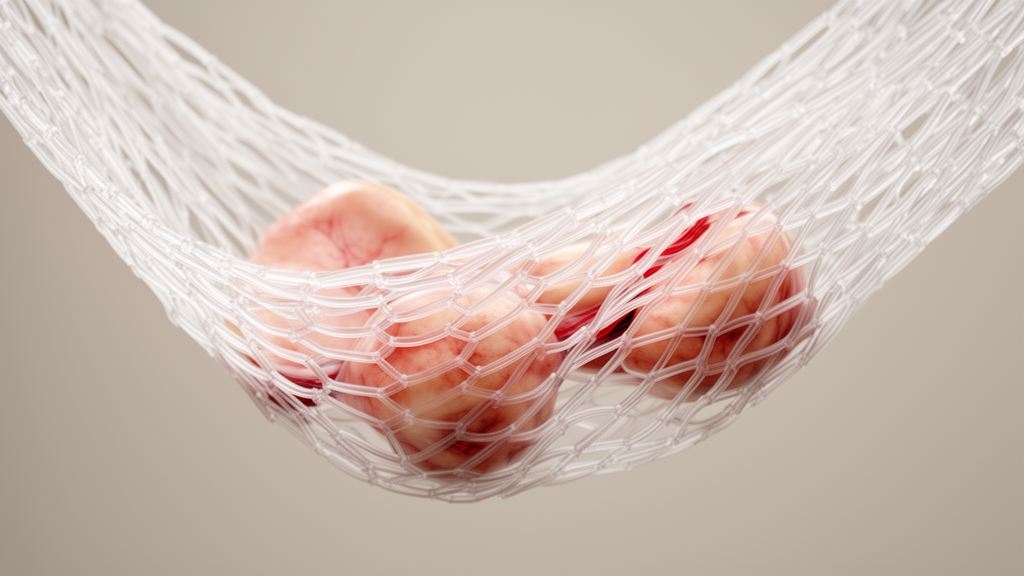
The technical core of the procedure lies in how the mesh is configured. After the tumor is excised en bloc with adequate oncologic margins, the dissection superior to the inguinal ligament is maintained in an extraperitoneal plane, meaning the surgeon works outside the peritoneum, the membrane lining the abdominal cavity. Any inadvertent peritoneal breach is repaired primarily. This leaves a composite defect of the lower abdominal wall with loss of the abdominal wall musculature and the inguinal ligament. The reconstruction then begins with a prosthetic mesh, most commonly polypropylene, placed in the extraperitoneal space and configured in a hammock-like manner.
Superiorly, the mesh is anchored to the parietal abdominal wall using transfascial sutures or tackers. Inferiorly, it is secured medially to Cooper’s ligament, folded downward, and its edges are anchored sequentially to the psoas muscle, the iliacus muscle, and the anterior superior iliac spine. Laterally, the mesh is tucked and fixed to the transverse process of the vertebra, taking care to preserve the neurovascular bundle. The folded edge of the mesh effectively serves as a reconstructed inguinal ligament, replicating the structural function of the native ligament that was sacrificed. In male patients, the testicular vessels are medialized and directed into the scrotum along with the vas deferens, or a new deep ring is created by fish-tailing the lateral end of the mesh. Finally, the residual anterior abdominal wall musculature is closed in layers or reconstructed with a flap, and skin closure is performed as appropriate.
The short-term results are encouraging. Within 30 days of surgery, 4 patients developed surgical site infections, and 2 of these experienced complete to near complete superficial wound dehiscence. Importantly, none of the patients with wound dehiscence had exposure of the mesh or a mesh infection, a critical distinction that speaks to the robustness of the extraperitoneal placement. Two patients were managed with daily dressings and healed by secondary intention, while two were managed with negative pressure wound therapy, one of whom eventually required a split-thickness skin graft. Seroma formation occurred in 2 patients, managed conservatively in one and with ultrasound-guided drain placement in the other. Both improved. The average length of hospital stay was 17 days, with a range of 9 to 32 days. There were no surgery-related mortalities and no documented cases of mesh infection.
In terms of soft tissue coverage, primary closure of the defect was possible in 11 of 13 patients, while 2 required local rotational flap reconstruction, one a pedicle rotation rectus abdominis myocutaneous flap and the other a tensor fascia lata rotation flap. Vascular reconstruction was undertaken in 3 patients. A polypropylene mesh was used in 11 patients, while a titanium-coated polypropylene mesh was used in 2. In the first case requiring a titanium-coated mesh, the patient had a markedly attenuated peritoneum with multiple tears that required primary repair, prompting the use of a mesh with a more bowel-friendly interface. In the second case, extensive sub-adventitial dissection around major vessels necessitated avoiding direct mesh-vessel contact, and the titanium-coated mesh was chosen for its inert, biocompatible surface.
The long-term oncological outcomes reflect the aggressive nature of the tumors themselves. Margin status was negative in 5 patients, close in 6, and positive in 2. The median follow-up period was 12 months, with an interquartile range of 7 to 24 months. Three patients developed local recurrence, and one developed distant metastasis with no local recurrence. Four patients passed away during the follow-up period, including two who experienced early recurrence within 6 months of surgery. These outcomes are consistent with the biology of soft tissue sarcomas in this region rather than with the reconstruction technique itself.
Against this backdrop, the hernia prevention results stand out. Only one patient was confirmed to have developed an incisional hernia, and it was asymptomatic, picked up only on surveillance imaging. With regard to quality of life, a formal assessment was not done, but none of the patients, excluding those with local recurrence to avoid confounding, complained of debilitating chronic pain, and all were able to carry out their activities of daily living. This is a notable achievement given that en bloc resection of the inguinal ligament disrupts the structural integrity of the myopectineal orifice and significantly increases the risk of postoperative hernia formation.
The technique also distinguishes itself from prior approaches described in the literature. Offodile and colleagues described reconstruction in a series of six patients with pelvic malignancies using an AlloDerm-polypropylene composite mesh anchored to the anterior superior iliac spine and pubic tubercle via bone anchors. Bott and colleagues reported using a pedicled fascia lata flap to reconstruct the inguinal ligament. Samà and colleagues employed a technique in which the mesh was rolled into a cylindrical configuration and fixed between the anterior superior iliac spine and pubic tubercle, forming a neo-inguinal ligament. Louis and colleagues described a hammock-style mesh placement closely resembling the Vellore technique, though most tumors in their series were approached via a transperitoneal route and their reconstruction used Phasix mesh exclusively, whereas the Indian team predominantly used an extraperitoneal approach and preferred a heavyweight polypropylene mesh.
The extraperitoneal placement offers several advantages. It avoids direct contact with intra-abdominal contents, reducing the risk of bowel adhesions and mesh-related complications. It allows for the use of polypropylene mesh, which is more cost-efficient in low-resource settings. The folded mesh anchored securely to the anterior superior iliac spine and pubic tubercle effectively replicates the structural function of the native inguinal ligament. And the mesh reinforces the entire myopectineal region, offering robust support to both primary and flap reconstructions. The authors acknowledge limitations, including the small sample size, the retrospective design, and follow-up conducted predominantly via telephone interviews, which limits definitive conclusions about the long-term incidence of incisional hernias. Larger prospective studies are inherently challenging given the rarity of these tumors. Still, the technique offers a simple, safe, cost-effective, and reproducible method for reconstructing the myopectineal orifice in patients undergoing radical resection of soft tissue tumors involving the inguinofemoral region, and the authors call for further studies with longer-term clinical and radiological follow-up to validate the durability and efficacy of the approach.
Subject of Research: Mesh reconstruction of the myopectineal region following wide local excision for inguinofemoral tumors
Article Title: Mesh reconstruction of the myopectineal region following wide local excision for inguinofemoral tumors
Article References: George, P. Y., Stephen, P. T., Titus, D. K., Roopavathana, B., Ambrose, N. P., Joseph, P., & Chase, S. (2026). Mesh reconstruction of the myopectineal region following wide local excision for inguinofemoral tumors. Journal of Abdominal Wall Surgery, 5, Article 16648. https://doi.org/10.3389/jaws.2026.16648
Image Credits: AI Generated
Keywords: abdominal wall reconstruction, inguinofemoral tumors, soft tissue sarcoma, incisional hernia, myopectineal orifice, extraperitoneal mesh, inguinal ligament, surgical oncology, Mesh, reconstruction, myopectineal, region
Cite Scienmag News
Nathaniel Bowman. (October 17, 2026). Mesh Hammock Rebuilds the Groin After Radical Cancer Surgery, Keeping Hernias at Bay. Scienmag. https://scienmag.com/mesh-hammock-rebuilds-the-groin-after-radical-cancer-surgery-keeping-hernias-at-bay/
Nathaniel Bowman. "Mesh Hammock Rebuilds the Groin After Radical Cancer Surgery, Keeping Hernias at Bay." Scienmag, 17 October 2026, https://scienmag.com/mesh-hammock-rebuilds-the-groin-after-radical-cancer-surgery-keeping-hernias-at-bay/. Accessed 17 October 2026.
Nathaniel Bowman. "Mesh Hammock Rebuilds the Groin After Radical Cancer Surgery, Keeping Hernias at Bay." Scienmag. October 17, 2026. https://scienmag.com/mesh-hammock-rebuilds-the-groin-after-radical-cancer-surgery-keeping-hernias-at-bay/


