


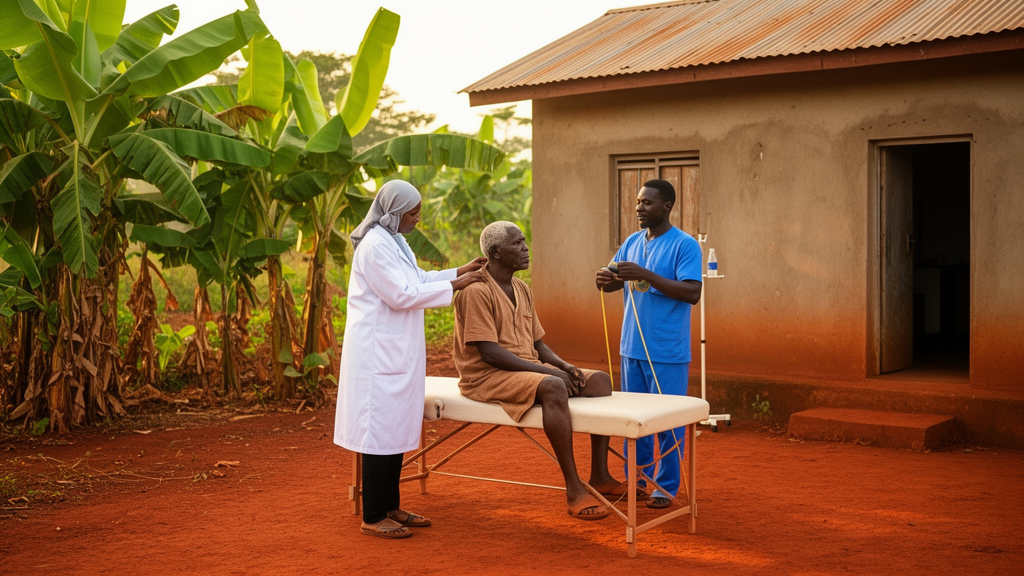
Chronic low back pain affects between 14 and 72 percent of populations across Africa, yet rigorous evidence comparing manual therapy approaches in sub-Saharan Africa remains strikingly scarce. A new pilot study from rural Cameroon, published in Frontiers in Musculoskeletal Disorders, offers one of the first head-to-head comparisons of osteopathic care and conventional physiotherapy in a resource-limited setting, and it arrives with an unexpected theoretical twist: the researchers propose that when rare expertise concentrates in one place, the practitioner himself becomes part of the treatment.
The study, conducted at Bafoussam Regional Hospital between January 2023 and December 2024, enrolled 47 patients with chronic low back pain, defined as pain persisting for more than six months. Participants were overwhelmingly women engaged in agricultural work, with 78.7 percent female and a mean age of 44.8 years. Crucially, 95.7 percent had already failed a course of physiotherapy before entering the study, making this one of the most treatment-resistant populations imaginable. Patients were allocated not by randomization but by the day they happened to consult: those arriving on Mondays and Wednesdays received osteopathic care, while Tuesday, Thursday, and Friday attendees received physiotherapy, reflecting the real-world organization of the hospital’s services.
The two interventions differed substantially in structure and dose. The osteopathic protocol consisted of ten 45-minute sessions over five weeks, progressing from structural assessment and spinal mobilization through correction of kinetic chain dysfunction to stabilization and postural education tailored to farming tasks. The physiotherapy protocol comprised fifteen 30-minute sessions over the same period, combining transcutaneous electrical nerve stimulation, infrared thermotherapy, passive mobilization, progressive core strengthening, and functional re-athletization exercises such as hoeing simulation and load carrying. Both protocols were explicitly adapted to the biomechanical demands of rural agricultural life, where hoeing, carrying, and repetitive bending dominate daily labor.
Across the five-week intervention, the osteopathic pathway showed larger magnitudes of improvement on both primary outcomes. Pain intensity, measured on the Visual Analog Scale, fell by 47.3 percent in the osteopathy group compared with 32.1 percent in the physiotherapy group, a difference that reached statistical significance with a large effect size of Cohen’s d equal to 0.85. Functional disability, assessed with the Eifel Disability Index, improved by 42.8 percent versus 31.5 percent, with a moderate-to-large effect size of 0.73. Patients receiving osteopathic care also required significantly fewer sessions, 9.8 on average compared with 14.1, and reported higher satisfaction scores of 8.4 versus 7.3 on a ten-point scale.
Beyond pain and function, the study introduced two novel assessment instruments developed specifically for the rural African context. The Therapeutic Autonomization Score, validated through a modified Delphi process with expert panels and cognitive interviews in French and the local Bamiléké language, measures four domains of patient self-management: knowledge acquisition, correct execution of exercises, practice regularity, and activity adaptation. Osteopathy patients scored 16.2 out of 20 compared with 13.8 for physiotherapy patients, a difference the authors suggest may be crucial where ongoing professional support is scarce. The Agricultural Functional Test, built from ten days of field observation of 47 common farming tasks, evaluates load-bearing capacity, sustained hoeing tolerance, functional bending, and lower-limb endurance, achieving inter-rater reliability above 0.75 for every component.
The qualitative findings may prove as influential as the quantitative ones. Patients in the osteopathy group consistently described immediate sensations of structural release, often accompanied by audible joint cavitation. One 52-year-old farmer who traveled five hours from Yaoundé reported feeling something click back into place, comparing it to unlocking a door that had been stuck for months. Physiotherapy patients, by contrast, described gradual, effort-dependent recovery, dependence on external modalities like heat and electrotherapy, and structural barriers to adherence stemming from distance and agricultural workload. The authors interpret this divergence as a fundamental difference in therapeutic temporality: osteopathy delivers instantaneous, embodied relief, while physiotherapy cultivates slower functional gains that demand sustained engagement.
From these observations, the research team articulated what they call the unique practitioner syndrome, a phenomenon in which disproportionate therapeutic attraction develops around a professional exercising rare competencies in a context of structural absence of local alternatives. The framework encompasses four interconnected mechanisms: credential-based therapeutic authority, in which internationally recognized training, particularly the practitioner’s Sorbonne University credentials and so-called France-diploma effect, functions as a primary determinant of therapeutic legitimacy; therapeutic scarcity dynamics, documented through patients traveling more than 200 kilometers specifically to access osteopathic care unavailable elsewhere; treatment experience saturation, the categorical resistance that develops after repeated failures with a single modality; and practitioner-centered therapeutic orientation, where confidence becomes embodied in the person of the healer rather than in specific procedures.
The economic observations, though descriptive rather than a formal cost-effectiveness analysis, add a practical dimension. Direct treatment costs averaged 47,500 Central African CFA francs, roughly 77 US dollars, for the osteopathic pathway versus 62,800 francs, about 101 dollars, for physiotherapy, a 24.4 percent difference. Because the average patient traveled two to four hours each way for treatment, the 4.3-session reduction associated with osteopathy translated to an estimated 32,400 francs, approximately 52 dollars, in avoided lost agricultural productivity per patient, based on regional daily income estimates of 6,000 francs.
Safety profiles were acceptable in both arms. The osteopathy group experienced no adverse events, while two physiotherapy patients, 7.1 percent of that group, developed minor superficial burns from prolonged infrared thermotherapy that resolved within 48 to 72 hours after parameter adjustment. The authors note that such events underscore the importance of careful monitoring when applying physical modalities in populations with potentially different skin sensitivity characteristics or limited prior exposure to technological therapeutic interventions.
The authors are unusually candid about their limitations, and these caveats fundamentally shape how the findings should be read. The non-randomized allocation by consultation day introduces potential selection bias that precludes causal inference. More seriously, the principal investigator simultaneously delivered the osteopathic intervention and conducted outcome assessments, a dual therapist-assessor role the authors themselves describe as a fundamental methodological flaw that likely inflated effect sizes in favor of osteopathic treatment. The highly selective population, with 95.7 percent prior physiotherapy failure, limits generalizability, the five-week window prevents evaluation of treatment durability, and the small sample of 47 patients precluded multivariate analysis. The observed effect sizes, which exceed those typically reported in osteopathic systematic reviews, likely represent an upper-bound estimate. The research team positions the study explicitly as hypothesis-generating rather than confirmatory, and they call for rigorously designed, adequately powered randomized controlled trials with blinded assessment, multi-site implementation, representative populations, and extended follow-up of twelve months or longer. Within those constraints, the study delivers genuine methodological innovations, including the first validated autonomization instrument for sub-Saharan African populations and a functional test grounded in the actual labor of rural farmers, alongside a conceptual framework that may reshape how health services research understands therapeutic authority in settings where one practitioner can become, in effect, the entire referral network.
Subject of Research: Comparative pilot study of osteopathic care versus physiotherapy for chronic low back pain in rural Cameroon and the healthcare-seeking phenomenon of the unique practitioner syndrome
Article Title: Chronic low back pain management in rural Cameroon: a pragmatic pilot study of osteopathic care, physiotherapy, and the “unique practitioner syndrome”
Article References: Moumeni, I. N., Moumeni, A.-N. N., Orlsiter, T. K. B., & Atemkeng-Tsatedem, F. (2026). Chronic low back pain management in rural Cameroon: a pragmatic pilot study of osteopathic care, physiotherapy, and the “unique practitioner syndrome”. Frontiers in Musculoskeletal Disorders, 3, Article 1716794. https://doi.org/10.3389/fmscd.2025.1716794
Image Credits: AI Generated
DOI: 10.3389/fmscd.2025.1716794
Keywords: chronic low back pain, osteopathy, physiotherapy, rural Cameroon, unique practitioner syndrome, manual therapy, pilot study, rehabilitation, therapeutic autonomization, agricultural functional test, health services research, sub-Saharan Africa
Cite Scienmag News
Ophelia Keating. (October 17, 2026). Osteopathy Outperforms Physiotherapy in Rural Cameroon Back Pain Pilot, But Bias Looms. Scienmag. https://scienmag.com/osteopathy-outperforms-physiotherapy-in-rural-cameroon-back-pain-pilot-but-bias-looms/
Ophelia Keating. "Osteopathy Outperforms Physiotherapy in Rural Cameroon Back Pain Pilot, But Bias Looms." Scienmag, 17 October 2026, https://scienmag.com/osteopathy-outperforms-physiotherapy-in-rural-cameroon-back-pain-pilot-but-bias-looms/. Accessed 17 October 2026.
Ophelia Keating. "Osteopathy Outperforms Physiotherapy in Rural Cameroon Back Pain Pilot, But Bias Looms." Scienmag. October 17, 2026. https://scienmag.com/osteopathy-outperforms-physiotherapy-in-rural-cameroon-back-pain-pilot-but-bias-looms/


