


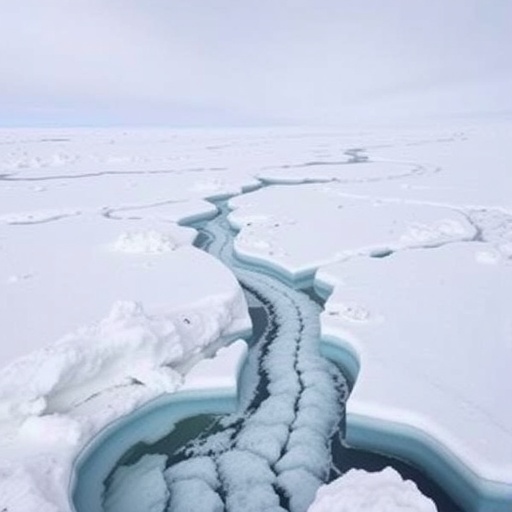
In a groundbreaking study that reshapes our understanding of ice sheet dynamics and their impact on global sea level rise, scientists have uncovered a significant mechanism whereby meltwater produced on the surface of Greenland’s ice sheet is partially halted in its path toward the ocean. This process—meltwater refreezing within the bare ice—serves as a natural brake on runoff, fundamentally altering predictions of how quickly the ice sheet may contribute to sea level increase. Published in Nature Communications, this research brings into sharp focus a vital, yet previously underappreciated, feedback within the Greenland ice system.
Greenland, one of the largest reservoirs of freshwater ice on the planet, has been a focal point for climate research due to its accelerating ice mass loss over recent decades. The conventional narrative has been straightforward: rising atmospheric temperatures cause more intense melting during summer, yielding vast quantities of surface meltwater that flow into the ocean, directly contributing to global sea level rise. However, this new work reveals that beneath the seemingly simple story lies a complex interplay of physical processes capable of modulating this meltwater flux.
At the heart of the discovery is the phenomenon of refreezing within the bare ice zone of the Greenland ice sheet. Unlike the more extensively studied firn layer—an intermediate snowpack stage where meltwater typically refreezes—bare ice was often assumed to allow meltwater to percolate rapidly downhill with minimal delay before reaching the ocean. This study overturns that assumption by demonstrating that refreezing also occurs directly in the bare ice, effectively trapping some of the meltwater and reducing net runoff volumes.
Using a combination of detailed field observations, remote sensing data, and sophisticated modeling approaches, the researchers quantified the extent to which meltwater refreezing alters runoff estimates. Their analysis revealed that refreezing within the bare ice could reduce runoff by a noteworthy percentage, a finding that demands recalibration of ice sheet hydrological models and their projections for sea level contributions. As the authors show, this process introduces an important positive feedback mechanism that could shift the timing and magnitude of meltwater drainage into the ocean.
Mechanistically, the process unfolds as meltwater generated at the surface infiltrates the porous and fractured bare ice. At certain depths, where temperatures drop below freezing during the summer diurnal cycle or due to insulation, this meltwater refreezes back into ice. This latent heat release during refreezing warms the surrounding ice, temporarily stabilizing the ice temperature profile and modulating further meltwater percolation. The consequences are twofold: less immediate runoff reaches meltwater channels, and the structural properties of the bare ice evolve, influencing both mechanical behavior and future meltwater pathways.
One of the challenges the research team faced was accurately representing these sub-surface refreezing processes within existing ice sheet models. Traditional models often treat the bare ice zone as a near-impermeable solid, allowing meltwater to either run off or be intercepted by localized melt ponds, but rarely capturing dynamic refreezing within the solid ice itself. By leveraging improved data assimilation techniques and incorporating thermodynamic adjustments, the team developed a more physically robust framework that illuminates the hidden complexity of ice sheet hydrology.
Beyond the immediate implications for understanding Greenland’s mass balance, the findings bear significant ramifications for projections of sea level rise under future climate scenarios. Current models might overestimate runoff volumes, thereby inflating anticipated contributions to oceanic water levels. Factoring in meltwater refreezing moderates these contributions, highlighting a previously overlooked buffer against rapid sea level acceleration. This subtle but powerful natural feedback strengthens the resilience of the ice sheet, albeit temporarily, in the face of climatic warming.
The spatial extent and temporal variability of this refreezing process were also key study components. Analysis of satellite imagery and in situ temperature profiles revealed that large portions of the bare ice zone participate in meltwater refreezing, particularly during early and late melt seasons when temperature conditions favor freeze-thaw cycles. This fine-scale temporal dimension adds crucial nuance to meltwater budget calculations, emphasizing that not all meltwater events translate immediately into runoff but undergo delayed and diffused transit.
Moreover, by comparing refreezing behavior across different sections of the ice sheet, the authors identified regional heterogeneity driven by factors such as surface slope, ice albedo, and localized microclimates. Areas with higher albedo and lower slope tend to foster more extensive refreezing, while steep and darkened regions present pathways favoring direct runoff. This spatial complexity underscores the necessity of high-resolution remote sensing combined with fieldwork to unravel the variable ice sheet responses to warming.
This revelation also invites reconsideration of the role of snow cover and firn layers in the Greenland melt system. Earlier conceptual models placed prime importance on firn as the primary refreezing medium during melt seasons. The new findings suggest a nested hierarchy of refreezing sites, with bare ice acting as an overlooked but crucial player alongside firn layers. Such insights call for integrated modeling frameworks that encompass this continuum of refreezing processes to accurately simulate ice sheet water budgets.
The study’s methodology itself is a milestone in cryospheric science. By integrating multidisciplinary tools—thermal sensors embedded within the ice, drone-based optical imaging, satellite surface temperature mapping, and advanced thermodynamic modeling—the research represents a synthesis of observational rigor and theoretical innovation. This holistic approach validates model predictions and strengthens confidence in forecasting capabilities, an essential advance as climate change accelerates ice sheet transformations.
Importantly, this work highlights that the Greenland ice sheet’s response to warming is not linear or uniform but influenced by intrinsic feedback processes emerging from meltwater-ice interactions. This reframes how scientists approach glacial hydrology, encouraging exploration of hidden controls that could be present in other ice masses worldwide. The implications extend to Antarctica and other glaciated regions, where similar melt-refreezing dynamics might exist but remain less explored.
From a policy and adaptation perspective, the discovery of meltwater refreezing acting as a mitigating factor in runoff generation introduces a crucial element in sea level rise risk assessments. Coastal planners and climate strategists rely heavily on accurate projections to design defenses and manage vulnerable environments. The refined understanding afforded by these new findings calls for adjustments in prediction intervals and uncertainty estimates, potentially buying valuable time for intervention strategies.
However, the investigators caution that the restraining effect of refreezing does not equate to a halt in ice loss. As global temperatures continue their upward trajectory, the balance may tip, reducing the extent or efficacy of refreezing processes. Warmer and longer melt seasons could exacerbate runoff despite current buffering effects, leading to accelerated ice mass loss in a non-linear fashion. Continuous monitoring and model refinement remain essential to track these evolving dynamics.
In essence, the discovery of meltwater refreezing within Greenland’s bare ice zone reveals a nuanced, dynamic process that tempers our expectations of future ice sheet meltwater contributions. It enriches the tapestry of glaciological knowledge by highlighting a previously hidden aspect that modulates runoff and, by extension, sea level rise forecasts. This insight underscores the multifaceted nature of climate change impacts on ice sheets and the urgent need to refine our scientific tools accordingly.
The implications for future research are vast. Understanding how refreezing processes interact with other factors—such as ice sheet structural integrity, subglacial hydrology, and ice flow velocity—will be a new frontier for studies aiming to unravel the full spectrum of Greenland ice sheet responses to climatic forcing. Collaboration between glaciologists, climate modelers, hydrologists, and remote sensing specialists will be paramount in advancing these integrated efforts.
In conclusion, the work by Cooper et al. constitutes a paradigm shift in how the cryosphere science community assesses Greenland’s meltwater dynamics. The identification and quantification of meltwater refreezing in bare ice not only recalibrate runoff estimates but deepen our appreciation for the inherent complexity and resilience of polar environments under climatic stress. It is a crucial piece of the puzzle as humanity grapples with understanding and mitigating the cascading consequences of global warming on Earth’s frozen frontiers.
Cite Scienmag News
Violet Maxwell. (September 12, 2025). Meltwater Refreezing Cuts Greenland Ice Sheet Runoff. Scienmag. https://scienmag.com/meltwater-refreezing-cuts-greenland-ice-sheet-runoff/
Violet Maxwell. "Meltwater Refreezing Cuts Greenland Ice Sheet Runoff." Scienmag, 12 September 2025, https://scienmag.com/meltwater-refreezing-cuts-greenland-ice-sheet-runoff/. Accessed 9 September 2026.
Violet Maxwell. "Meltwater Refreezing Cuts Greenland Ice Sheet Runoff." Scienmag. September 12, 2025. https://scienmag.com/meltwater-refreezing-cuts-greenland-ice-sheet-runoff/


