


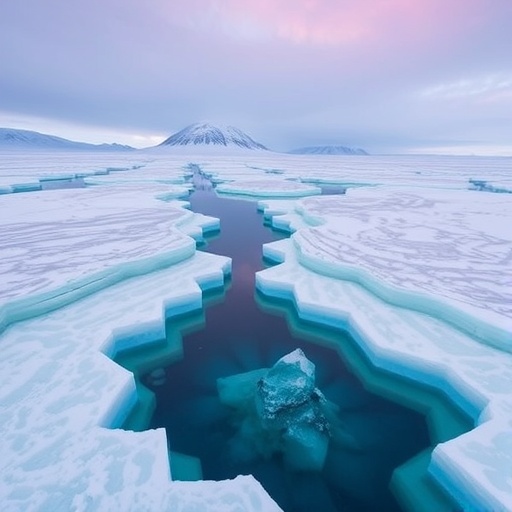
In the relentless march of climate change, the Greenland Ice Sheet stands as both a sentinel and a bellwether, its melting intimately tied to global sea level rise and the broader dynamics of Earth’s climate system. A recent groundbreaking study has illuminated a subtle yet significant mechanism influencing this melting process: the underestimated radiative effect of meltwater ponding on the ice sheet’s surface. These findings, published in Nature Communications, challenge longstanding assumptions and reveal critical feedbacks that could accelerate surface melting with profound consequences for climate projections and coastal communities worldwide.
The Greenland Ice Sheet, a colossal expanse spanning over 1.7 million square kilometers, is a dominant driver of global sea level fluctuations. As the climate warms, surface melting intensifies, generating pools of meltwater that accumulate in depressions across the ice surface. These meltwater ponds, often transient and seemingly innocuous, are now recognized as dynamic agents that alter the ice sheet’s energy balance in ways previously underestimated. Through advanced remote sensing and innovative radiative transfer modeling, the researchers meticulously quantified how these ponds modulate the reflection and absorption of solar radiation, revealing an amplification in melting processes.
At the heart of this research lies the fundamental physics of light and heat interaction with surface materials. Ice and snow naturally reflect a high percentage of incoming solar radiation, a property known as albedo, which modulates how much energy the surface absorbs. However, when meltwater ponds form, the local albedo decreases significantly. Water absorbs more solar energy than ice or snow, thereby trapping additional heat and accelerating local melting. The study demonstrates that existing models often overlook the spatial complexity and temporal persistence of ponding, thereby underestimating the extent to which these pools influence the ice sheet’s net radiative budget.
A pivotal insight from the research is the quantification of the radiative feedback mechanism driven by ponding. These melt ponds act as small, dark basins, capturing sunlight and increasing the surface temperature of the ice sheet. This increased absorption leads to enhanced localized melting, which in turn allows ponds to expand or new ones to form, establishing a self-reinforcing cycle. What complicates this feedback is the heterogeneity of pond distribution and evolution over time, which has historically posed a challenge for climate modelers attempting to integrate these effects into broader ice sheet simulations.
The researchers employed a combination of satellite observations, including high-resolution optical and thermal imagery, alongside field measurements captured during expeditions to the ice sheet. These complementary datasets enabled them to establish accurate pond coverage maps and temperature profiles. By integrating these empirical observations into state-of-the-art radiative transfer models, the team could simulate the energy exchanges at the ice surface with unprecedented precision. Their approach allowed for the isolation of the ponding effect from other melting factors such as atmospheric temperature, wind, and precipitation variability.
One of the surprising revelations was the temporal persistence of meltwater ponds throughout the melt season. Contrary to prior assumptions that ponds are ephemeral features quickly draining through the porous ice, many persistently occupy the surface, insulating the underlying ice and maintaining elevated absorption levels. This persistence not only prolongs the warming effect but also alters the physical properties of the ice sheet, potentially influencing ice flow dynamics and crevasse formation due to differential melting rates.
Furthermore, the study sheds light on the geographic variability of ponding effects. Particular regions of Greenland, especially those at mid-elevations where temperatures hover near the melting point, exhibit pronounced ponding phenomena. This spatial heterogeneity suggests that regional melt projections could be substantially revised, with some areas experiencing more rapid ice loss than previously estimated. Such refined spatial understanding is crucial for improving regional predictions of sea level rise contributions from Greenland.
In addition to illuminating current melt dynamics, the implications for future climate scenarios are profound. Climate models that fail to account for the amplified radiative effect of meltwater ponding risk underestimating the pace and magnitude of Greenland Ice Sheet mass loss. Given that meltwater ponding is expected to increase with rising temperatures, this feedback could represent a tipping point in the ice sheet’s response to climate warming. The research underscores the necessity of integrating meltwater ponding processes into global climate models to better forecast future sea level trajectories.
The methodologies developed in this study also open new avenues for remote monitoring of ice sheet dynamics. By exploiting satellite-borne spectral instruments and thermal sensors, scientists can now track melt pond formation, evolution, and radiative effects in near real-time. Such monitoring capabilities will greatly enhance the predictive power of ice sheet models and improve early warning systems for rapid ice loss events.
Beyond the direct climatic implications, the study has broader relevance for understanding cryospheric processes globally. Meltwater ponding is not unique to Greenland but occurs on other glaciated regions, including the Antarctic Peninsula and mountain glaciers worldwide. The insights gained here provide a framework for investigating how surface hydrology interacts with radiative forcing across different cryospheric environments, potentially refining our understanding of global freshwater inputs to the oceans.
Importantly, the findings highlight the interconnectedness of surface hydrology, energy balance, and ice dynamics. Melt ponds not only influence melting rates but also impact ice sheet structural integrity by lubricating the ice-bed interface and promoting mechanical fracturing. This multi-faceted interplay signifies that hydrological features, often overlooked in climate models, can have outsized effects on ice sheet stability.
The research team advocates for continued interdisciplinary collaboration, combining glaciology, atmospheric science, remote sensing, and modeling expertise to fully unravel these complex interactions. Such integrative approaches are vital to develop robust predictive frameworks capable of anticipating Greenland’s future in a warming world.
This study reignites urgent discussions about the vulnerability of polar ice masses. As meltwater ponding exacerbates radiative warming of the ice surface, the Greenland Ice Sheet may contribute more rapidly to sea level rise than previously recognized. Coastal megacities, island nations, and low-lying regions may face heightened risks, underscoring the critical need for climate mitigation and adaptation strategies informed by cutting-edge science.
In essence, meltwater ponds are no longer minor features in the cryosphere—they are dynamic, influential actors reshaping the radiation and melting balance of the Greenland Ice Sheet. Addressing this newfound feedback in climate projections is not merely an academic exercise; rather, it is a pressing imperative for global climate resilience.
The nuanced picture revealed by this study invites a reassessment of how we understand ice sheet responses to climate warming. Incorporating meltwater ponding into next-generation climate and sea level models will better capture the complexities of the Earth system, enhancing our capacity to predict the trajectory of global change. This revelation marks a pivotal step forward in glaciology and climate science, transforming our grasp of polar processes and their planetary consequences.
As meltwater ponds silently pool across Greenland’s vast frozen expanse, they cast a disproportionately large shadow on the future of our planet’s climate. Their underestimated radiative effect serves as a reminder that even seemingly small surface features can have transformative impacts, urging the scientific community and society at large to deepen our engagement with the subtle intricacies of a changing cryosphere.
Cite Scienmag News
Violet Maxwell. (September 12, 2025). Meltwater Ponding Amplifies Greenland Ice Sheet Radiative Impact. Scienmag. https://scienmag.com/meltwater-ponding-amplifies-greenland-ice-sheet-radiative-impact/
Violet Maxwell. "Meltwater Ponding Amplifies Greenland Ice Sheet Radiative Impact." Scienmag, 12 September 2025, https://scienmag.com/meltwater-ponding-amplifies-greenland-ice-sheet-radiative-impact/. Accessed 4 September 2026.
Violet Maxwell. "Meltwater Ponding Amplifies Greenland Ice Sheet Radiative Impact." Scienmag. September 12, 2025. https://scienmag.com/meltwater-ponding-amplifies-greenland-ice-sheet-radiative-impact/


