

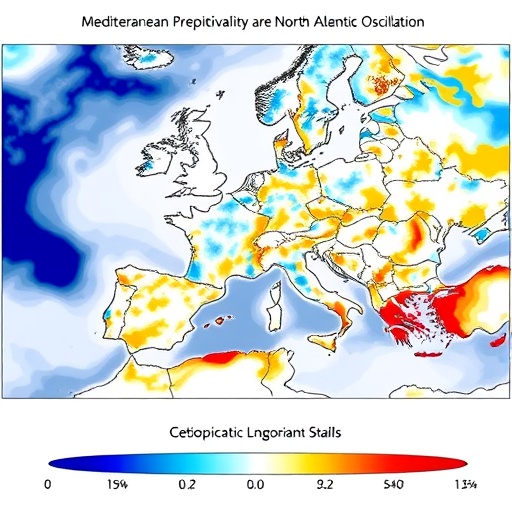
In recent years, the intricate dynamics of Mediterranean precipitation variability have garnered significant attention from climate scientists. A groundbreaking study led by Luppichini et al. (2025) profoundly enhances our understanding of this phenomenon, revealing that the fluctuations in rainfall across the Mediterranean region are influenced by a multitude of atmospheric mechanisms that extend far beyond the well-known North Atlantic Oscillation (NAO). This research paves the way for a more comprehensive grasp of the climate factors shaping rainfall patterns, thus unlocking vital information for ecology, agriculture, and water management in the Mediterranean basin.
The study meticulously analyzes atmospheric conditions that contribute to precipitation patterns in the Mediterranean, a region characterized by its unique climate and ecology. Traditionally, the NAO has been acknowledged as a primary driver of short-term weather variations in the area; however, Luppichini and colleagues unveil a much more complex web of relationships influencing atmospheric energetics. By leveraging sophisticated meteorological models, the researchers bridge gaps in our current understanding, showcasing that local precipitation cannot be solely attributed to NAO activity.
At the heart of the investigation lies an exploration of various atmospheric patterns that interact cyclically and sometimes chaotically, leading to changes in moisture transport and precipitation distribution. Particularly interesting is the identification of interactions between the subtropical high-pressure systems and mid-latitude cyclone activities, which are pivotal in shaping rain distribution across the Mediterranean. The study elucidates how these systems can diverge from traditional climatic expectations, leading to anomalous precipitation events that can have severe implications for regional ecosystems and human activities.
Furthermore, the authors contribute to the growing body of evidence suggesting that climate change plays a significant role in altering atmospheric dynamics. The evolving patterns of global warming have far-reaching effects on the frequency and intensity of extreme weather events. The Mediterranean already faces a myriad of climate-related challenges, from increased drought occurrences to flooding, and understanding how atmospheric mechanisms are shifting is crucial for forecasting future scenarios. The implications are profound as they inform agricultural practices and water resource management frameworks, given the Mediterranean’s reliance on stable and predictable precipitation for food production and water supply.
A novel aspect of Luppichini et al.’s work is the focus on long-term climate data, which reveals patterns not immediately observable in short-term analyses. By analyzing data spanning decades, the researchers identify subtle shifts in atmospheric interactions that hint at an overall trend. These trends are crucial for making future climate predictions, providing policymakers with the necessary information to adapt and mitigate the impacts of climate variability on vulnerable communities in the region.
The study employs advanced statistical methodologies to dissect the correlations between various atmospheric factors and precipitation anomalies. The rigorous approach allows for a more nuanced understanding of how unusual weather events arise. Statistical analyses reveal the surprising nature of these relationships, confirming that factors like tropical-extratropical interactions and stratosphere-troposphere coupling significantly influence precipitation outcomes in the Mediterranean.
Medieval Climate Anomalies are also revisited in this context. The authors juxtapose historical data with modern observations to argue that the mechanisms driving current precipitation patterns are not entirely new but rather exacerbations of long-established atmospheric behaviors. This revelation not only underscores the importance of understanding historical climate variability but also emphasizes the lessons that can be gleaned from past weather patterns to prepare for future variability.
What stands out in this collective body of research is the integration of interdisciplinary approaches. Luppichini and colleagues combine atmospheric science, historical climatology, and advanced computational modeling to offer a comprehensive view of the climate mechanisms at play. This integration stands as a testament to how collaborative approaches in science can yield richer, more holistic insights that might otherwise be overlooked.
One cannot overstate the relevance of Luppichini et al.’s findings in light of ongoing climate discourse. The research adds crucial evidence to the argument that climate change is a multifaceted challenge that necessitates multifaceted solutions. As precipitation patterns in the Mediterranean grow erratic, communities must adopt adaptive strategies to manage water resources, safeguard agricultural productivity, and protect ecological systems that are sensitive to these variations.
This groundbreaking work is bound to provoke discussion among climate scientists, policy formulators, and stakeholders across Mediterranean nations. As the findings resonate within the scientific community and beyond, they highlight an urgent need for collaborative international efforts to address the impending challenges associated with climatic shifts in one of the most vital regions of the world.
In the realm of public engagement, the communication of these findings will be key. As awareness of the complexities surrounding climate change deepens, scientists will be tasked with distilling these intricate analyses into accessible information for the general public. A well-informed society is better equipped to advocate for sustainable policies and practices that can mitigate the impacts of variable precipitation patterns in the Mediterranean.
In summary, the study conducted by Luppichini et al. is a crucial contribution to the broader understanding of climatic variability in the Mediterranean. By shining a light on the intricate atmospheric mechanisms at play, the authors facilitate a deeper understanding of how such dynamics influence the region’s precipitation patterns. Their work serves as a vital resource for researchers, policymakers, and communities alike, emphasizing the need for proactive measures in an age of climate uncertainty.
As ensuing discussions continue, the hope is that this research will inspire further studies, in-depth analyses and ultimately, greater resilience against the climatic challenges that lie ahead. While rainfall variation in the Mediterranean may seem like a localized concern, its implications ripple through international economies, ecosystems, and societies at large. Thus, the urgency of Luppichini et al.’s research echoes far beyond the confines of academia, urging all stakeholders to pay heed to the future of Mediterranean weather patterns.
Subject of Research: The intricate dynamics of Mediterranean precipitation variability and atmospheric mechanisms beyond the North Atlantic Oscillation.
Article Title: Mediterranean precipitation variability is driven by complex atmospheric mechanisms beyond the North Atlantic Oscillation.
Article References:
Luppichini, M., Natali, S., Columbu, A. et al. Mediterranean precipitation variability is driven by complex atmospheric mechanisms beyond the North Atlantic Oscillation.
Commun Earth Environ (2025). https://doi.org/10.1038/s43247-025-03104-4
Image Credits: AI Generated
DOI: 10.1038/s43247-025-03104-4
Keywords: Mediterranean, precipitation variability, atmospheric mechanisms, North Atlantic Oscillation, climate change, weather patterns.


