

Wednesday, August 19, 2026
Science
No Result
View All Result
  • Login
  • HOME
  • SCIENCE NEWS
  • CONTACT US
  • HOME
  • SCIENCE NEWS
  • CONTACT US
No Result
View All Result
Scienmag
No Result
View All Result
Home Science News Chemistry

Mechanical strain creates chirality

July 29, 2026
in Chemistry
Reading Time: 3 mins read
0
Mechanical strain creates chirality

Mechanical strain creates chirality

65
SHARES
587
VIEWS
Share on FacebookShare on Twitter
ADVERTISEMENT
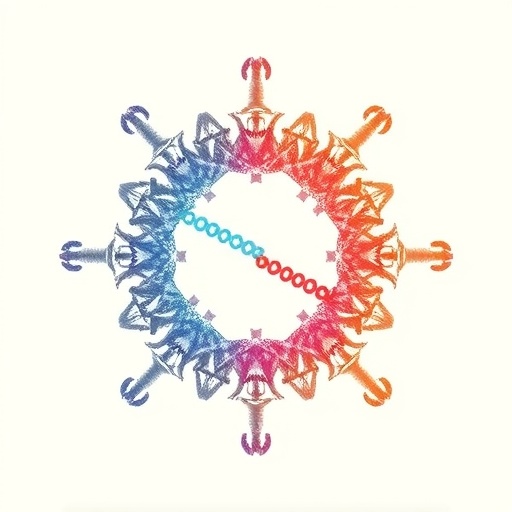
Mechanical strain illustration
image: Mechanical strain can deform a solid at the atomic level, forming a chiral structure. 

view more 

Credit: © Jörg Harms, Zhiyang Zeng (MPSD)

Chirality is an important property of matter. It is defined as a property of objects that cannot be superimposed to their mirror images through any combination of rotations or translations, much like the distinct left and right hands. In chiral crystals, the spatial arrangement of atoms gives rise to a specific handedness, with the crystal structure twisting along one propagation direction in a way similar to a screw. As a consequence, propagation in one direction, for example of an electrical current, may experience different resistance than that propagating in the opposite direction. This effect also influences certain chemical reactions and biological processes, which select for one specific handedness. In this sense, the ability to control chirality on demand, turning a right-handed structure into a left-handed one, is very desirable. 

Yet “unlike electrical polarization or magnetization, chirality has lacked a general physical handle for external control,” notes Zhiyang Zeng, first author of this study. The MPSD researchers have now shown that mechanical strain provides precisely such a handle. Rather than synthesizing a chiral material, they begin with a crystal that is not chiral in its unstrained state. Applying strain rearranges the positions of the atoms in the crystal just enough to create a left- or right-handed structure.

To demonstrate this effect, the team monitored the appearance of the crystal’s optical activity – a characteristic signature of chirality – while applying controlled mechanical strain. Remarkably, the handedness of the induced chiral state is determined by the strain conditions. Tensile and compressive strain generate opposite handedness, while applying strain along different crystal directions provides another way to select the resulting chiral state. “Because the deformation is reversible, the induced chirality can be generated, removed, and selected repeatedly,” explains Michael Först, co-author of this publication.

Beyond demonstrating the effect experimentally, the team established a theoretical framework that reveals when crystal symmetry allows this piezochiral effect to occur. They used it to compile an open-access database of candidate materials ( making it possible for researchers worldwide to search for and explore piezochiral crystals.

This work establishes a new strategy for engineering chirality. Instead of being permanently fixed by crystal growth or chemical synthesis, chirality can now be generated, controlled, and switched on demand in an originally achiral material. This is opening new opportunities to control mechanically reconfigurable materials. 

“We termed this phenomenon the piezochiral effect,” says Andrea Cavalleri, who led the research in Hamburg (in collaboration with Paolo Radaelli from the University of Oxford). “It enables one to induce chirality in substrates for a large variety of thin films or in bulk materials,  and may enable strategies to, for example, create new types of chiral properties such as superconductivity”.

This work received financial support from the Deutsche Forschungsgemeinschaft via the Cluster of Excellence ‘CUI: Advanced Imaging of Matter’. The MPSD is a member of the Center for Free-Electron Laser Science (CFEL), a joint enterprise with DESY and the University of Hamburg.


Journal

Nature

DOI

10.1038/s41586-026-10845-5

Method of Research

Experimental study

Subject of Research

Not applicable

Article Title

The piezochiral effect

Article Publication Date

29-Jul-2026

Media Contact

Marius Hoffmann

Max Planck Institute for the Structure and Dynamics of Matter

pr@mpsd.mpg.de

Office: 8998 88044

Journal

Nature

DOI

10.1038/s41586-026-10845-5

Method of Research

Experimental study

Subject of Research

Not applicable

Article Title

The piezochiral effect

Article Publication Date

29-Jul-2026

Tags: atomic arrangement and chiralityatomic deformation and molecular chiralityatomic-level deformation in solidschiral crystal structureseffects of mechanical stress on material propertieshandedness in materialsinfluence of mechanical forces on crystal symmetrylong-tail keywords related to chiral materialsmechanical strain-induced chiralitymirror image non-superimposability in matterscrew-like crystal twistingstrain-induced material properties
Share26Tweet16
Previous Post

Okafor named president-elect of ACVPM Epidemiology Specialty

Next Post

Donor cord blood composition may influence CAR NK cell therapy outcomes

Related Posts

Dynamic duo weaves hierarchical DNA materials using two classes of biomolecular nanomachines
Chemistry

Dynamic duo weaves hierarchical DNA materials using two classes of biomolecular nanomachines

August 19, 2026
Generating and transferring nitrenes enables unnatural biosynthesis in living cells
Chemistry

Generating and transferring nitrenes enables unnatural biosynthesis in living cells

August 19, 2026
KAIST Transforms Troublesome Protons into Battery Energy-Storage Resources
Chemistry

KAIST Transforms Troublesome Protons into Battery Energy-Storage Resources

August 19, 2026
Tuning Endergonic Triplet Photosensitization Enables Bicyclo[1.1.0]butane–Alkene Cycloadditions
Chemistry

Tuning Endergonic Triplet Photosensitization Enables Bicyclo[1.1.0]butane–Alkene Cycloadditions

August 19, 2026
New plastic vaporizes when heated, then reforms upon cooling
Chemistry

New plastic vaporizes when heated, then reforms upon cooling

August 18, 2026
SUNY Chancellor King Announces Simons Empire Faculty Fellowship Recipients
Chemistry

SUNY Chancellor King Announces Simons Empire Faculty Fellowship Recipients

August 18, 2026
Next Post
Donor cord blood composition may influence CAR NK cell therapy outcomes

Donor cord blood composition may influence CAR NK cell therapy outcomes

  • Mothers who receive childcare support from maternal grandparents show more

    Mothers who receive childcare support from maternal grandparents show more parental warmth, finds NTU Singapore study

    27656 shares
    Share 11059 Tweet 6912
  • University of Seville Breaks 120-Year-Old Mystery, Revises a Key Einstein Concept

    1061 shares
    Share 424 Tweet 265
  • Bee body mass, pathogens and local climate influence heat tolerance

    682 shares
    Share 273 Tweet 171
  • Researchers record first-ever images and data of a shark experiencing a boat strike

    546 shares
    Share 218 Tweet 137
  • Groundbreaking Clinical Trial Reveals Lubiprostone Enhances Kidney Function

    531 shares
    Share 212 Tweet 133
Science

Embark on a thrilling journey of discovery with Scienmag.com—your ultimate source for cutting-edge breakthroughs. Immerse yourself in a world where curiosity knows no limits and tomorrow’s possibilities become today’s reality!

RECENT NEWS

  • Bedrock Type Shapes Forest Population Responses to Drought
  • Chemigenetic Biosensor Tracks Endogenous Ras Activity in Living Cells During Drug Research
  • Chronic Kidney Disease in Women: Global Burden and Metabolic-Cardiovascular Connections
  • Large Language Models Win Gold at International Astronomy and Astrophysics Olympiad

Categories

  • Agriculture
  • Anthropology
  • Archaeology
  • Athmospheric
  • Biology
  • Biotechnology
  • Blog
  • Bussines
  • Cancer
  • Chemistry
  • Climate
  • Earth Science
  • Editorial Policy
  • Marine
  • Mathematics
  • Medicine
  • Pediatry
  • Policy
  • Psychology & Psychiatry
  • Science Education
  • Social Science
  • Space
  • Technology and Engineering

Subscribe to Blog via Email

Enter your email address to subscribe to this blog and receive notifications of new posts by email.

Join 5,150 other subscribers

© 2025 Scienmag - Science Magazine

Welcome Back!

Login to your account below

Forgotten Password?

Retrieve your password

Please enter your username or email address to reset your password.

Log In
No Result
View All Result
  • HOME
  • SCIENCE NEWS
  • CONTACT US

© 2025 Scienmag - Science Magazine

Discover more from Science

Subscribe now to keep reading and get access to the full archive.

Continue reading
