

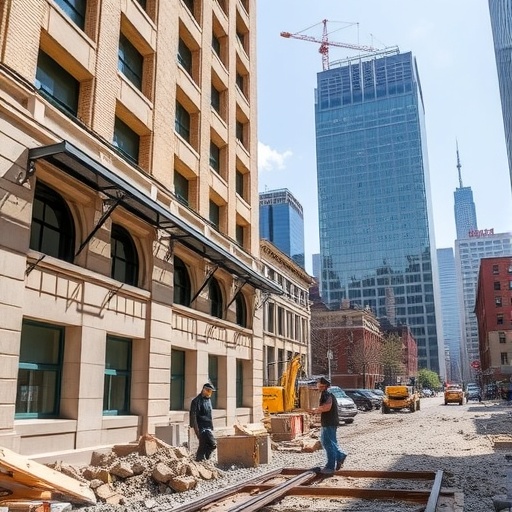
In a groundbreaking study set to be published in the esteemed journal “Earthquake Engineering and Engineering Vibration,” researchers M. Kamal, M. Inel, and E. Deniz have meticulously investigated the seismic gap distance between adjacent reinforced concrete (RC) buildings. Their work sheds crucial light on one of the most significant concerns in urban planning and safety: the risk of floor-to-column pounding during seismic events. This phenomenon occurs when two buildings sway during an earthquake, potentially leading to disastrous structural failures that endanger lives.
Recent seismic events have illuminated the vulnerabilities inherent in urban landscapes, especially where parallel structures exist. The researchers propose that understanding and quantifying the seismic gap distance can significantly mitigate these risks. This study aims to provide a comprehensive analysis on how the distance between buildings should be defined to minimize damage from such impacts. The gap distance acts as a buffer, absorbing the kinetic energy generated during an earthquake and protecting the structures from direct collisions.
To approach this investigation, Kamal and colleagues employed advanced analytical models that simulate various seismic scenarios. Utilizing historical earthquake data, they evaluated how different gap distances affect the likelihood of pounding. The results underscore an urgent need for engineering adaptations: without proper specifications for seismic gaps, adjacent buildings remain perilously close, exposing them to severe impacts during ground motion.
The heart of this research revolves around identifying the optimal seismic gap. The authors emphasize that this is not a one-size-fits-all solution; instead, the ideal distance must consider several variables, including the height and mass of the buildings, soil characteristics, and regional seismic activity. By developing a dynamic model that accounts for these factors, the researchers successfully illustrated how specific calculations lead to more resilient urban architectures.
The implications of their findings are profound, especially in densely populated metropolitan areas. As cities expand and older structures remain largely unchanged, the probability of inter-building collisions grows. Kamal’s work serves as a clarion call for architects and engineers to incorporate seismic gap considerations into building codes and planning practices decisively.
Moreover, the study advocates for a paradigm shift in how structural safety is quantified. Instead of merely adhering to past parameters, Kamal and his team suggest a proactive approach that anticipates future seismic challenges. This forward-thinking perspective is particularly vital in regions prone to earthquakes, where the stakes are not just theoretical but can result in catastrophic loss of life and property.
The researchers also delve into construction practices that could enhance building resilience against seismic events. They argue for the integration of innovative materials and construction techniques that can withstand not only vertical loads but lateral forces caused by seismic activity. This multifaceted approach underscores the idea that structural resilience is intrinsically linked to the gaps that separate buildings, enhancing overall urban safety and sustainability.
This research also raises public awareness about the often-overlooked details that contribute to structural integrity. While many discussions about earthquake preparedness focus on emergency responses and public safety protocols, Kamal’s work pushes the discourse deeper into the engineering realm. It invites policymakers and stakeholders to appreciate the engineering calculations that safeguard public infrastructure.
Turning to the methodologies employed, the researchers utilized a combination of experimental and computational approaches. They conducted simulations that replicated various earthquake magnitudes and building configurations to validate their findings. This rigorous analysis reinforces the credibility of their conclusions, suggesting a robust framework for future studies in this domain.
As the research gains attention, it holds the potential to influence international building codes and safety regulations. The introduction of new guidelines focusing on seismic gap distances could revolutionize how buildings are designed, offering a layer of protection previously overlooked. The acknowledgment of these gaps as critical safety features, rather than mere spaces, could prompt a significant shift in architectural design philosophy.
The dissemination of this research is expected to engage not only the academic community but also a broader audience concerned with urban safety and disaster preparedness. The authors vision an engaging public discussion about the importance of engineered spaces that facilitate not only aesthetic considerations but also safety in the face of natural disasters.
In conclusion, Kamal, Inel, and Deniz’s investigation represents a pivotal moment in understanding earthquake dynamics and architectural safety. Through their groundbreaking research, they highlight a glaring need for innovation in urban design—one that prioritizes resilience and safety above all. As we look to the future of urban environments, their work serves as a beacon of hope, guiding us towards safer, more resilient cities.
This study opens pathways for future research, encouraging further exploration of the relationships between structural design, urban zoning laws, and public safety initiatives. The dialogue sparked by their findings may lead to collaborative efforts among engineers, architects, and policymakers, creating a unified front in the fight against seismic hazards.
As this research hits the ground running, it’s clear that the conversation around earthquake resilience is far from over. The potential for viral impact and widespread adoption of these crucial findings is significant, promising a future where urban spaces are not only designed for beauty and function but also for safety and resilience in the face of nature’s unpredictability.
Subject of Research: Seismic gap distance between adjacent reinforced concrete (RC) buildings.
Article Title: Determination of seismic gap distance between adjacent RC buildings with potential floor-to-column pounding.
Article References:
Kamal, M., Inel, M. & Deniz, E. Determination of seismic gap distance between adjacent RC buildings with potential floor-to-column pounding.
Earthq. Eng. Eng. Vib. 24, 1067–1087 (2025). https://doi.org/10.1007/s11803-025-2358-9
Image Credits: AI Generated
DOI:
Keywords: seismic gap, reinforced concrete buildings, earthquake resilience, structural safety, urban planning.


