


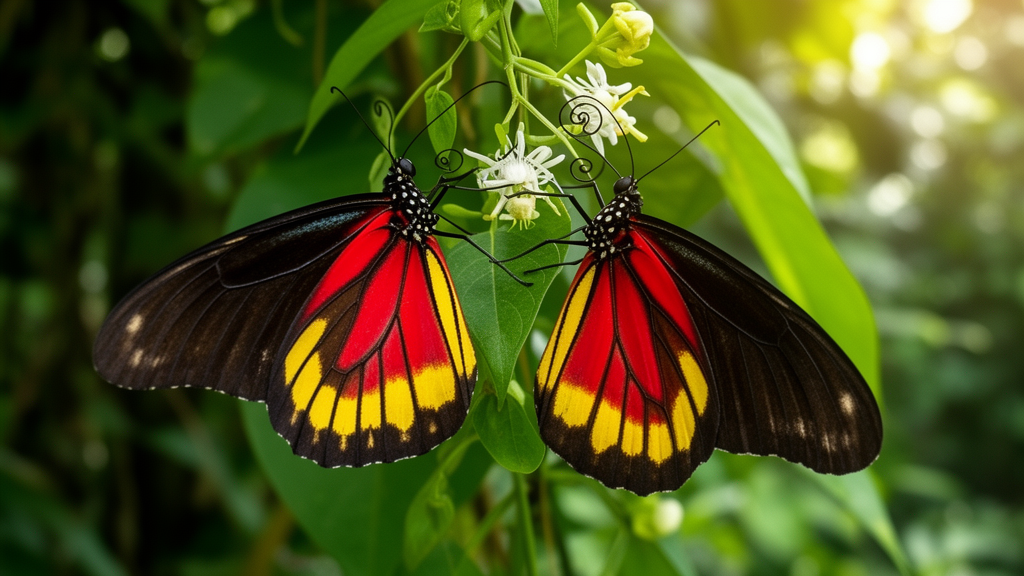
In the rainforests of Central and South America, the longwing butterflies of the genus Heliconius have become evolutionary icons, celebrated for their vivid warning colours and their remarkable capacity for mimicry. Yet the bold patterns painted on their wings tell only part of the story. A new study, published in Nota Lepidopterologica, has taken a closer look at the geometry of the wings themselves, and its findings suggest that the forces sculpting these insects’ flight apparatus are more tangled, and more intriguing, than previously appreciated. By combining geometric morphometrics with an analysis of mating behaviour and mimicry, researchers have uncovered a complex interplay between natural selection, sexual selection and shared evolutionary history in the design of Heliconius wings.
Flight is among the most energetically expensive activities any animal can undertake, and for butterflies it underpins nearly every aspect of survival and reproduction, from foraging and predator evasion to courtship and egg laying. Wing shape and size determine aerodynamic efficiency, manoeuvrability and speed, which in turn shape an individual’s behavioural repertoire and fitness. Evolutionary theory predicts that wing morphology should therefore be tuned to the specific flight demands placed on each species and each sex: females carrying heavy loads of eggs and ovarioles might benefit from designs that reduce the cost of takeoff, while males engaged in prolonged courtship displays might evolve shapes that maximise flight efficiency during these costly performances.
To test these ideas, the researchers analysed 203 specimens representing eleven Heliconius species, with nine individuals of each sex per species, using digital images of the right forewing taken from museum collections at the Universidad Nacional Autónoma de México and from freshly collected individuals near Xalapa, Mexico. Using the landmark-based technique of geometric morphometrics, they recorded the positions of five anatomical landmarks and nine semi-landmarks along the wing contour, then applied Procrustes superimposition to strip away differences in size and orientation, leaving pure shape information. Centroid size served as a measure of overall wing dimensions, and a suite of statistical tools, including Procrustes ANOVA, canonical variate analysis, thin plate spline visualisation and morphological disparity tests, allowed the team to disentangle the contributions of mating system, sex and clade membership to wing shape variation.
The genus Heliconius offers an unusually clean experimental system for such questions. Its species are sexually monomorphic in colouration, yet they divide unambiguously into two mating systems, each confined to a distinct clade. Pupal mating species, which form a monophyletic group within the Heliconiini, are characterised by males that locate a female pupa, follow its development and initiate mating before the adult female has even emerged. Non-pupal mating species, by contrast, employ the more typical strategy of courting flying adults, with males patrolling or perching in search of receptive females. Crucially, these mating systems are not correlated with differences in habitat, foraging pattern, oviposition preferences or geographic distribution, meaning that species from both clades face broadly similar ecological pressures and predation intensities. Any consistent differences in wing shape between the two groups therefore point more strongly to sexual selection than to natural selection driven by environmental context.
The results were striking. Procrustes ANOVA revealed significant effects on wing shape from all three main factors: mating system, sex and clade membership, with mating system exerting the strongest influence. Canonical variate analysis confirmed that males and females of both mating systems differ significantly in wing shape, and thin plate spline deformation grids showed that pupal mating males possess forewings that are more elongated and narrower than those of their non-pupal relatives. This slender, high-aspect-ratio design is associated with more efficient flight and improved manoeuvrability, traits that would serve a male well as he hovers near a pupa to assess the receptivity of the developing female inside, an energetically demanding form of flight that demands precise control and rapid directional changes.
Non-pupal mating males, in contrast, display wider and shorter forewings, a configuration that increases wing loading and airspeed, potentially at greater energetic cost, but which suits the demands of actively searching for and courting adult females in continuous flight. Previous work on butterfly mating strategies has distinguished between patrolling males, which invest in endurance and flight efficiency, and perching males, which favour acceleration and speed. The Heliconius data suggest that the pupal mating strategy, an evolutionary innovation that arose only once in the tribe, has driven its own distinctive wing design, one that enhances the hovering and acrobatic displays central to this unusual reproductive behaviour. Evidence from earlier studies also indicates that longer forewings confer advantages in male-male competition across pupal mating species, directly linking wing geometry to mating success.
Perhaps the most unexpected finding concerns the females. Despite the pronounced differences between males of the two mating systems, females from both clades showed remarkably similar wing shapes and low morphological disparity, a pattern that was statistically non-significant between groups. The researchers interpret this as evidence that there is no strong genetic correlation between the sexes in Heliconius, unlike in many other Lepidoptera. Instead, female wing design appears to reflect an optimal solution to a shared set of pressures: counterbalancing the weight of a heavier abdomen loaded with eggs, and meeting the morphological demands of locating oviposition hosts. In species that show no obvious sexual dimorphism in colouration, the sexes nonetheless diverge sharply in the geometry of their wings, each shaped by its own reproductive role.
Natural selection, however, has not been idle. When the team compared wing shapes across four groups, two Müllerian co-mimic pairs and two sets of non-mimetic species, they found a clear mimetic effect. The wing shape of the erato-melpomene pair closely resembled that of the sapho-cydno pair, and both mimetic pairs were significantly different from the non-mimetic groups, even though some of these species belong to the same subclade. This convergence in wing shape, occurring between species from different evolutionary lineages that share warning colour patterns, suggests that natural selection for predator avoidance extends beyond colouration to the physical architecture of the wing itself. Similar wing shapes may underpin the previously described phenomenon of locomotor mimicry, in which co-mimetic species converge not just in appearance but in flight biomechanics, including centre of mass, wing mass and wing-beat frequency, thereby reinforcing the warning signal presented to avian predators.
Taken together, the findings identify sexual selection, acting through mating systems and sex-specific reproductive pressures, as the predominant force shaping wing shape dimorphism in Heliconius, while natural selection drives convergence among mimetic pairs. The study’s authors emphasise that wing design in these butterflies is not the product of any single selective pressure but rather the outcome of multiple forces acting independently, synergistically or antagonistically, constrained by evolutionary history and biomechanical limits. They note that future work should include aerodynamic analysis to quantify how these morphological variations translate into differences in flight performance, and phylogenetic comparative studies across the wider Heliconiini to determine whether wing shape is truly independent of evolutionary history in this group.
For a genus that has long served as a textbook example of adaptive radiation and mimicry, the new results add a subtle but significant layer to the story. The wings of Heliconius are not merely billboards for warning colouration; they are finely tuned instruments whose geometry reflects the competing demands of courtship, egg carrying and predator evasion. As researchers continue to probe the relationship between form, function and fitness in these butterflies, the interplay between sexual and natural selection revealed here offers a compelling reminder that even the most familiar evolutionary narratives can harbour unexpected complexity when examined through the right lens.
Subject of Research: Wing shape evolution in Heliconius butterflies in relation to mating systems, sexual dimorphism and Müllerian mimicry
Article Title: Complex interspecific and intersexual patterns of wing design in Heliconius butterflies
Article References: Mendoza-Cuenca, L. (2025). Complex interspecific and intersexual patterns of wing design in Heliconius butterflies. Nota Lepidopterologica, 48, 229-241. https://doi.org/10.3897/nl.48.148344
Image Credits: AI Generated
DOI: 10.3897/nl.48.148344
Keywords: Heliconius, wing shape, geometric morphometrics, mating systems, pupal mating, Müllerian mimicry, sexual selection, natural selection, Lepidoptera, flight performance, sexual dimorphism, butterflies
Cite Scienmag News
Gavin Prescott. (October 17, 2026). Mating Systems and Mimicry Shape the Wings of Heliconius Butterflies. Scienmag. https://scienmag.com/mating-systems-and-mimicry-shape-the-wings-of-heliconius-butterflies/
Gavin Prescott. "Mating Systems and Mimicry Shape the Wings of Heliconius Butterflies." Scienmag, 17 October 2026, https://scienmag.com/mating-systems-and-mimicry-shape-the-wings-of-heliconius-butterflies/. Accessed 17 October 2026.
Gavin Prescott. "Mating Systems and Mimicry Shape the Wings of Heliconius Butterflies." Scienmag. October 17, 2026. https://scienmag.com/mating-systems-and-mimicry-shape-the-wings-of-heliconius-butterflies/


