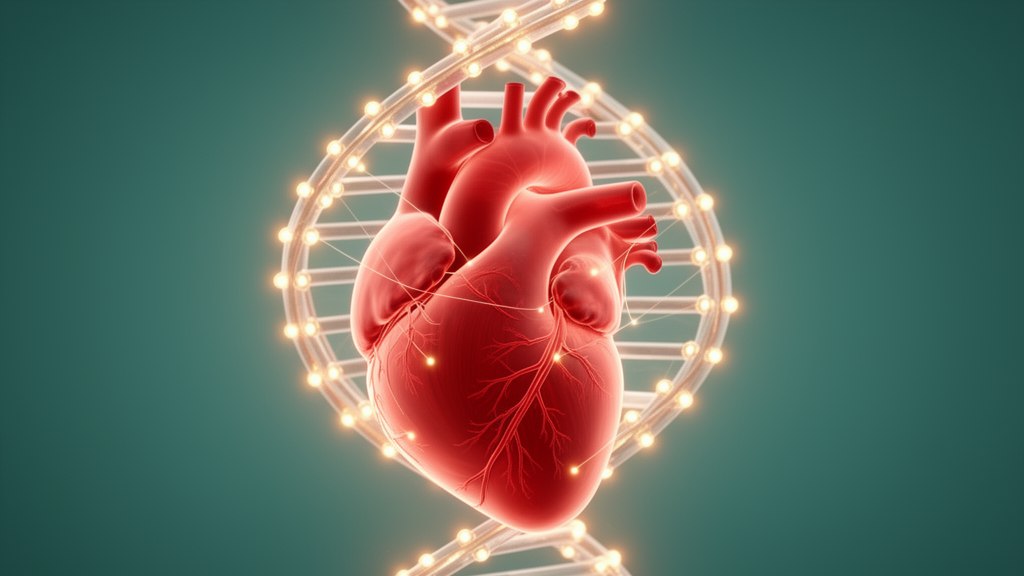
An international collaboration led by Vanderbilt Health researchers has created a functional “map” of 1,757 genetic variations that can trigger a life-threatening heart rhythm disorder called long QT syndrome, according to a study published in the journal Circulation. Using an innovative, high-throughput technique, the team measured the effects of nearly all possible variations in a key cardiac ion channel gene, converting thousands of previously ambiguous genetic test results into evidence that clinicians can act on. The work may enable more precise diagnosis and treatment of a disorder that causes sudden death in about 3,500 people in the United States each year, many of them struck down in the prime of life.
Long QT syndrome, or LQTS, is a heart rhythm disorder that affects the electrical system of the heart. It is named for its primary characteristic, an abnormally long QT interval on the electrocardiogram, and it can trigger fast, chaotic heartbeats that can cause fainting or even death. The condition is congenital, meaning it is inherited, and the most common cause is loss-of-function variants in a potassium channel gene called KCNQ1. That gene encodes a protein that regulates the flow of potassium ions during each heartbeat, a process that is central to the heart’s electrical stability.
Determining how KCNQ1 variants affect normal ion channel function is critical to developing precision medicine approaches to prevent arrhythmia. Yet the clinical impact of at least 70 percent of variants identified through genetic testing is not fully understood, and there are too many of them to assess using standard laboratory techniques. “We’re sequencing more and more people every year and finding new mutations faster than we can study them,” said Vanderbilt Health geneticist Andrew Glazer, PhD, the paper’s corresponding author. As a result, most newly discovered mutations are labeled “variants of uncertain significance,” a designation that leaves patients and their physicians without clear guidance on whether a finding is dangerous or harmless.
The traditional way to test whether a particular variant is likely to cause disease is to determine the function of the mutated ion channel protein in a laboratory-grown cell. But that approach, which isolates one variant at a time, can take months or years, Glazer said. In this study, the researchers instead used an emerging high-throughput genetic technique called multiplexed assay of variant effect, or MAVE, to generate and measure the functional impact of nearly all possible variations, more than 13,000, in the amino acid sequence of the ion channel protein encoded by KCNQ1. Rather than interrogating each mutation individually, the method allows thousands of variants to be evaluated simultaneously in a single experimental framework.
The paper’s first author, Lorena Harvey, PhD, a staff scientist in the Roden and Glazer labs, led the high-throughput experimental work and analyzed how the findings relate to disease risk. “It’s one thing to identify a genetic variant in a patient, but it’s another to understand what that variant actually does and whether it could increase their risk of disease,” Harvey said. “Our work helps bridge that gap by providing experimental evidence for thousands of variants that we previously knew very little about.”
Of the variants studied, 1,757 demonstrated strong pathogenic evidence, while 6,600 showed moderate benign evidence, the researchers reported. The map effectively sorts a long list of genetic unknowns into categories backed by direct experimental measurements of how each variant alters the function of the potassium channel protein.
The researchers then scoured the matching electronic health records of more than 700,000 people whose sequenced DNA is stored in three large biobanks, including Vanderbilt Health’s BioVU. They found that patients with loss-of-function variants in their genetic sequence also had been diagnosed with a prolongation of the long QT interval, providing an independent clinical check that the laboratory measurements correspond to real-world disease indicators. By linking functional data to de-identified health records at scale, the study connected what a variant does in a test tube with what it does in the people who carry it.
“Our hope is that now that we have this map, we can find a broader set of people who have this disease and get them treated,” said Glazer, who is Assistant Professor of Medicine in the Division of Genetic Medicine and Clinical Pharmacology and the paper’s co-senior author with Dan Roden, MD, the Sam L. Clark, MD, PhD Professor of Medicine and Senior Vice President for Personalized Medicine at Vanderbilt Health. “With proper management, … you can really reduce the risk of sudden death.” “Our hope is that with our dataset … there will be less uncertainty going forward when patients are found with a new variant, because we already have some functional data available,” Glazer added. “This disease is pretty treatable.”
Treatment options for long QT syndrome are well established once the condition is identified. Cardiovascular medications called beta blockers are highly effective, and patients are also advised to avoid certain drugs that can trigger an abnormal heart rhythm. But, Glazer noted, “You really want to find it ahead of time.” The value of a comprehensive variant map lies precisely in that early identification: when a genetic test reveals a KCNQ1 variant whose dangerousness was previously unknown, the new dataset can indicate whether it belongs among the strongly pathogenic variants or the moderately benign ones, allowing clinicians and families to make informed decisions before symptoms appear.
“It’s becoming clear that using genetic information to care for patients will be an increasing part of the way we practice medicine,” said Roden, who is internationally known for his research on arrhythmias and variability in drug responses. “One of the barriers to that vision is sorting out which variants are especially dangerous and which can be ignored,” he said. “That’s the challenge we addressed in this study for one key gene where variants can cause serious or even fatal heart rhythm abnormalities.” The study was conducted by the CardioVar Consortium, a multi-institutional effort led by Roden and his colleagues to map genetic variations affecting heart function. The effort was supported by an $8.2 million grant awarded in 2022 by the National Heart, Lung, and Blood Institute of the National Institutes of Health, with additional support from the NIH, the American Heart Association, and the Medical Research Future Fund: Genomics Health Futures Mission.
The methods developed in the study are designed to extend well beyond a single gene. “Now that we’ve gotten these methods working, we can apply them to a much broader set of genes that impact important diseases,” Glazer said. “That’s what we’re working on next … to (investigate) not just one or two genes over a decade, but several per year.” Glazer also pointed to the unique research environment that made the work possible. “Vanderbilt Health may be one of the only places in the world that could have led this study,” he said, citing the institution’s focus on arrhythmia biology through the Vanderbilt Center for Arrhythmia Research and Therapeutics, directed by Bjorn Knollmann, MD, PhD, the William Stokes Professor of Experimental Therapeutics and a co-author of the paper. Coupled with BioVU, the world’s largest repository of genetic material linked to de-identified electronic health records that is based at a single academic center, “it made this the perfect place to do this experiment,” he added. Other Vanderbilt coauthors included Ellen Osborn, Megan Lancaster, Jeremy Smith, Temidayo Abe, Ayesha Muhammad, Rose Kannankeril, Tao Yang, Maria Calandranis, Daniel Blackwell, Richard Dolder III, Jessa Aldridge, Matthew Fleming, Marcia Blair, Eduardo Soria, Giovanni Davogustto, and Brett Kroncke, while collaborators from Stanford University, Harvard Medical School, the University of Pittsburgh, The Ohio State University, and institutions in Australia also contributed to the study.
Subject of Research: Functional mapping of KCNQ1 gene variants that cause long QT syndrome and sudden cardiac death
Article Title: Vanderbilt Health-led team maps gene variants that can cause sudden death
Article References: Vanderbilt Health-led team maps gene variants that can cause sudden death. Original publication (Bibliographic details unavailable.)
Image Credits: AI Generated
DOI: Not provided
Keywords: long QT syndrome, KCNQ1, genetic variants, sudden cardiac death, multiplexed assay of variant effect, variant of uncertain significance, precision medicine, BioVU, arrhythmia, Vanderbilt University Medical Center, Circulation, cardiac ion channels
Cite Scienmag News
Juliet Wilcox. (October 28, 2026). Massive Genetic Map Pinpoints 1,757 Heart Rhythm Variants Linked to Sudden Death. Scienmag. https://scienmag.com/massive-genetic-map-pinpoints-1757-heart-rhythm-variants-linked-to-sudden-death/
Juliet Wilcox. "Massive Genetic Map Pinpoints 1,757 Heart Rhythm Variants Linked to Sudden Death." Scienmag, 28 October 2026, https://scienmag.com/massive-genetic-map-pinpoints-1757-heart-rhythm-variants-linked-to-sudden-death/. Accessed 28 October 2026.
Juliet Wilcox. "Massive Genetic Map Pinpoints 1,757 Heart Rhythm Variants Linked to Sudden Death." Scienmag. October 28, 2026. https://scienmag.com/massive-genetic-map-pinpoints-1757-heart-rhythm-variants-linked-to-sudden-death/