


Scientists are harnessing cells to make new types of materials that can grow, repair themselves and even respond to their environment. These solid “engineered living materials” are made by embedding cells in an inanimate matrix that’s formed in a desired shape. Now, researchers report in ACS Central Science that they have 3D printed a bioink containing plant cells that were then genetically modified, producing programmable materials. Applications could someday include biomanufacturing and sustainable construction.

Credit: Adapted from ACS Central Science 2024, DOI: 10.1021/acscentsci.4c00338
Scientists are harnessing cells to make new types of materials that can grow, repair themselves and even respond to their environment. These solid “engineered living materials” are made by embedding cells in an inanimate matrix that’s formed in a desired shape. Now, researchers report in ACS Central Science that they have 3D printed a bioink containing plant cells that were then genetically modified, producing programmable materials. Applications could someday include biomanufacturing and sustainable construction.
Recently, researchers have been developing engineered living materials, primarily relying on bacterial and fungal cells as the live component. But the unique features of plant cells have stirred enthusiasm for their use in engineered plant living materials (EPLMs). However, the plant cell-based materials created to date have had fairly simple structures and limited functionality. Ziyi Yu, Zhengao Di and colleagues wanted to change that by making intricately shaped EPLMs containing genetically engineered plant cells with customizable behaviors and capabilities.
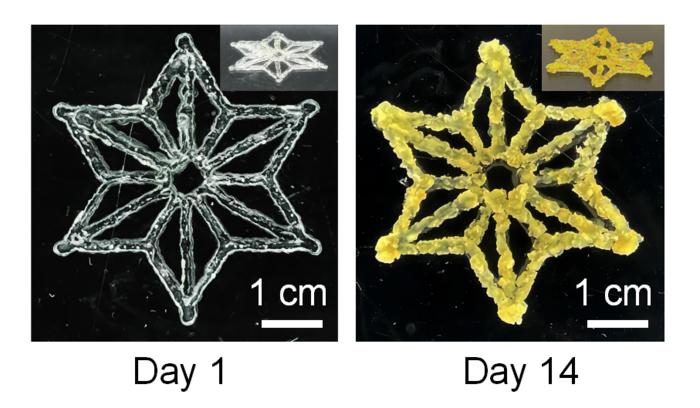
The researchers mixed tobacco plant cells with gelatin and hydrogel microparticles that contained Agrobacterium tumefaciens, a bacterium commonly used to transfer DNA segments into plant genomes. This bioink mixture was then 3D printed on a flat plate or inside a container filled with another gel to form shapes such as grids, snowflakes, leaves and spirals. Next, the hydrogel in the printed materials was cured with blue light, hardening the structures. During the ensuing 48 hours, the bacteria in the EPLMs transferred DNA to the growing tobacco cells. The materials were then washed with antibiotics to kill the bacteria. In the following weeks, as the plant cells grew and replicated in the EPLMs, they began producing proteins dictated by the transferred DNA.
In this proof-of-concept study, the transferred DNA enabled the tobacco plant cells to produce green fluorescent proteins or betalains — red or yellow plant pigments that are valued as natural colorants and dietary supplements. By printing a leaf-shaped EPLM with two different bioinks — one that created red pigment along the veins and the other a yellow pigment in the rest of the leaf — the researchers showed that their technique could produce complex, spatially controlled and multifunctional structures. Such EPLMs, which combine the traits of living organisms with the stability and durability of non-living substances, could find use as cellular factories to churn out plant metabolites or pharmaceutical proteins, or even in sustainable construction applications, according to the researchers.
The authors acknowledge funding from National Key Research and Development Program of China, the National Natural Science Foundation of China, the Natural Science Foundation of Jiangsu Province, and the State Key Laboratory of Materials-Oriented Chemical Engineering.
The paper’s abstract will be available on May 1 at 8 a.m. Eastern time here:
###
The American Chemical Society (ACS) is a nonprofit organization chartered by the U.S. Congress. ACS’ mission is to advance the broader chemistry enterprise and its practitioners for the benefit of Earth and all its people. The Society is a global leader in promoting excellence in science education and providing access to chemistry-related information and research through its multiple research solutions, peer-reviewed journals, scientific conferences, eBooks and weekly news periodical Chemical & Engineering News. ACS journals are among the most cited, most trusted and most read within the scientific literature; however, ACS itself does not conduct chemical research. As a leader in scientific information solutions, its CAS division partners with global innovators to accelerate breakthroughs by curating, connecting and analyzing the world’s scientific knowledge. ACS’ main offices are in Washington, D.C., and Columbus, Ohio.
To automatically receive news releases from the American Chemical Society, contact newsroom@acs.org.
Note: ACS does not conduct research, but publishes and publicizes peer-reviewed scientific studies.
Follow us: X, formerly Twitter | Facebook | LinkedIn | Instagram
Journal
ACS Central Science
Article Title
Advancing Engineered Plant Living Materials through Tobacco BY-2 Cell Growth and Transfection within Tailored Granular Hydrogel Scaffolds
Article Publication Date
1-May-2024
Cite Scienmag News
Denise Maddox. (May 1, 2024). Marriage of synthetic biology and 3D printing produces programmable living materials. Scienmag. https://scienmag.com/marriage-of-synthetic-biology-and-3d-printing-produces-programmable-living-materials/
Denise Maddox. "Marriage of synthetic biology and 3D printing produces programmable living materials." Scienmag, 1 May 2024, https://scienmag.com/marriage-of-synthetic-biology-and-3d-printing-produces-programmable-living-materials/. Accessed 4 September 2026.
Denise Maddox. "Marriage of synthetic biology and 3D printing produces programmable living materials." Scienmag. May 1, 2024. https://scienmag.com/marriage-of-synthetic-biology-and-3d-printing-produces-programmable-living-materials/

