


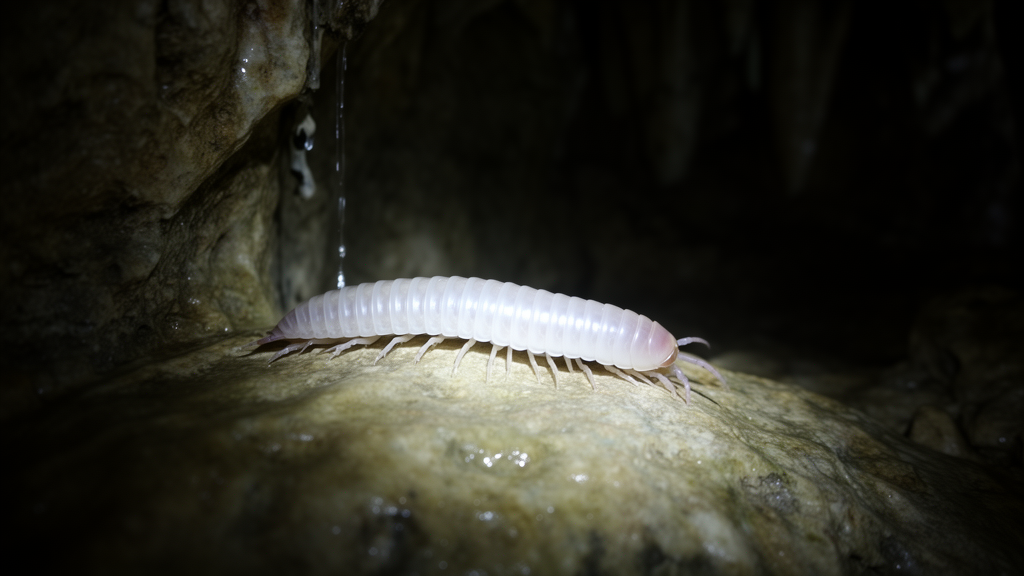
Deep inside limestone caves in northern Vietnam, researchers have uncovered a lineage of millipedes so distinct that it required an entirely new genus to classify it. The animals, collected from caves in Tuyen Quang Province, belong to the family Paracortinidae, a group of callipodidan millipedes known from Southeast and East Asia. In a new taxonomic study, the team describes the genus Vietpetalum, which brings together three species: one previously described under a different genus name and two that are new to science, Vietpetalum marmoratum and Vietpetalum simplex. The finding adds to a growing catalogue of cave-dwelling invertebrates from Vietnam’s karst landscapes and provides DNA barcodes for members of this millipede family.
The family Paracortinidae was established in 1993 to accommodate the genus Paracortina from southern China. Since then, additional genera and species have been described from China and Vietnam, and a major revision published in 2023 reorganized the group based on the detailed morphology of the gonopods. That revision left the family with 19 species in four genera: Angulifemur with two species from caves in Yunnan, southern China; Scotopetalum with two species in northern Vietnam and southern China; Crassipetalum with two species in southern China; and Paracortina, the largest genus, with 13 species in northern Vietnam and southern China. Crucially, the authors of that revision expressed doubts about the generic placement of two Vietnamese species, Paracortina kyrang and Paracortina multisegmentata, hinting that some Vietnamese taxa might form a morphologically distinct group of their own.
The discovery of the two new Vietnamese species supported that suspicion. The researchers propose the new genus Vietpetalum to house Paracortina kyrang, now recombined as Vietpetalum kyrang, together with the two new species. The name combines Viet, a reference to Vietnam, with the suffix -petalum, which is commonly used in naming genera within the order Callipodida. The genus is currently known to be endemic to Vietnam, with records from Tuyen Quang and Cao Bang provinces in the north of the country. One Vietnamese cave species, however, remains unresolved: Paracortina multisegmentata, also described from a cave in Vietnam, shows a different habitus and gonopod structure, including telopodites that cross proximally, and its position within Paracortinidae remains uncertain.
What sets Vietpetalum apart is a suite of features concentrated in the male reproductive structures. In members of the new genus, the head usually bears a projection on the vertex, and the sixth leg pair is unmodified, while the seventh leg pair carries pointed mesal processes on the coxae and strong spines on the trochanters. The gonopods run mostly parallel, converge distally, and point outward to the sides. Each gonopod has one or two subequal prefemoroidal processes and a slender falcate coxal process that reaches the distal part of the telopodite, the main branch of the organ. Most tellingly, the telopodite is sinuous or curved, strongly narrowed toward the tip, and bent in place at a right angle to the main branch, with the apex downturned. The authors distinguish the genus from all other paracortinids by the strongly twisted, narrower telopodital stem and its mostly unbranched sinuous distal portion.
The two new species were recovered from caves in Tuyen Quang Province and described from specimens preserved in 90 percent ethanol. The holotype and most paratypes are deposited in the Myriapod collection of the Institute of Biology in Hanoi. Morphological characters were examined with a stereomicroscope, and the dissected gonopods were photographed at multiple focal planes using a camera attached to a stereomicroscope, with the resulting images stacked with focus-stacking software to produce sharp composite pictures. Alongside the classical morphology, the team extracted DNA and amplified and sequenced a 680-base-pair fragment of the mitochondrial cytochrome c oxidase subunit I gene, the standard COI barcode, using universal primers. The sequences were verified against public databases and registered in GenBank with unique accession numbers.
Vietpetalum marmoratum, the type species of the new genus, is a striking animal. The male holotype measures about 70.6 millimetres in length with 72 pleurotergites plus the telson, and living specimens are brownish grey, while ethanol-preserved animals turn reddish brown with whitish-yellow marbled spots near the third primary crest, a pattern that inspired the species name, from the Latin adjective meaning marbled. The head is modified, with a strong projection on the frons and a concave forehead and vertex, and the long antennae extend beyond the posterior edge of the seventh pleurotergite when folded backwards. The field of ommatidia is black and well delineated, composed of 48 ommatidia in eight vertical rows. Males have a strongly enlarged sixth pleurotergite, and the gonopods carry a long subfalcate prefemoroidal process densely covered with long macrosetae, with the telopodite curving at a 90-degree angle and bearing no distomesal spine.
The species was found in two roughly horizontal caves about 1.5 kilometres apart, both at elevations of 600 to 700 metres above sea level. Both caves have small, narrow entrances that widen inside, with darkness beginning about 10 metres from the entrance. The cave floors are mostly wet and covered with small rocks, and clay deposits occur where the millipedes were discovered, on clay ground and large rocks 100 to 200 metres from the entrances. Callipodidans, glyphiulid millipedes, and ground beetles shared the caves with the new species. The team collected specimens on three separate occasions: only subadult males in April 2019, only females in December 2022, and both mature males and females in June 2026. From these observations, the authors suggest that the maturation period likely extends from June to October or November each year.
Vietpetalum simplex, the second new species, is smaller and plainer. The male holotype is about 52.4 millimetres long with 59 pleurotergites plus the telson, and living specimens are brownish yellow, while preserved animals are generally whitish yellow with blackish brown dorsal crests. Its eye field contains 38 ommatidia in four or five horizontal rows, and its Tömösváry organ is about four times larger than the largest ommatidium. The species name, a Latin noun used in apposition, emphasizes the simplicity of the gonopods, which in place are strongly curved into a C shape, with two small clavate prefemoroidal processes and a telopodite lacking a conspicuous distal lamella. No female specimens have been found. The COI barcode of this species shows a genetic similarity of 89.45 percent with Paracortina kyrang, while the barcode of V. marmoratum shows 82.86 percent similarity with the more distantly related Abacion magnum, underscoring how genetically distinct these animals are from previously sequenced taxa.
The second species was discovered in a cave close to the Vietnam–China border at an elevation of 1,800 metres above sea level, a notably different habitat from the lower caves of V. marmoratum. The entrance forms a tunnel for the first 20 metres before widening, and darkness begins approximately 3 metres from the entrance. The floor is predominantly wet and covered with small rocks, but no clay deposits were observed where the species was found; the millipedes were collected on the cave wall and on large rocks just 20 metres from the entrance. Several other millipede groups were present in the same cave, including Eutrichodesmus species, polydesmids, and julids. Both new species are known only from their type localities.
Beyond the descriptions themselves, the study highlights how much remains unknown about Vietnam’s karst fauna. The country’s limestone cave systems cover approximately 60,000 square kilometres across four major subregions, from the Viet Bac region in the northeast to North-central Vietnam, and the isolation of limestone outcrops creates ecological islands that foster high endemism among plants, land snails, and cave-adapted invertebrates. Molecular data for the genera Paracortina, Crassipetalum, and Angulifemur remain unavailable because most paracortinid species were described before DNA barcoding became common practice, and extracting usable genetic information from old museum specimens remains challenging because their DNA is often fragmented and degraded. In this context, the COI sequences obtained for the three Vietpetalum species provide a reference for species delimitation and contribute toward a barcode library and an understanding of phylogenetic relationships within the family. The authors argue that intensive surveys of northern Vietnam’s caves will very likely reveal more undescribed taxa, underscoring the significance of these karst systems for biodiversity.
Subject of Research: Taxonomy and DNA barcoding of a new cave millipede genus from northern Vietnam
Article Title: A new paracortinid millipede genus from caves in northern Vietnam, with descriptions of two new species ( Diplopoda , Callipodida , Paracortinidae )
Article References: Le, H.-A., Dang, D. V., Nguyen, C. T., Phan, Y. T., Akkari, N., & Nguyen, A. D. (2026). A new paracortinid millipede genus from caves in northern Vietnam, with descriptions of two new species (Diplopoda, Callipodida, Paracortinidae). ZooKeys, 1295, 255-275. https://doi.org/10.3897/zookeys.1295.213545
Image Credits: AI Generated
DOI: 10.3897/zookeys.1295.213545
Keywords: millipedes, Paracortinidae, Vietpetalum, new genus, new species, cave fauna, Vietnam, karst biodiversity, taxonomy, DNA barcoding, COI, Callipodida
Cite Scienmag News
Margaret Porter. (October 24, 2026). Marbled cave millipedes from northern Vietnam reveal a brand-new genus. Scienmag. https://scienmag.com/marbled-cave-millipedes-from-northern-vietnam-reveal-a-brand-new-genus/
Margaret Porter. "Marbled cave millipedes from northern Vietnam reveal a brand-new genus." Scienmag, 24 October 2026, https://scienmag.com/marbled-cave-millipedes-from-northern-vietnam-reveal-a-brand-new-genus/. Accessed 24 October 2026.
Margaret Porter. "Marbled cave millipedes from northern Vietnam reveal a brand-new genus." Scienmag. October 24, 2026. https://scienmag.com/marbled-cave-millipedes-from-northern-vietnam-reveal-a-brand-new-genus/


