


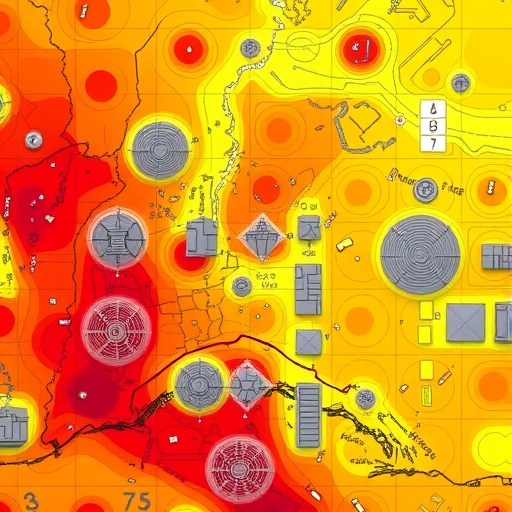
As heat waves increasingly threaten urban environments, understanding their manifestations and implications has become imperative for policymakers and researchers alike. Recent studies have revealed alarming trends in temperature elevations, exacerbated by climate change and urbanization. Among the most significant contributions to this field is the work of Hoang, Huynh, and Bui, who utilized a sophisticated interpretable machine learning framework to explore urban heat waves’ hotspots and their driving factors. This innovative approach not only sheds light on the intense spatial variations in temperature but also provides a holistic view of contributing elements in urban areas.
The study embarks on an ambitious journey to identify and map heat wave hotspots using machine learning— a form of artificial intelligence. The goal is to devise methods that not only utilize large datasets effectively but also present results in an understandable manner. By harnessing the power of machine learning, researchers circumvent common barriers such as the inability to process vast amounts of data and the challenges of human interpretation of complex models. The study champions transparency, making this advanced technology accessible to those who need it most: urban planners and climate scientists.
One of the remarkable aspects of this research is its methodology. The authors employed various machine learning algorithms to analyze the relationship between recorded temperatures during heat waves and demographic, environmental, and geographical data. These variables included the urban heat island effect, land use patterns, population density, and green space availability. By incorporating diverse datasets, the researchers were able to weave a comprehensive narrative of heat intensifications in urban locales, providing insights that were previously unavailable.
Heat islands are a significant concern in metropolitan areas, as they can elevate temperatures by several degrees compared to surrounding rural areas. This phenomenon is driven primarily by human activities and land modifications. Parks and vegetation often mitigate heat, while buildings and asphalt intensify it. The study by Hoang and his colleagues elucidated how these factors contribute in variable landscapes. Specific zones within cities emerged as locations with exacerbated temperatures during heat waves, raising crucial questions about urban sustainability and public health.
Moreover, this research delves deep into the socio-economic aspects influencing urban heat distributions. Particularly when looking at heat vulnerability, understanding who is most at risk during extreme temperature events is vital. Vulnerable populations, often located in hotter areas, face increased health risks from heat-related illnesses. Through their machine learning framework, the researchers pinpointed not just the areas most impacted by heat but also the communities that inhabit these spaces. This dual focus on environmental and social data reflects a growing awareness of equity and justice in urban planning.
As cities evolve, so too does the context of climate change. Hotter climates demand innovative architectural and infrastructural solutions. The findings from Hoang et al. advocate for thoughtful interventions, such as increasing green spaces, improving building designs for thermal efficiency, and implementing managed urban development strategies. Machine learning’s role here is profound; by laying bare the intricate relationships between different factors, it allows municipal authorities to prioritize initiatives that will most effectively reduce heat exposure among residents.
The interpretation of complex machine learning models can often deter their applications in real-world scenarios, but the authors of this study tackled this challenge head-on. They deliberately designed their framework to be interpretable, ensuring that results could be readily understood by urban planners, policymakers, and the general public. Through visualizations and straightforward analytics, their findings communicate the urgency of the issue while remaining accessible.
Additionally, the implications of their work extend beyond immediate urban environments. The predictive capabilities of their model could serve as an early warning system for impending heat waves. Instead of reacting to these climatic events post-facto, cities could prepare in advance by strategically allocating resources where they are most needed. A proactive stance significantly mitigates risks and contributes to public safety.
Finally, it is crucial to recognize the broader trajectory of this research. As machine learning technology continues to evolve, its integration into environmental science promises to redefine our understanding of climate interactions. This transformative potential motivates further investigations into how technology can enhance adaptive strategies for urban resilience. The urgent dialogue raised by this study epitomizes the crossroads at which society stands today—balancing growth with sustainability in a world increasingly affected by climate change.
In conclusion, Hoang, Huynh, and Bui’s research represents a powerful intersection of technology and urban planning. Their interpretable machine learning framework not only identifies heat wave hotspots but also lays bare the socio-economic and environmental factors that drive urban heat intensification. As cities around the globe grapple with rising temperatures, insights from this framework could be crucial in formulating sustainable urban policies that protect vulnerable communities while promoting robust ecological health.
Hoang, ND., Huynh, TC. & Bui, DT. An interpretable machine learning framework for mapping hotspots and identifying their driving factors in urban environments during heat waves.
Environ Monit Assess 197, 1017 (2025). https://doi.org/10.1007/s10661-025-14461-0
Cite Scienmag News
Blake Davidson. (August 27, 2025). Mapping Urban Heat Wave Hotspots: An Interpretable Approach. Scienmag. https://scienmag.com/mapping-urban-heat-wave-hotspots-an-interpretable-approach/
Blake Davidson. "Mapping Urban Heat Wave Hotspots: An Interpretable Approach." Scienmag, 27 August 2025, https://scienmag.com/mapping-urban-heat-wave-hotspots-an-interpretable-approach/. Accessed 4 September 2026.
Blake Davidson. "Mapping Urban Heat Wave Hotspots: An Interpretable Approach." Scienmag. August 27, 2025. https://scienmag.com/mapping-urban-heat-wave-hotspots-an-interpretable-approach/


