

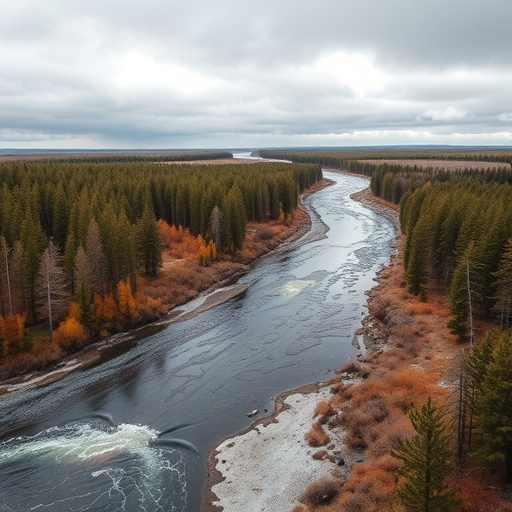
In a groundbreaking study published in the journal Environmental Monitoring and Assessment, researchers have unveiled an innovative methodology for quantifying the bryofauna of a large Siberian river. The paper, authored by a team led by T.A. Zotina, takes a significant leap towards understanding the biodiversity of aquatic ecosystems through the integration of airborne sensing technologies and traditional contact sampling techniques. This approach not only stands to enhance our grasp of biodiversity but also holds the potential to revolutionize ecological assessments across diverse environments.
Siberian rivers are known for their pristine yet sensitive ecosystems, hosting a rich variety of bryofauna, which includes mosses, liverworts, and other non-vascular plants that thrive in moist environments. These organisms play critical roles in ecological functions, including water retention, soil stabilization, and serving as habitat for various microorganisms. However, assessing their abundance and distribution has historically proved challenging due to the limitations associated with traditional sampling methods and the inaccessibility of certain riverbank environments. This necessity for a more effective analysis drove the researchers to explore the synergy between airborne sensing and on-the-ground methods.
The study employed advanced airborne sensors designed to capture high-resolution images of the riverbanks. These sensors were mounted on drones, allowing for an extensive aerial survey of the targeted riverine habitat. The resultant imagery provided a detailed visualization of the bryophyte communities, enabling the researchers to identify patches of significant ecological importance. The use of drones for aerial surveys not only enhanced the efficiency of the data collection process but also minimized the ecological footprint that often accompanies ground-based sampling efforts.
In tandem with the aerial surveys, the research team conducted contact sampling to complement the data obtained from airborne sensing. By physically collecting bryophyte samples from selected sites, the researchers ensured the validation of the remote sensing data. This hybrid approach of combining drone technology with meticulous field sampling provided a comprehensive dataset that significantly improved the accuracy of the bryofauna quantification efforts. The results showcased a holistic view of the biodiversity present in these river ecosystems, revealing patterns that were previously obscured.
Another pivotal aspect of this research hinges on the quantification aspect, which is critical in ecology for assessing both biodiversity and the health of ecosystems. Through advanced analytical techniques, the authors were able to not only identify various bryophyte species but also estimate their population densities across the riverbanks. This quantification is essential for establishing baseline data that can be utilized in future environmental monitoring and conservation efforts.
Furthermore, the findings underscore the importance of preserving these fragile ecosystems amid increasing threats from climate change and human activity. As environmental concerns rise globally, the ability to rapidly assess and monitor biodiversity is imperative. The methodology developed in this study offers an exemplary model for applying technological innovations in ecological research, paving the way for broader applications in biodiversity conservation.
Importantly, this research also emphasizes the need for interdisciplinary collaboration in environmental sciences. By amalgamating expertise from remote sensing, ecology, and environmental monitoring, the authors have constructed a framework that holds promise for addressing complex ecological questions. This approach could be adopted in various ecosystems worldwide, advocating for a global shift towards embracing technology in ecological assessments.
As scientists strive to mitigate biodiversity loss, the integration of advanced technologies into ecological monitoring continues to warrant significant attention. The ability to collect data efficiently and accurately not only saves time and resources but also enhances the potential for practical applications in conservation policy and management strategies. It encourages a proactive stance towards biodiversity, where data-driven decisions can be informed, leading to more effective conservation outcomes.
The implications of this research extend beyond the immediate geographical area of study. The methodologies and findings can serve as a template for similar assessments in diverse habitats, ranging from temperate forests to coastal wetlands. As technology continues to evolve, the intersection of ecology and aerial sensing will likely yield further advancements, enabling scientists to tackle pressing environmental issues in myriad contexts.
In conclusion, the quantification of bryofauna in large Siberian rivers represents a pivotal contribution to the field of environmental monitoring. By successfully combining airborne sensing and contact sampling, this study not only advanced our understanding of these vital ecosystems but also demonstrated the transformative potential of technology in ecological research. As we continue to face the dual challenges of preserving biodiversity and mitigating the impacts of climate change, such innovative approaches will be critical in informing conservation efforts and achieving sustainability.
As the world becomes increasingly aware of environmental issues, research of this nature can gain significant traction among the public, especially on social media platforms. By effectively communicating the importance of biodiversity and the groundbreaking technologies being utilized to study it, scientists have a unique opportunity to inspire action and foster greater public engagement with ecological issues. This study’s novel methods for assessing and monitoring bryofauna can serve as a rallying point, igniting interest and prompting discussions on the significance of our natural ecosystems and the urgent need for their protection.
The future of ecological monitoring could very well rely on similar interdisciplinary approaches, where technology and ecological research coalesce. This work serves as an instantiation of how employing innovative methodologies can enhance our understanding of the natural world, ensuring that we remain well-equipped to protect and manage our invaluable biodiversity resources for generations to come.
Subject of Research: Bryofauna quantification in a large Siberian river using airborne sensing and contact sampling.
Article Title: Quantification of bryofauna of a large Siberian river using airborne sensing and contact sampling.
Article References: Zotina, T.A., Erunova, M.G., Konovalova, D.A. et al. Quantification of bryofauna of a large Siberian river using airborne sensing and contact sampling. Environ Monit Assess 198, 164 (2026). https://doi.org/10.1007/s10661-026-15004-x
Image Credits: AI Generated
DOI: https://doi.org/10.1007/s10661-026-15004-x
Keywords: bryofauna, Siberian river, airborne sensing, ecological monitoring, biodiversity conservation.


