


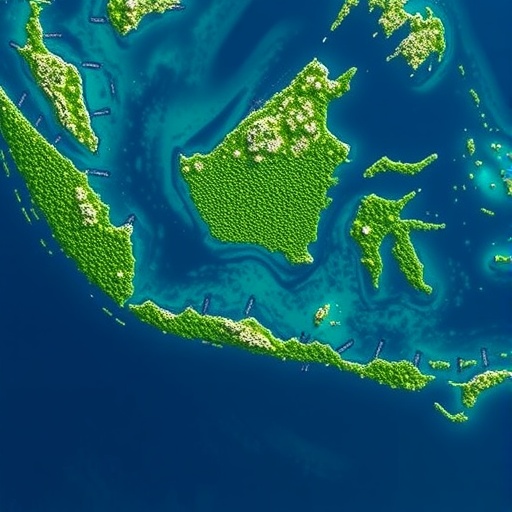
Indonesia’s seagrass meadows are revealing a striking ecological divide: some are thriving as exceptionally diverse underwater habitats, while others are showing clear signs of degradation despite being located within the same broad coastal region. A new study led by Professor Rohani Ambo-Rappe of Hasanuddin University has mapped these differences across 21 meadows in Central and Eastern Indonesia, identifying ecological “hotspots,” “coldspots,” and outliers that could transform how conservation resources are directed. Rather than treating every seagrass meadow as equally healthy—or equally threatened—the research provides a spatially detailed framework for determining where protection, restoration, or immediate intervention may have the greatest impact.
The findings are particularly significant because Indonesia contains more than 660,000 hectares of seagrass habitat, making it one of the world’s most important seagrass strongholds. These submerged flowering plants support fisheries, provide nursery grounds for marine organisms, store atmospheric carbon in sediments, stabilize coastlines, and help maintain the productivity of shallow tropical seas. Yet seagrass ecosystems are increasingly exposed to coastal development, pollution, sedimentation, destructive activity, and climate-related changes. Their condition can also differ sharply over relatively short distances, making broad national assessments too blunt to guide effective local management. The new analysis addresses that challenge by comparing ecological quality across a geographically varied set of Indonesian coastal sites.
The researchers quantified conditions using the Seagrass Ecological Quality Index, or SEQI, a composite measure designed to translate several ecological properties into a single assessment of meadow health. The index incorporated five indicators: seagrass species richness, total seagrass cover, water clarity, macroalgae cover, and epiphyte cover. Species richness and plant cover provide direct information about the structure and complexity of the meadow, while water clarity reflects the availability of light required for photosynthesis. Macroalgae and epiphytes can be natural components of a healthy ecosystem, but excessive growth may compete with seagrass for light and space, often signaling nutrient enrichment or other environmental pressures. Combining these indicators allowed the team to evaluate ecological quality more comprehensively than any single measurement could.
SEQI values across the 21 meadows ranged from 0.39 to 0.88, demonstrating a substantial gradient from highly degraded conditions to relatively strong ecological performance. The highest values were recorded at Pasi-Gusung, Parak, and Maharayya, where researchers observed a combination of high species richness, comparatively extensive seagrass cover, and clear water. These characteristics suggest that the meadows retain much of the biological complexity and physical structure needed to support marine life and withstand environmental stress. At the opposite end of the scale, Lae-Lae recorded the lowest index value. Its low score was associated with very limited seagrass cover and species richness, together with reduced water clarity—an ecological combination that can restrict photosynthesis and make recovery more difficult.
The study went beyond ranking individual meadows. Using spatial and multivariate analyses, the researchers examined whether nearby sites shared similar ecological conditions or whether particular locations differed markedly from their surroundings. This approach revealed a spatial mosaic rather than a simple pattern of healthy and unhealthy regions. In Central Indonesia, several high-quality meadows formed ecological hotspots, including Pasi-Gusung, Liukangloe, Maharayya, and Parak. These sites were not only healthy in isolation; they were also surrounded by areas with similarly favorable conditions. Such spatial reinforcement may indicate broader zones of ecological resilience, where conservation could preserve functioning ecosystems before they are affected by further disturbance.
The analysis also identified coldspots—areas where low ecological quality was concentrated. Sekotong, Lanjukang, Badi-Alami, Badi-Restorasi, Waboela, and Lapandewa were classified among the locations requiring particular attention. Their degraded conditions suggest that restoration alone may not be sufficient unless the pressures responsible for ecological decline are also reduced. Depending on local circumstances, effective responses could include controlling sources of sediment and pollution, improving coastal planning, reducing physical damage to meadows, and strengthening community-based monitoring. The value of the coldspot classification is that it helps distinguish areas where intervention may need to be coordinated across neighboring sites rather than applied to a single meadow in isolation.
Some locations displayed a different pattern: they were ecological outliers whose condition contrasted with the health of surrounding meadows. Bone Batang and Barrang Lompo contained relatively healthy seagrass communities within less healthy surroundings. These sites may function as ecological refugia, retaining biological features that have been lost nearby. Their isolation could make them especially vulnerable, because local damage may remove important remaining sources of biodiversity and ecological recovery. Protecting such refugia could therefore have benefits beyond the boundaries of the individual meadow, particularly if they supply propagules, organisms, or habitat functions that help sustain adjacent coastal ecosystems.
The opposite type of outlier was found at Lae-Lae and Bonto Bahari, where degraded meadows were embedded within healthier seagrass systems. These locations may represent strategic restoration opportunities. In ecological terms, restoring a damaged meadow within a relatively functional landscape could be more effective than attempting to rebuild a severely isolated ecosystem surrounded by persistent environmental stress. Nearby healthy meadows may provide biological material and favorable conditions that support recolonization, although successful recovery would still depend on addressing the causes of degradation. This spatial perspective gives policymakers a way to prioritize restoration sites according to their wider ecological context, not simply their current index score.
The researchers say the framework can help move Indonesian seagrass management away from a one-size-fits-all model. A high-scoring hotspot may require protection and careful monitoring, while a coldspot may need pressure reduction followed by restoration. A healthy outlier may warrant urgent safeguards because it represents a rare remaining refuge, whereas a degraded outlier within a healthier region could offer an unusually promising target for recovery. These distinctions are important for blue-carbon strategies as well. Seagrass meadows capture carbon through plant growth and can store substantial amounts of organic carbon in marine sediments, but the climate benefit depends on maintaining intact ecosystems and preventing the disturbance that can release stored carbon.
Published in Science of The Total Environment, the study demonstrates how ecological indicators, spatial statistics, and multivariate analysis can be combined to produce actionable conservation intelligence. The work was made available online on May 25, 2026, and appeared in Volume 1039 of the journal on July 10, 2026. By mapping ecological quality across Central and Eastern Indonesia, the researchers have created a method that can help identify where limited conservation funding should be concentrated and where long-term monitoring is most urgently needed. The broader message is clear: Indonesia’s seagrass future will depend not only on how much habitat remains, but also on understanding the precise ecological condition and geographical role of each meadow. Protecting the strongest ecosystems, restoring strategically located damaged sites, and reducing pressures around vulnerable refugia could help preserve marine biodiversity, strengthen coastal resilience, and maintain one of the planet’s most important natural carbon-storage systems.
News Publication Date: May 25, 2026
Web References: https://doi.org/10.1016/j.scitotenv.2026.181904
References: Science of The Total Environment, Volume 1039. DOI: 10.1016/j.scitotenv.2026.181904
Cite Scienmag News
Margaret Porter. (August 21, 2026). Mapping Indonesia’s Seagrass Health Reveals Blue Carbon Conservation Priorities. Scienmag. https://scienmag.com/mapping-indonesias-seagrass-health-reveals-blue-carbon-conservation-priorities/
Margaret Porter. "Mapping Indonesia’s Seagrass Health Reveals Blue Carbon Conservation Priorities." Scienmag, 21 August 2026, https://scienmag.com/mapping-indonesias-seagrass-health-reveals-blue-carbon-conservation-priorities/. Accessed 3 September 2026.
Margaret Porter. "Mapping Indonesia’s Seagrass Health Reveals Blue Carbon Conservation Priorities." Scienmag. August 21, 2026. https://scienmag.com/mapping-indonesias-seagrass-health-reveals-blue-carbon-conservation-priorities/


