


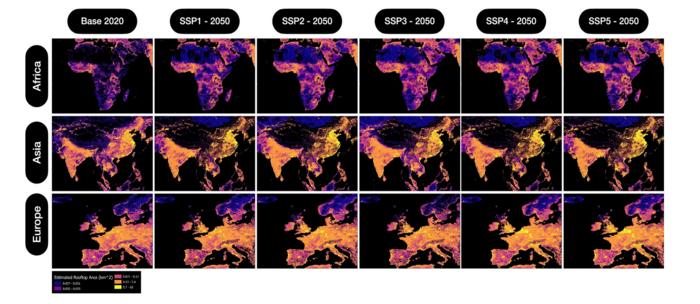
A novel machine learning framework developed by IIASA researchers to estimate global rooftop area growth from 2020 to 2050 can aid in planning sustainable energy systems, urban development, and climate change mitigation, and has potential for significant benefits in emerging economies.

Credit: Joshi et al. (2024)
A novel machine learning framework developed by IIASA researchers to estimate global rooftop area growth from 2020 to 2050 can aid in planning sustainable energy systems, urban development, and climate change mitigation, and has potential for significant benefits in emerging economies.
In 2019, buildings around the world used around 18% of yearly electricity generated and produced 21% of greenhouse gases released into the atmosphere, thereby contributing significantly to climate change. As the world’s population continues to grow, we will need more buildings, which will in turn increase demand for both electricity and construction materials.
Global rooftop area refers to the total gross surface area of all the roofs on buildings around the world. This measurement is important for various purposes, such as installing roof mounted solar panels for clean energy, planning cities, and studying environmental impacts. By understanding the global rooftop area and its growth in the next 30 years, we can better plan for sustainable energy systems, improve urban development, and reduce the impacts of buildings on issues such as climate change and biodiversity loss.
To help with this, IIASA researchers have developed a machine learning framework that uses big data from about 700 million building footprints, global land cover, as well as global road, and population information. Their framework, which has since been published in the journal Scientific Data, provides estimates of rooftop area growth from 2020 to 2050 under five different future scenarios. The data covers approximately 3.5 million small areas worldwide.
Using the framework, the researchers estimated that in 2020, the total rooftop area globally was 0.25 million square kilometers, out of a total human-made built-up surface area of 1.46 million square kilometers. Asia had the largest share with 0.12 million square kilometers, followed by Europe with 0.047 million, North America with 0.039 million, and Africa with 0.02 million. By 2050, the global rooftop area is expected to increase to between 0.3 and 0.38 million square kilometers, representing a 20-52% increase from 2020. Africa is projected to see the highest growth, potentially doubling its rooftop area.
The team’s work provides the first high-resolution global estimate of rooftop area growth based on different socioeconomic pathway narratives and demonstrates how large geospatial datasets and machine learning can support sustainable development and climate action. The key takeaway is that rooftop solar power holds significant potential for emerging economies. With rapid rooftop area growth, these regions can leverage their manufacturing capabilities, high solar potential, cost-effective labor, and entrepreneurial spirit to achieve sustainable development and prosperity.
“The implications of this research for policy and the public are significant. Our dataset can aid in more realistic planning of decentralized solar energy systems, thereby promoting sustainable energy solutions. Estimating the potential of rooftop solar technology in achieving climate policies, especially in emerging economies, can help these policies be more effective and affordable, in line with the Sustainable Development Goals for clean energy, sustainable cities, climate action, and life on land,” concludes lead author Siddharth Joshi, a research scholar in the Integrated Assessment and Climate Change Research Group of the IIASA Energy, Climate, and Environment Program.
Joshi started work on the conceptualization, development, and analysis of the framework while participating in the 2021 IIASA Young Scientists Summer Program. He received the Mikhalevich Award for his work in this regard.
The full dataset is available at:
Reference
Joshi, S., Zakeri, B., Mittal, S., Mastrucci, A., Holloway, P., Krey, V., Ramprasad Shukla, P., O’Gallachoir, B., & Glynn, J. (2024). Global high-resolution growth projections dataset for rooftop area consistent with the shared socioeconomic pathways, 2020–2050. Scientific Data DOI: 10.1038/s41597-024-03378-x
About IIASA:
The International Institute for Applied Systems Analysis (IIASA) is an international scientific institute that conducts research into the critical issues of global environmental, economic, technological, and social change that we face in the twenty-first century. Our findings provide valuable options to policymakers to shape the future of our changing world. IIASA is independent and funded by prestigious research funding agencies in Africa, the Americas, Asia, and Europe. www.iiasa.ac.at
Journal
Scientific Data
Article Title
Global high-resolution growth projections dataset for rooftop area consistent with the shared socioeconomic pathways
Article Publication Date
30-May-2024
Cite Scienmag News
Courtney Benton. (July 16, 2024). Mapping global rooftop growth for sustainable energy and urban planning. Scienmag. https://scienmag.com/mapping-global-rooftop-growth-for-sustainable-energy-and-urban-planning/
Courtney Benton. "Mapping global rooftop growth for sustainable energy and urban planning." Scienmag, 16 July 2024, https://scienmag.com/mapping-global-rooftop-growth-for-sustainable-energy-and-urban-planning/. Accessed 3 September 2026.
Courtney Benton. "Mapping global rooftop growth for sustainable energy and urban planning." Scienmag. July 16, 2024. https://scienmag.com/mapping-global-rooftop-growth-for-sustainable-energy-and-urban-planning/

