

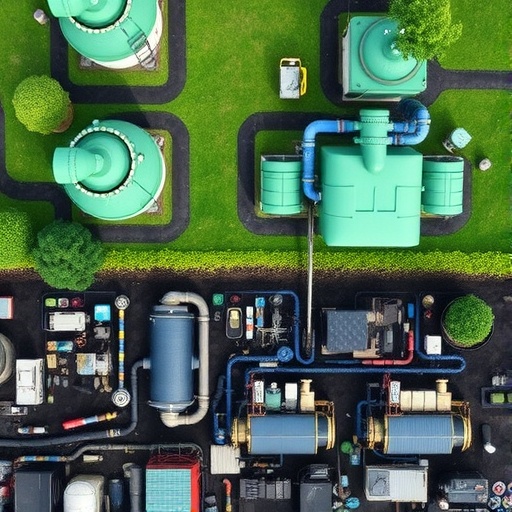
New Revelations Expose Massive Underestimation of Greenhouse Gas Emissions from Wastewater Systems
In a groundbreaking study that challenges long-standing perceptions, researchers at Princeton University have revealed that global greenhouse gas emissions from wastewater facilities have been significantly underestimated by as much as 19 to 27 percent. This substantial discrepancy is largely attributed to the continued reliance on outdated estimation methodologies, particularly those set forth in the 2006 guidelines issued by the Intergovernmental Panel on Climate Change (IPCC). The findings, published in the February 11 edition of Nature Climate Change, underscore the urgent need for adopting updated frameworks that more accurately account for nitrous oxide and methane emissions, alongside emissions from often overlooked sources such as latrines and untreated sewage discharge points.
Historically, national inventories have depended heavily on the IPCC’s 2006 guidelines when reporting emissions stemming from wastewater treatment infrastructure. These inventories, however, fail to capture the full spectrum of emissions associated with wastewater systems, largely because they omit certain subsystems and newer research findings. The study spearheaded by Professor Z. Jason Ren and his team highlights the enormous gap created by these omissions. The team’s comprehensive analysis of 38 diverse countries spanning five continents demonstrates that the extent of underreporting spans economically developed nations as well as emerging economies, revealing a systemic problem in global emissions accounting.
The wastewater sector, often overshadowed by more visible emitters such as transportation and energy production, emerges in this research as a significant yet underestimated contributor to greenhouse gas emissions. Methane and nitrous oxide—key contributors to global warming with much higher global warming potentials than carbon dioxide—are emitted copiously throughout the wastewater treatment process. The researchers quantify the overlooked emissions as ranging between 94 and 150 million metric tons of carbon dioxide equivalent annually on the global scale. This volume places wastewater emissions on par with other major sectors, including aviation and commercial maritime shipping, thereby recalibrating the perceived environmental footprint of waste management infrastructure worldwide.
What sets this study apart is its focus on the intricacies of wastewater systems themselves, which produce these potent greenhouse gases through biological and chemical processes occurring during sewage decomposition and treatment. Unlike carbon dioxide emissions primarily tied to fuel combustion, methane and nitrous oxide emissions are products of microbial activity in anaerobic and aerobic environments within wastewater facilities. This complexity demands more sophisticated measurement approaches and emission factors that align with contemporary scientific understanding — which was notably updated in the IPCC’s 2019 refinement. By failing to incorporate such updates, many national inventories underestimate real-world emissions, leading to substantial policy blind spots.
The ramifications of this underestimation extend well beyond just numbers on paper. Professor Ren underscores the critical role that accurate emission inventories play in formulating effective climate policies and technological interventions within the wastewater sector. Without reliable data, efforts to implement mitigation strategies risk being misdirected or insufficient. Wastewater infrastructure is extraordinarily long-lived—often functioning for several decades or more—meaning decisions made today about treatment technologies and infrastructure design have consequences that can influence climate outcomes well into the next century.
Moreover, the sector presents unique opportunities for meaningful emission reductions, yet it remains underexplored relative to sectors like power generation and transportation. This lack of attention is partially due to the historical focus on carbon dioxide, while emissions of methane and nitrous oxide from wastewater were either overlooked or inaccurately accounted. The research advocates for elevating the wastewater sector’s profile in climate action agendas, emphasizing that better monitoring, reporting, and technological innovation could unlock significant mitigation potential currently untapped.
The methodology underpinning the study combines rigorous statistical analysis of national reports with on-the-ground emissions measurements at major wastewater facilities and untreated sewage discharge points. By integrating these multiple data sources, the researchers identify specific system components commonly omitted or underreported, such as latrines and untreated sewage, that contribute disproportionately to the emissions gap. This holistic approach ensures a more comprehensive greenhouse gas inventory that spans the entire wastewater value chain rather than focusing solely on treatment plants.
The authors make urgent recommendations for policy-makers and international bodies such as the IPCC to accelerate the adoption of updated emission accounting standards globally. By aligning national inventories with the latest scientific guidance, countries can better grasp the true emissions from their wastewater systems, enabling more precise climate modeling and informed regulatory frameworks. Essentially, it is a call for a paradigm shift in emissions accounting that integrates wastewater as a critical contributor to climate change mitigation efforts.
Supporting these conclusions, the study team highlights the collaboration across academia and policy institutions, which strengthens the relevance and applicability of the findings. Besides Professor Ren, contributors include Wei Peng and Cuihong Song of Princeton and David Ponder from the U.S. Water Alliance. Financial support from the Grantham Foundation for the Protection of the Environment and the Water Research Foundation enabled the pursuit of this vital research. Such cross-sector commitments are pivotal to translating scientific discoveries into actionable climate solutions.
The implications for environmental engineering are profound. A better understanding of emission sources and mechanisms in wastewater treatment can fuel innovations that reduce methane and nitrous oxide production, optimize energy consumption, and minimize the sector’s overall carbon footprint. This research thus provides a foundation for developing new technologies and operational protocols that not only improve public health outcomes—through enhanced wastewater treatment—but concurrently advance climate goals.
In summary, this study dismantles misconceptions around wastewater systems as minor greenhouse gas emitters and instead places them among the most critical yet neglected sectors in the climate mitigation landscape. It demands immediate attention from scientists, engineers, and policymakers to revise existing emission inventories, upgrade estimation frameworks, and prioritize emissions reduction strategies within the wastewater sector. Addressing this hidden emissions gap could accelerate global progress toward mitigating climate change while improving sustainability across wastewater infrastructure worldwide.
Subject of Research:
Not available
Article Title:
Discrepancies in national inventories reveal a large emissions gap in the wastewater sector
News Publication Date:
11-Feb-2026
Web References:
https://www.nature.com/articles/s41558-025-02540-6
References:
Ren, Z. Jason, Wei Peng, Cuihong Song, and David Ponder. “Discrepancy of National Inventories Reveals Large Emissions Gap in the Wastewater Sector.” Nature Climate Change (2026).
Image Credits:
Nathan Li/Princeton University
Keywords:
Climate change; Wastewater; Hydrology; Environmental sciences; Environmental engineering; Natural resources management; Climate change mitigation; Greenhouse effect


