Researchers in India have reported that crude extracts from the stem of the mangrove tree Bruguiera gymnorrhiza can inhibit the growth of several disease-causing bacteria in laboratory assays, while also showing moderate radical-scavenging activity in two standard antioxidant tests. The study, published in the journal Discover Molecules, combined classical microbiology with high-resolution mass spectrometry to profile the chemistry of extracts prepared from stems collected in the Coringa mangrove forest of Andhra Pradesh.
The team, led by Jayasree Danduprolu and Lalitha Chinta, collected stem material from the Coringa Mangrove Forest near Kakinada, which the authors describe as the second largest mangrove ecosystem in India after the Sundarbans, covering roughly 124 square kilometres. The stem was cleaned, shade-dried and pulverised, and 80 grams of powder were extracted sequentially in a Soxhlet apparatus using six solvents of increasing polarity: n-hexane, ethyl acetate, chloroform, ethanol, methanol and distilled water. The resulting crude extracts were concentrated and stored at 4 degrees Celsius until testing.
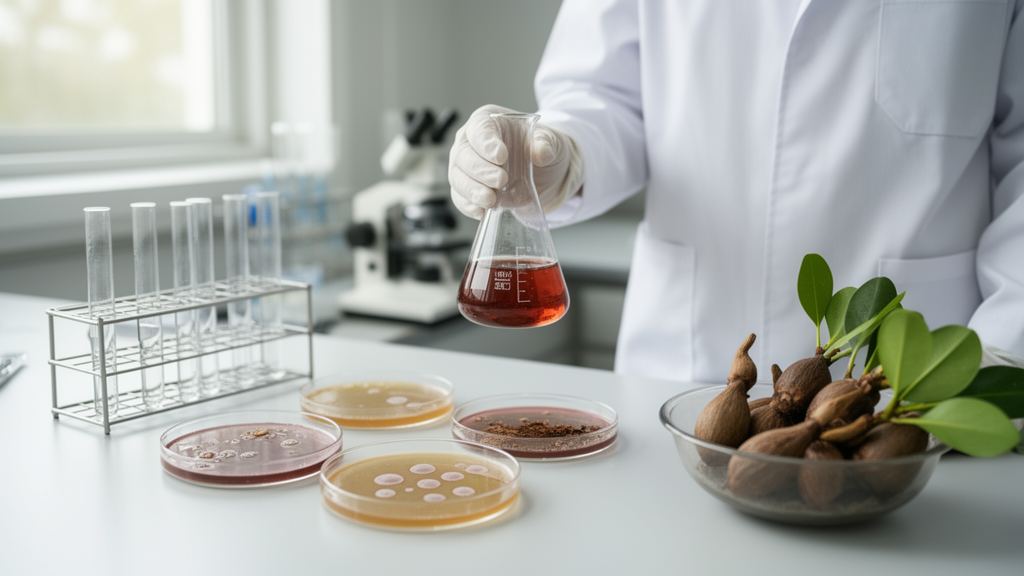
Antibacterial activity was assessed against eight bacterial strains obtained from the Microbial Type Culture Collection: six Gram-negative species, namely Escherichia coli, Salmonella enterica typhimurium, Shigella flexneri, Klebsiella pneumoniae, Pseudomonas aeruginosa and Vibrio parahaemolyticus, and two Gram-positive species, Staphylococcus aureus and Streptococcus pyogenes. In the disc diffusion assay, 6 mm discs were loaded with extract concentrations ranging from 2 to 8 milligrams per millilitre dissolved in 5 percent dimethyl sulfoxide, with 5 percent DMSO alone as a negative control and the antibiotic streptomycin at 200 micrograms per millilitre as a positive control. Plates were incubated for 24 hours at 37 degrees Celsius, and zones of inhibition were measured using ImageJ software.
Two extracts stood out. The chloroform extract, labelled BGC, produced the largest inhibition zones at the highest concentration tested: 29.7 millimetres against Salmonella typhi, 27.7 millimetres against E. coli, 26 millimetres against Klebsiella pneumoniae, 25 millimetres against Vibrio parahaemolyticus, and 23.5 millimetres against both Staphylococcus aureus and Streptococcus pyogenes, with smaller zones against Shigella flexneri and Pseudomonas aeruginosa. The ethyl acetate extract, BGEA, was most effective against Klebsiella pneumoniae, producing a 30 millimetre zone, and also inhibited Staphylococcus aureus with a 24 millimetre zone, while its activity against E. coli, Salmonella typhi and Pseudomonas aeruginosa was weaker at the same concentration. The methanol extract showed only moderate inhibition, typically below 13 millimetres, and the hexane, ethanol and water extracts showed minimal or no activity.
Minimum inhibitory concentration testing, performed with a standard microdilution method using two-fold dilutions from 25 down to 1.5 milligrams per millilitre and a tetrazolium dye to indicate bacterial growth, supported the disc diffusion results. The chloroform extract achieved the lowest MIC values across almost all tested organisms: 1.5625 milligrams per millilitre for E. coli and Salmonella typhimurium, 6.25 milligrams per millilitre for Shigella flexneri and Klebsiella pneumoniae, and 3.125 milligrams per millilitre for Pseudomonas aeruginosa, Staphylococcus aureus, Vibrio parahaemolyticus and Streptococcus pyogenes. The authors note that when compared with streptomycin, which produced zones ranging from 16 to 27.8 millimetres, the plant extracts were less potent, with the antibiotic consistently surpassing even the best-performing extract. A three-way analysis of variance found that both solvent type and extract concentration had statistically significant effects on antibacterial screening outcomes.
Antioxidant activity was measured only for the two most antibacterial extracts, using DPPH and ABTS radical scavenging assays with the synthetic antioxidant butylated hydroxytoluene as a reference standard. Both extracts showed concentration-dependent scavenging across the tested range of 100 to 400 micrograms per millilitre. In the DPPH assay, the ethyl acetate extract scavenged 14.04 to 25.32 percent of radicals across this range, while the chloroform extract rose from 7.04 to 30.92 percent. In the ABTS assay, the ethyl acetate extract reached 38.26 to 50.17 percent activity, whereas the chloroform extract ranged from 26.56 to 29.82 percent. The calculated IC50 values, the concentrations needed to scavenge half of the radicals, were 641.6 micrograms per millilitre for the chloroform extract in the DPPH assay and 440.5 micrograms per millilitre for the ethyl acetate extract in the ABTS assay, with the ethyl acetate extract far weaker in DPPH at 1040.3 micrograms per millilitre and the chloroform extract far weaker in ABTS at 2327.0 micrograms per millilitre. The authors describe this activity as moderate and note that previous studies of B. gymnorrhiza fruit and leaf extracts reported lower IC50 values, possibly reflecting differences in phytochemical content between plant parts or extraction methods.
To understand which compounds might underlie these activities, the researchers profiled the ethyl acetate and chloroform extracts by liquid chromatography coupled to electrospray ionisation quadrupole time-of-flight tandem mass spectrometry, performed at the Sophisticated Analytical Instrumentation Facility at IIT Bombay. The analysis used a Thermo Scientific Vanquish UHPLC system connected to a Q Exactive Plus Orbitrap mass spectrometer, with positive-mode electrospray ionisation, data-dependent acquisition, full-scan resolution of 70,000 and a scan range of mass-to-charge ratios from 70 to 1050. Compounds were putatively annotated at Metabolomics Standards Initiative level 2 using the mzCloud database, meaning identifications rest on accurate mass and fragmentation patterns rather than authentic reference standards.
The profiling tentatively identified 51 metabolites spanning flavonoids, fatty acids, terpenoids, carboxylic acids, phenolic acids, quinones and alkaloids. Named compounds included the flavonoids apigenin, quercetin and hesperetin, the isoflavone glycitein, the plant hormone abscisic acid, the triterpenoid 18-beta-glycyrrhetinic acid, chlorogenic acid and caffeoylquinic acid isomers, the steroids tetrahydrocortisone and beta-oestradiol, phenolic glycosides and several coumarins. The ethyl acetate fraction captured a more diverse set of mid-polarity compounds, including the flavonoids and chlorogenic acid derivatives, while the chloroform fraction extracted more lipophilic metabolites such as hesperetin. The authors suggest that the antibacterial effects of the extracts may be linked to these lipophilic phytometabolites, since flavonoids, tannins, alkaloids, terpenoids and fatty acids are reported to disrupt bacterial membranes, inhibit nucleic acid synthesis, interfere with enzymes, induce oxidative stress and block quorum-sensing pathways. They also note that redox imbalance induced by antioxidant-active compounds may indirectly contribute to antimicrobial effects.
The study has clear limitations that the authors themselves acknowledge. All results come from in vitro assays of crude extracts, so the specific compounds responsible for the observed bioactivity were not isolated, and nothing is known about how these extracts would behave in a living organism, since pharmacokinetics and in vivo efficacy remain untested. The compound identifications are putative rather than confirmed, and comparisons with earlier work on B. gymnorrhiza from Bangladesh, Goa and China, which reported different compound profiles such as vanillic and gallic acids, rutin or condensed tannins, underline that phytochemistry varies with plant tissue, geography and environmental conditions. The authors also place their work in the context of antimicrobial resistance, citing World Health Organization figures that roughly one in six laboratory-confirmed bacterial infections worldwide were resistant to antibiotics in 2023. They argue that B. gymnorrhiza stem extracts could serve as renewable sources of phytochemicals for developing plant-based therapeutics against multidrug-resistant bacteria, while stressing that compound isolation, in vivo efficacy validation and pharmacokinetic studies are necessary before any pharmaceutical potential can be assessed.
Subject of Research: Antibacterial and antioxidant activity and phytochemical profiling of Bruguiera gymnorrhiza stem extracts
Article Title: Antibacterial, antioxidant activities and phytochemistry of Bruguiera gymnorrhiza stem using LC-ESI-QTOF-MS/MS
Article References: Danduprolu, J., & Chinta, L. (2026). Antibacterial, antioxidant activities and phytochemistry of Bruguiera gymnorrhiza stem using LC-ESI-QTOF-MS/MS. Discover Molecules, 3(1), Article 31. https://doi.org/10.1007/s44345-026-00069-5
Image Credits: AI Generated
DOI: 10.1007/s44345-026-00069-5
Keywords: Bruguiera gymnorrhiza, mangrove, antibacterial activity, antioxidant, LC-ESI-QTOF-MS/MS, phytochemistry, MIC, DPPH assay, ABTS assay, flavonoids, Coringa mangrove forest, antimicrobial resistance
Cite Scienmag News
Bethany Barker. (October 28, 2026). Mangrove Stem Extracts Show Antibacterial and Antioxidant Activity in Lab Tests. Scienmag. https://scienmag.com/mangrove-stem-extracts-show-antibacterial-and-antioxidant-activity-in-lab-tests/
Bethany Barker. "Mangrove Stem Extracts Show Antibacterial and Antioxidant Activity in Lab Tests." Scienmag, 28 October 2026, https://scienmag.com/mangrove-stem-extracts-show-antibacterial-and-antioxidant-activity-in-lab-tests/. Accessed 29 October 2026.
Bethany Barker. "Mangrove Stem Extracts Show Antibacterial and Antioxidant Activity in Lab Tests." Scienmag. October 28, 2026. https://scienmag.com/mangrove-stem-extracts-show-antibacterial-and-antioxidant-activity-in-lab-tests/