


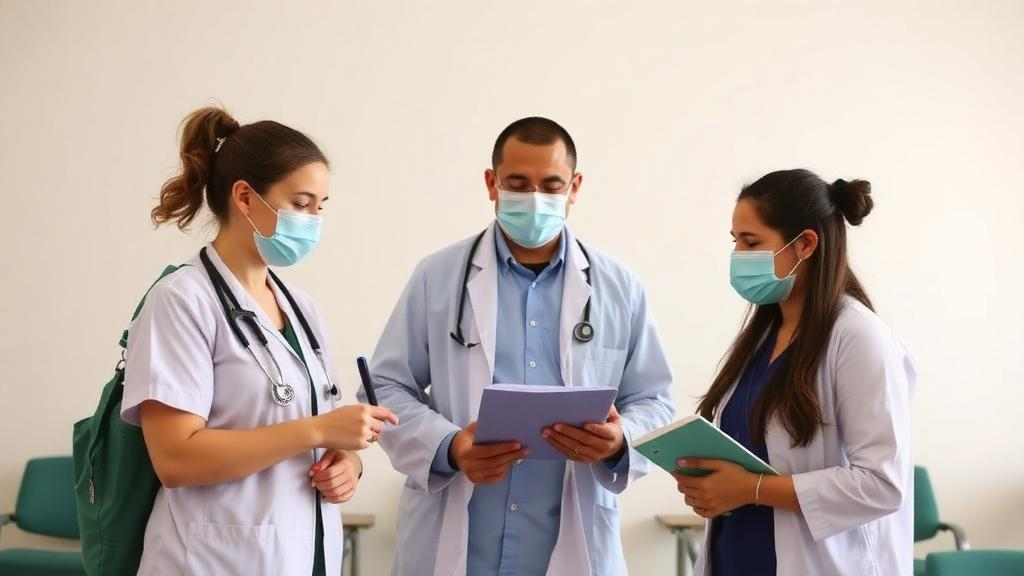
When future doctors, nurses, midwives, pharmacists, physical therapists, and occupational therapists are thrown together to deliver real preventive care, something remarkable happens to how they see themselves as collaborators. That is the central finding of a new study from the Angers Faculty of Health in France, published in BMC Medical Education, which measured a significant rise in health students’ self-perceived interprofessional collaborative skills after they completed the country’s Student Health Service program. With 553 analyzable responses drawn from more than a thousand eligible students, the research offers one of the largest single-cohort evaluations to date of a mandatory interprofessional training experience, and it arrives at a moment when health systems worldwide are searching for reliable ways to teach teamwork rather than simply hope it emerges on the job.
The Student Health Service, known in France as the Service Sanitaire, occupies a unique position in the landscape of health professional education. Introduced as a compulsory component of French health curricula, it requires students from six distinct disciplines to work side by side on prevention projects aimed at communities, schools, and other beneficiary populations. According to the study’s authors, it is the only mandatory and universal interprofessional training experience embedded in French health education. That universality makes it an unusually powerful natural laboratory: unlike voluntary electives or single-institution pilots, the program reaches essentially every health student in a given region, allowing researchers to assess skill development across an entire cohort rather than a self-selected sample of enthusiasts.
To quantify the change, the research team turned to a validated instrument called the Interprofessional Collaborative Competency Attainment Survey, or ICCAS. The tool asks respondents to rate their own competence across the domains of interprofessional collaboration, including roles and responsibilities, teamwork, communication, and collaborative patient- or client-centered practice. The French version was used with written permission from Professor Douglas Archibald, with a minor contextual adaptation: references to the patient or family were reworded to refer to the beneficiary of the preventive action, matching the prevention-focused mission of the Student Health Service. The survey uses a seven-point scale, and the study’s primary endpoint was the change in mean score between a retrospective pre-program rating and a post-program rating collected at the same time.
That retrospective pre-post design deserves a technical note, because it is both the study’s methodological strength and a source of interpretive caution. Rather than asking students to rate their skills before the program and then again afterward, the researchers collected both the before and after ratings simultaneously once the program was complete. This approach, widely used in educational research, is thought to reduce response-shift bias, the phenomenon in which participants’ internal standards shift during an intervention, making their earlier self-assessments incomparable with later ones. By anchoring both judgments to a common frame of reference at a single moment, the retrospective design attempts to isolate genuine perceived growth from mere changes in how students understand the rating scale itself.
The scale of the data collection was ambitious. All 1,141 students completing their Student Health Service during the 2024–2025 academic year in the departments of Maine-et-Loire, Mayenne, and Sarthe were eligible. Of these, 943 received the questionnaire, 638 responded, and 553 questionnaires met the predefined completion criterion and entered the final analysis. The results were striking in their consistency. The mean ICCAS score rose from 5.81 before the program to 6.37 afterward, a statistically significant mean improvement of 0.55 points with a p-value below 0.001. In practical terms, students moved from a self-assessment comfortably above the scale’s midpoint to one approaching its upper range, and every one of the ICCAS domains showed significant improvement.
The distribution of individual responses adds texture to the headline numbers. A decisive majority, 86.6 percent of students, reported an improvement in their self-perceived interprofessional skills. A small fraction, 9.9 percent, reported no change, and 3.4 percent actually reported a decrease. The researchers also ran exploratory analyses to see whether the size of the gain varied by field of study, by department, or by the prevention topic students worked on. No significant differences emerged, although the authors caution that some subgroups were small, limiting the statistical power of those comparisons. The apparent uniformity of benefit across professions is itself notable: it suggests the program’s effect is not driven by one discipline’s curriculum or one region’s implementation but appears to operate broadly across the interprofessional mix.
One of the study’s most intriguing findings came from its sensitivity analysis, which compared paper-based questionnaires with digital ones. Students who completed the survey on paper reported a mean improvement of 0.586 points, while those using the digital format reported a mean gain of only 0.251 points, a difference that was itself statistically significant at p below 0.001. The authors do not overinterpret this gap, but it raises genuine methodological questions for anyone designing self-assessment research. Response formats can influence how people recall and evaluate their own past states, and the nearly threefold difference between modalities suggests that survey delivery is not a neutral technical choice. Future evaluations of interprofessional education may need to account for, or standardize, the medium through which self-perception is measured.
Why does a mandatory prevention placement move the needle on collaboration skills at all? The theoretical answer lies in the architecture of interprofessional education itself. Decades of research have argued that health professions students learn in silos, absorbing the norms, vocabularies, and hierarchies of their own discipline while rarely practicing the negotiation of roles that real clinical teamwork demands. The Student Health Service forces that negotiation early. Because prevention projects require students to define who does what, communicate across professional boundaries, and center the needs of a shared beneficiary, they create authentic opportunities to exercise exactly the competencies the ICCAS measures. The study’s findings are consistent with the idea that collaborative competence is not an abstract attitude but a practical skill that develops through structured, repeated, real-world interaction with other professions.
The implications extend beyond France. Health systems globally face workforce shortages, rising chronic disease burdens, and mounting evidence that fragmented care harms patients, all of which have pushed interprofessional education to the top of curricular reform agendas. Yet rigorous evaluations of mandatory, large-scale interprofessional programs remain scarce, partly because few countries have made such training universal. The Angers study, covering six professions across three departments in a single academic year, provides a template for how such evaluations can be conducted: a validated self-assessment instrument, a retrospective pre-post design, and a completion criterion applied before analysis. Its conclusion that the program strengthened interprofessional training in French health curricula gives policymakers empirical support for maintaining and expanding the model.
The authors are careful about the limits of what self-report can show. Self-perceived competence is not the same as objectively measured competence, and students may overestimate or underestimate their actual collaborative abilities. The study’s own recommendation points the way forward: further research should explore the relationship between self-perceived and objectively measured interprofessional competencies, ideally through observational measures, standardized assessments, or longitudinal follow-up into professional practice. There is also the question of durability, whether gains measured immediately after the program persist once students enter clinical rotations and, eventually, the workforce. Still, the core message stands. When a thousand-plus students across medicine, nursing, midwifery, pharmacy, and the therapies were required to collaborate on real prevention work, nearly nine in ten came away believing they had become better team members, and the numbers behind that belief were statistically robust. For a field long criticized for teaching teamwork in lecture halls, that is evidence worth taking seriously.
Subject of Research: Changes in self-perceived interprofessional collaborative skills among health students after a mandatory student health service program
Article Title: Changes in students’ self-perceived interprofessional collaborative skills following participation in the student health service program
Article References: Donat, T., De Roquefeuil, E., Busson, A., Baglin, I., Poiroux, L., Ramond-Roquin, A., Ammi, M., & Levaillant, M. (2026). Changes in students’ self-perceived interprofessional collaborative skills following participation in the student health service program. BMC Medical Education. https://doi.org/10.1186/s12909-026-10479-1
Image Credits: AI Generated
DOI: 10.1186/s12909-026-10479-1
Keywords: interprofessional education, interprofessional collaboration, Student Health Service, ICCAS, self-assessment, health professions students, medical education, teamwork, preventive care, France, BMC Medical Education, curriculum evaluation
Cite Scienmag News
Courtney Benton. (October 7, 2026). Mandatory Student Health Service Boosts Future Clinicians’ Teamwork Skills, Study Finds. Scienmag. https://scienmag.com/mandatory-student-health-service-boosts-future-clinicians-teamwork-skills-study-finds/
Courtney Benton. "Mandatory Student Health Service Boosts Future Clinicians’ Teamwork Skills, Study Finds." Scienmag, 7 October 2026, https://scienmag.com/mandatory-student-health-service-boosts-future-clinicians-teamwork-skills-study-finds/. Accessed 7 October 2026.
Courtney Benton. "Mandatory Student Health Service Boosts Future Clinicians’ Teamwork Skills, Study Finds." Scienmag. October 7, 2026. https://scienmag.com/mandatory-student-health-service-boosts-future-clinicians-teamwork-skills-study-finds/


