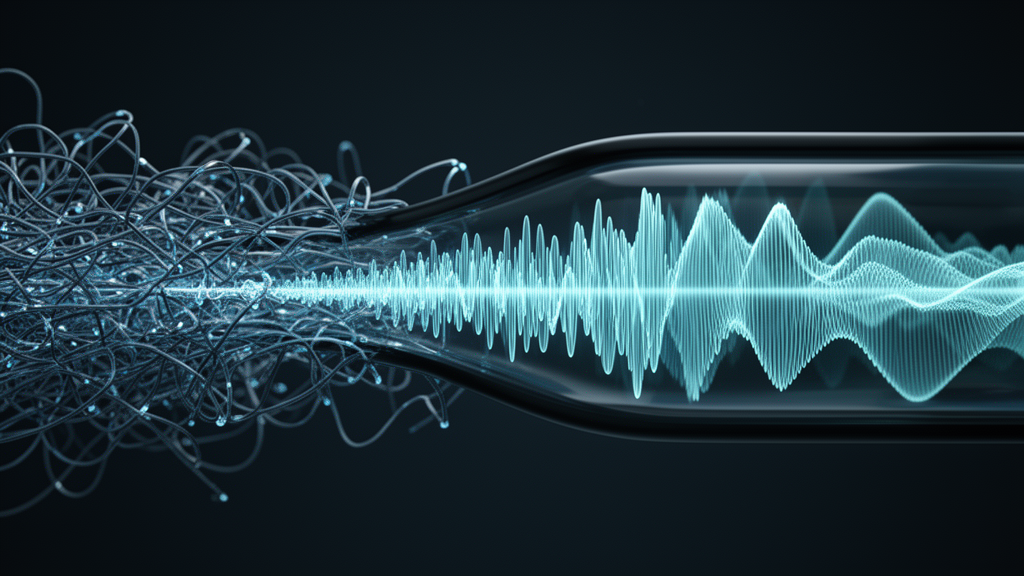
Researchers at VIT-AP University in Amaravati, India, have unveiled a compact deep learning framework that cleans noisy speech more effectively than many far heavier models, and they have done it by borrowing one of the most talked-about ideas in modern artificial intelligence: the Mamba state-space architecture. Their system, called TF-Mamba-DPHNet, is described in a study published in Frontiers in Signal Processing, and its results suggest that the architecture behind some of today’s fastest language models may be just as transformative for audio as it has been for text.
…
The appeal of combining Mamba-style state-space modeling with speech enhancement lies in how the two problems align. Speech is, at its core, a long sequential signal whose meaning unfolds over time, and the spectrogram representation used by most modern enhancement systems turns that signal into a two-dimensional grid of time and frequency. A selective state-space model processes such sequences with a fixed-size internal state that is updated at every step, which means the computational cost grows linearly with sequence length rather than quadratically as it does for the self-attention operation at the heart of Transformers. For audio, where a single utterance can span tens of thousands of time frames once the signal is converted to spectral frames, that difference in scaling is not a theoretical curiosity but a practical constraint on latency, memory, and the feasibility of running the model on everyday hardware such as hearing aids, earbuds, or mobile phones.
The selective aspect of the mechanism matters as much as the efficiency. Earlier generations of state-space models treated every element of the input sequence with the same fixed dynamics, which limited their ability to decide what to remember and what to forget. The selective formulation, introduced with the Mamba architecture, allows the model’s parameters to vary with the input itself, so the network can dynamically emphasize frames that carry speech content and attenuate its response to stretches dominated by stationary noise. This input-dependent gating is conceptually similar to what attention accomplishes, but it is achieved through recurrent state evolution rather than explicit pairwise comparisons, which is precisely why the authors argue it preserves spectral continuity and avoids the over-smoothing that global aggregation can introduce. In a spectrogram, over-smoothing manifests as blurred harmonic structure and softened consonant transitions, artifacts that listeners perceive as muffled or robotic speech even when objective scores remain respectable.
The dual-axis design of the TF-Mamba module reflects another property of speech that single-axis models often miss. Time and frequency are not interchangeable dimensions: along the time axis, the network must track how formants glide, how voicing begins and ends, and how syllables follow one another; along the frequency axis, it must understand the harmonic scaffolding of voiced sounds and the broadband character of fricatives. By running separate selective state-space scans along each axis and combining their outputs, the module can model dependencies that are purely temporal, purely spectral, or that span both dimensions. This mirrors the logic of dual-path architectures that have become standard in source separation and enhancement, where chunking the spectrogram into segments and processing within-segment and across-segment contexts separately makes long inputs tractable while retaining local detail.
The bottleneck of the proposed network stacks four of these dual-path interaction blocks, and the placement is significant. In an encoder-decoder design, the bottleneck is where the representation is most compressed and most abstract, carrying a summary of the entire utterance. Placing the long-range modeling machinery there, rather than scattering it across every resolution, concentrates the expensive global computation on the most compact representation, which keeps the overall architecture light. The encoder and decoder, by contrast, are built from multi-scale feature extraction blocks that use parallel convolutional kernels of different sizes, letting the network capture both narrow-band spectral textures and broader temporal patterns at the same layer. This division of labor—local, multi-scale convolution at high resolutions and selective state-space modeling at the compressed center—follows a pattern seen across successful deep architectures, where each component is assigned the granularity it handles best.
Perhaps the most consequential design decision in the paper concerns the skip connections themselves. U-Net-style architectures copy encoder features directly to the decoder at matching resolutions, and while these shortcuts preserve fine detail, they also form a highway for noise: whatever noise representations the encoder has not yet suppressed travel unimpeded to the decoder, where they can contaminate the reconstructed speech. The hybrid cross-scale feature calibration modules address this by treating the skip pathway not as a passive copy but as an active fusion point. Global features produced at the bottleneck are used to guide the recalibration of the hierarchical encoder features, effectively asking the question, at every skip connection, which channels and which spatial regions of the copied features are consistent with the globally understood speech content, and which are likely to be residual noise. Features that survive this cross-examination are passed forward; those that do not are down-weighted.
This calibration strategy speaks to a broader tension in enhancement network design. Fine-grained spectral detail, which is essential for natural-sounding speech, lives in the early encoder layers, but so does much of the noise. Global context, which is essential for deciding what is speech and what is noise, accumulates deeper in the network, but by then fine detail has been compressed away. The skip connection is where these two kinds of information meet, and how they are reconciled largely determines whether the output speech sounds crisp or washed out. Prior approaches have tried nested or dense skip connections to enrich this fusion, but these add parameters and complexity. The cross-scale-guided approach taken here attempts to get the benefit of informed fusion without a proportional increase in model size, which is consistent with the paper’s overall emphasis on efficiency.
The evaluation on Common Voice and LibriSpeech is worth contextualizing. Both are large, publicly available corpora of read speech drawn from many speakers, which makes them standard proving grounds for enhancement models, but they differ in character: Common Voice is crowd-contributed recordings with wide variation in recording conditions and speaker demographics, while LibriSpeech derives from audiobook recordings with relatively clean acoustics that are typically mixed with synthetic noise at controlled signal-to-noise ratios for enhancement experiments. Testing on both gives some protection against a model simply overfitting to the acoustic quirks of one dataset. The reported improvements over earlier models span the standard objective metrics for the field, including PESQ, which estimates perceptual quality on a scale from minus half to four and a half, and STOI, which estimates intelligibility as a correlation-based score between zero and one. These metrics are imperfect proxies for human listening, but they correlate reasonably well with subjective judgments and remain the de facto currency for comparing enhancement systems.
The broader significance of the work lies in what it suggests about the trajectory of audio processing architectures. Transformers transformed natural language processing, and attention-based models subsequently dominated speech enhancement benchmarks, but their quadratic cost and their tendency to blur fine spectral structure have long been acknowledged limitations for real-time audio. State-space models offer an alternative that is not merely a cheaper approximation of attention but a genuinely different inductive bias: one that treats the signal as an evolving dynamical system rather than a bag of tokens to be compared. The evidence accumulating across speech processing, vision, and language suggests that this bias suits long, continuous, structured signals particularly well. If the gains reported here hold up under independent replication and in on-device deployments, the Mamba lineage may come to play the role in audio that Transformers played in text: not a total replacement for prior architectures, but a new backbone around which efficient, high-quality systems are assembled.
There are also practical implications for where such models can run. Speech enhancement is increasingly expected to happen on the edge—in hearing aids that must operate for days on a small battery, in conference systems that must process audio with minimal round-trip delay, and in mobile applications that cannot rely on cloud connectivity. Every architectural choice in TF-Mamba-DPHNet, from the linear-time state-space scans to the placement of global modeling at the compressed bottleneck to the lightweight calibration of skip features, is oriented toward keeping the parameter count and computational budget modest while preserving quality. The comparison the authors draw with heavier adversarially trained and densely connected predecessors is not simply about leaderboard scores but about the ratio of quality to cost, which is the metric that ultimately determines what ships in a product.
Finally, the work illustrates a recurring lesson in applied deep learning: progress often comes not from any single novel module but from the careful composition of complementary mechanisms. Multi-scale convolution, selective state-space modeling, dual-path interaction, and cross-scale calibration each address a specific failure mode—insufficient receptive field diversity, inefficient long-range modeling, weak temporal-spectral coupling, and noise leakage through skips—and it is their combination, rather than any one of them alone, that the authors credit for the observed gains. As state-space architectures continue to mature, the interesting research frontier will likely shift from demonstrating that they can match attention-based models to understanding which combinations of mechanisms, at which points in the network, deliver the best trade-off between perceptual quality, robustness to unseen noise, and real-world deployability.
Subject of Research: A deep learning framework combining selective state-space modeling and cross-scale feature calibration for single-channel speech enhancement
Article Title: TF-Mamba-DPHNet: a time-frequency state-space and dual-path interaction framework with hybrid cross-scale feature calibration for speech enhancement
Article References: AreefaBegam, S., & Vanambathina, S. (2026). TF-Mamba-DPHNet: a time-frequency state-space and dual-path interaction framework with hybrid cross-scale feature calibration for speech enhancement. Frontiers in Signal Processing, 6, Article 1911510. https://doi.org/10.3389/frsip.2026.1911510
Image Credits: AI Generated
DOI: 10.3389/frsip.2026.1911510
Keywords: speech enhancement, Mamba, state-space models, deep learning, time-frequency modeling, U-Net, attention mechanisms, PESQ, STOI, audio signal processing, noise suppression, VIT-AP University
Cite Scienmag News
Cassandra Pierce. (October 16, 2026). Mamba-Inspired AI Strips Noise From Speech While Preserving Every Fine Spectral Detail. Scienmag. https://scienmag.com/mamba-inspired-ai-strips-noise-from-speech-while-preserving-every-fine-spectral-detail/
Cassandra Pierce. "Mamba-Inspired AI Strips Noise From Speech While Preserving Every Fine Spectral Detail." Scienmag, 16 October 2026, https://scienmag.com/mamba-inspired-ai-strips-noise-from-speech-while-preserving-every-fine-spectral-detail/. Accessed 16 October 2026.
Cassandra Pierce. "Mamba-Inspired AI Strips Noise From Speech While Preserving Every Fine Spectral Detail." Scienmag. October 16, 2026. https://scienmag.com/mamba-inspired-ai-strips-noise-from-speech-while-preserving-every-fine-spectral-detail/