


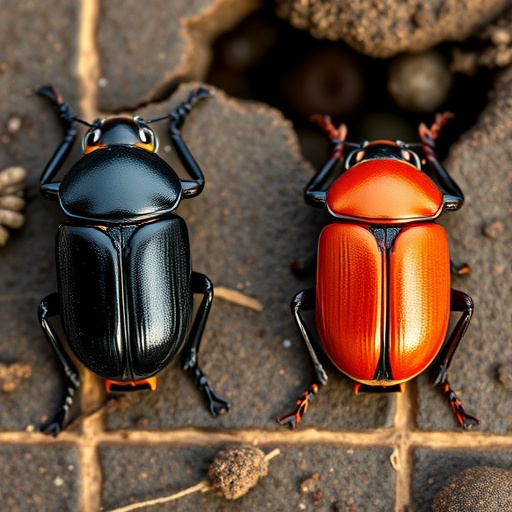
In the dim world beneath forest floors, one of nature’s most remarkable hitchhiking arrangements has just come into sharper focus. A team of Polish researchers studying burying beetles and the mites that ride on them has uncovered a striking pattern: male beetles carry significantly more mites than females, while the long-standing ecological assumption that larger hosts transport more symbionts does not hold. The study, published in Frontiers in Zoology, examined nearly 900 beetles across three species and revealed that not all burying beetles are equally important vehicles for their microscopic passengers.
Phoresy, the phenomenon at the heart of this research, is a form of temporary symbiosis in which a smaller organism attaches itself to a larger one purely for transport. It is especially common among mites, minute and weakly mobile arthropods that exploit ephemeral, patchily distributed resources such as carrion. While phoresy has traditionally been viewed as a benign commensal arrangement, scientists increasingly recognize that such relationships can slide along a continuum from commensalism to mutualism or even parasitism, depending on the costs and benefits experienced by both partners. In highly specific phoresy, where the association is long-term or permanent, the evolutionary consequences can be profound, including synchronization of life cycles, cospeciation, or a transition toward parasitic dependence.
The mites in question belong to the Uroobovella nova species complex, a group of cryptic species within the order Uropodina that are transported exclusively by burying beetles of the genus Nicrophorus. Unlike most uropodine mites, which hitch rides on a broad spectrum of insect carriers, U. nova deutonymphs, the specialized juvenile dispersal stage, depend entirely on burying beetles. Previous molecular work demonstrated that what was once considered a single generalist species actually comprises at least five cryptic species associated with different beetle hosts. Yet compared with the better-studied Poecilochirus mite–burying beetle system, in which mites ride beetles into underground brood chambers and reproduce alongside them, the Uroobovella interaction remains poorly understood.
Led by Daria Bajerlein of Adam Mickiewicz University in Poznań, the research team set out to determine whether different burying beetle species play equal roles in the local dispersal of these mites. Their previous work on the common European burying beetle Nicrophorus vespilloides had documented an extraordinarily high mite prevalence of roughly 90 percent, with an average of nearly 25 deutonymphs per beetle, strong site selectivity on the host body, and a slight preference for females. The new study focused on three additional, less abundant species collected from the same woodland: N. vespillo, N. humator, and N. interruptus. The central question was whether these species serve as primary carriers or merely incidental hosts.
The fieldwork took place in the Niepołomice Forest, a roughly 110-square-kilometer woodland near Kraków in southern Poland. Beetles were collected as bycatch in flight interception traps originally deployed for saproxylic beetles in 2018 and 2019. The traps used ethylene glycol as a preservative, which had the crucial side effect of immobilizing attached mites and preventing them from moving between hosts, thereby preserving the original infestation patterns. From the material gathered between mid-July and mid-September 2018, the researchers analyzed 880 beetles: 275 N. humator, 315 N. interruptus, and 290 N. vespillo. Every specimen was dissected to determine sex, measured for body size via pronotum width, and examined under magnification for both attached mites and empty pedicels, the stalk-like attachment structures that remain as evidence of a mite’s prior presence.
The statistical analysis employed generalized linear models to test the effects of beetle species, sex, and body size on both the prevalence of infestation, meaning the proportion of beetles carrying mites, and the intensity of infestation, meaning the average number of mites per infested beetle. A generalized linear mixed model was used to examine mite distribution across eleven body regions on the left and right sides of each beetle. The results were unambiguous in several respects. Nicrophorus vespillo proved to be the most frequently infested species, followed by N. humator, with N. interruptus the least infested of all. N. vespillo and N. humator also carried the greatest numbers of mites, while N. interruptus hosted significantly fewer. Notably, N. interruptus had never before been reported as a carrier of U. nova mites.
The sexual bias was equally striking. Across the sample, male beetles exhibited both higher mite prevalence and higher infestation intensity than females, and this pattern was particularly pronounced in N. vespillo and N. humator. Males of these two species carried the heaviest mite loads, whereas in N. interruptus no sex-related difference in mite number was detected. The researchers suggest that these sex-specific infestation patterns likely stem from differences in breeding biology between males and females. Biparental cooperation, in which both sexes prepare brood chambers and provide parental care together, has been well documented in N. vespilloides and N. vespillo but not in the other species examined. Because deutonymphs disperse by riding beetles to and from breeding sites, variation in how each sex uses carcasses and brood chambers could strongly influence which individuals end up carrying the mites.
Perhaps the most conceptually important finding concerns body size. The three beetle species differed significantly in size, with N. humator the largest and N. interruptus the smallest, yet variation in body size was not a significant predictor of mite prevalence, intensity, or distribution. This directly challenges the widespread ecological assumption that larger hosts inevitably carry more symbionts. The point is reinforced by a comparison with the team’s earlier work: N. vespilloides, the smallest of all four species studied across the two projects, with a mean pronotum width of just under five millimeters, was more heavily infested than the much larger N. humator. The finding aligns with a growing body of parasitological literature suggesting that host size does not consistently determine host suitability for symbionts, and that behavioral and ecological factors often outweigh simple morphological scaling.
The spatial distribution of mites on their carriers added another layer of complexity. In all three species, more deutonymphs attached to anterior body regions than to posterior ones, with the prothorax presternum, the plate on the underside of the front section of the thorax, serving as the preferred attachment site, along with the lateral margins of the ventral pronotum and the coxae of the forelegs. However, the fine-grained patterns were species- and sex-specific. In N. humator, mites were distributed relatively evenly across favored regions, while in N. vespillo the dominance of the presternum was more pronounced. In N. interruptus, deutonymphs showed an unusual additional preference for the femur of the left hindleg, the only case in which mite numbers differed between the left and right sides of the body. Males, overall, bore more heavily infested body regions than females, with the most pronounced intersexual differences appearing at the presternum, and females of N. humator and N. vespillo showed more even mite distribution across the body than males.
Why would these patterns exist? The researchers propose that the mites examined likely represent a single cryptic species, Uroobovella sp. 3, previously identified through molecular markers on N. vespilloides and N. vespillo, possibly with host races associated with N. humator and N. interruptus. Differences in infestation among beetle species probably arise not from different mite species but from interspecific differences in carrier biology, particularly breeding behavior, seasonal activity, population dynamics, body surface morphology, and grooming habits. Niche overlap between beetle species also matters: N. vespilloides and N. vespillo show consistently high overlap in their seasonal activity, which may facilitate host switching by the mites, whereas overlap with the forest-dwelling N. humator is low in spring and only increases later in the year. Importantly, direct switching on carcasses appears unlikely, because uropodine deutonymphs detach only in suitable microhabitats and are anchored by pedicels that limit movement between hosts. Host switching most plausibly occurs when a breeding chamber is taken over by another beetle species, allowing the next mite generation to disperse with the new host’s offspring.
The study’s conclusions carry weight beyond the carrion beetle community. At the local scale, individual burying beetle species evidently play different roles in mite dispersal, with N. vespilloides confirmed as the primary carrier, followed by N. vespillo and N. humator, and N. interruptus playing a far smaller role. The demonstration that sex can consistently shape symbiont loads, while size does not, adds nuance to how ecologists model host–symbiont associations. The authors call for future work on local genetic differentiation within the U. nova complex to clarify its taxonomy, and for laboratory experiments observing the mites inside beetle brood chambers, their impacts on hosts, and their interactions with competing Poecilochirus mites. Such research promises to illuminate how phoretic symbiosis is shaped when mites and beetles coevolve within the transient, fiercely contested world of vertebrate carrion, where every carcass is both a nursery and a highway junction for some of nature’s smallest travelers.
Cite Scienmag News
Gavin Prescott. (September 9, 2026). Male burying beetles carry more mites than females, regardless of size. Scienmag. https://scienmag.com/male-burying-beetles-carry-more-mites-than-females-regardless-of-size/
Gavin Prescott. "Male burying beetles carry more mites than females, regardless of size." Scienmag, 9 September 2026, https://scienmag.com/male-burying-beetles-carry-more-mites-than-females-regardless-of-size/. Accessed 9 September 2026.
Gavin Prescott. "Male burying beetles carry more mites than females, regardless of size." Scienmag. September 9, 2026. https://scienmag.com/male-burying-beetles-carry-more-mites-than-females-regardless-of-size/


