


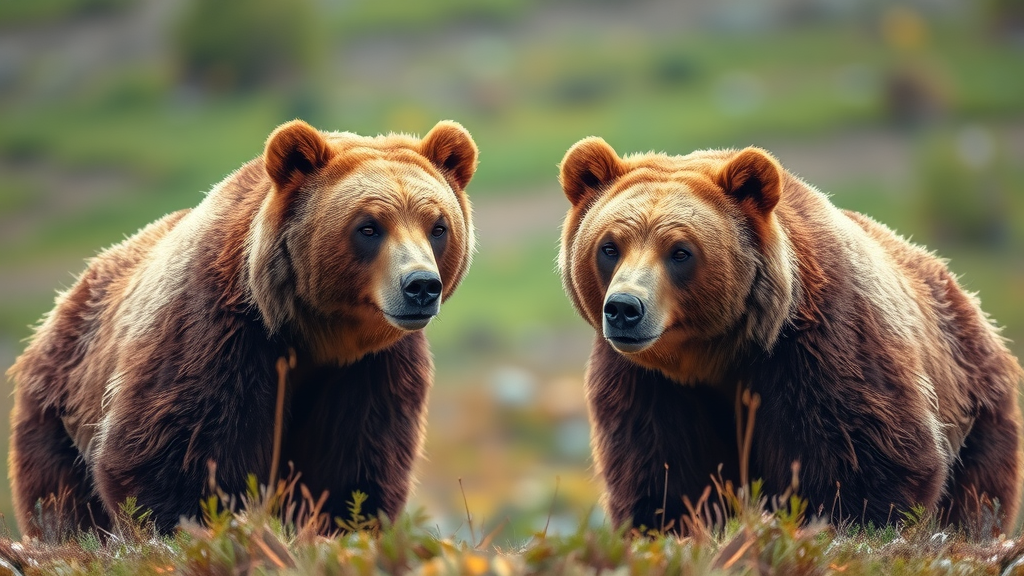
On the northern Japanese island of Hokkaido, brown bears tell a genetic story that has puzzled scientists for decades. The island’s bears carry three deeply divergent mitochondrial DNA lineages, each confined to a different part of the island, yet their Y chromosomes show almost no structure at all. A new genomic study, published in Ecology and Evolution, has now untangled this mismatch and revealed a remarkable demographic history: a population that colonized Hokkaido from the Eurasian continent, collapsed during the Last Glacial Period, and then rebounded largely on the backs of long-distance dispersing males.
The research team, led by Yu Endo of the Hokkaido Research Organization collaboration, analyzed 49 brown bears sampled from all six management units defined in Hokkaido’s brown bear management plan, from the Oshima Peninsula in the southwest to the Doto region in the east. Using double digest restriction-site associated DNA sequencing, or ddRAD-seq, the researchers generated millions of autosomal genetic variants, alongside X-chromosomal markers, and compared these with previously published mitochondrial and Y-chromosomal data. The result was one of the most detailed genomic portraits of any insular brown bear population to date.
The genetic structure analyses told a consistent story. Principal component analysis, fineRADstructure clustering, and ADMIXTURE all separated the southern subpopulations of South Oshima and South Ishikari from the central and eastern subpopulations of Central Hidaka, Central Sohya, and East Doto. The differentiation between south and rest was substantial, with FST values ranging from 0.047 to 0.089, while differentiation among the central and eastern subpopulations was weak. Notably, the boundary between the southern group and the rest coincided with the boundary between two of the three mitochondrial lineages, clade 4 and clade 3a2, but the boundary between clades 3a2 and 3b found no clear support in the autosomal data.
That asymmetry is the fingerprint of sex-biased dispersal. In brown bears, as in most carnivores, males disperse far from their birthplace while females stay near where they were born. In Hokkaido, adult male home ranges span 199 to 496 square kilometers, whereas females occupy just 13.4 to 43 square kilometers. Because mitochondrial DNA is inherited only through mothers, it records female movement, which is limited; the Y chromosome records male lineages, which mix freely; and the autosomes record both. The Hokkaido bears show exactly the pattern predicted by extreme male-biased dispersal: structured mitochondria, unstructured Y chromosomes, and autosomes in between.
The team quantified this bias using Q statistics, which compare genetic drift on the X chromosome with drift on the autosomes. If effective population sizes and dispersal are equal between the sexes, Q converges on 0.75. In the Hokkaido bears, all Q values fell well below that expectation, ranging from 0.324 to 0.463, indicating that X-chromosomal differentiation was stronger than expected under sex-neutral demography. Because brown bears show no confirmed bias in sex ratio or in reproductive success between the sexes, the most parsimonious explanation is male-biased dispersal, which reduces the effective migration of X-linked variants relative to autosomal ones.
Demographic modeling with fastsimcoal2, using more than 11 million autosomal sites, tested five scenarios of population change. The best-supported model was a single bottleneck: the effective population size began declining roughly 80,663 years ago, with a 95 percent confidence interval of about 59,000 to 102,000 years, and the decline ended around 31,834 years ago. Those dates place the crash squarely within the Last Glacial Period, which ran from approximately 70,000 to 10,000 years ago. After the bottleneck, the model detected a rapid recent expansion, consistent with a population that now numbers around 12,200 individuals as of 2022.
Why did the population crash? The answer appears to lie in climate. The researchers built species distribution models using Maxent, trained on occurrence records from the Global Biodiversity Information Facility and seven uncorrelated bioclimatic variables, dominated by precipitation of the driest quarter, mean temperature of the wettest quarter, and temperature annual range. Projecting the model onto paleoclimate surfaces for the Last Glacial Maximum around 21,000 years ago revealed that relative habitat suitability in Hokkaido was low. During that period the island was covered largely by coniferous forest, grassland, and tundra, and palynological records indicate that oak nuts, a staple of the brown bear diet, were scarce. The absence of Late Pleistocene brown bear fossils on Hokkaido further supports the inference that the island was marginal habitat at the height of the ice age.
Landscape genetics added a second layer to the story: geography shaped the recovery. Mantel tests, partial Mantel tests, and resistance modeling with ResistanceGA all showed that low elevation, not high elevation, acted as the main barrier to gene flow. The Ishikari lowland, which separates the southern subpopulations from the rest of the island, emerged as the region of lowest estimated migration in EEMS analysis. During the mid-Holocene this lowland contained a brackish lake, oxbow lakes, and extensive peatlands, environments poor in the forest foods bears depend on. Crucially, the lowland barrier signal appeared in mitochondrial and autosomal data but not in Y-chromosomal data, meaning females were impeded by the lowlands while males crossed them with ease. In other bear species, such as the American black bear and the Asiatic black bear, highlands act as dispersal barriers; Hokkaido’s bears are unusual in that their movements are constrained by the flats.
Synthesizing these lines of evidence, the authors propose a three-act demographic history. First, bears migrated into Hokkaido from Eurasia before the Last Glacial Period, though the exact timing and whether the three mitochondrial lineages were already geographically separated remain unresolved. Second, as glacial climate shrank suitable habitat, the population contracted and retreated, allowing different mitochondrial lineages to become fixed in different refugial regions, a process consistent with the random differential fixation proposed by earlier whole-genome work but now tied to a specific climatic mechanism. Third, after the climate ameliorated, the population expanded, and because dispersing males carried their genes across the island far more effectively than philopatric females, the Y chromosome and much of the genome were homogenized while the maternal lineages retained their separate distributions. The nuclear genome of Hokkaido’s bears is monophyletic relative to the continent, confirming that this mixing happened entirely on the island after colonization.
The findings carry practical weight for conservation. Hokkaido’s bears endured a severe cull-driven decline in the 1990s, and human-bear conflict is rising again as the population stabilizes. The study’s genomic results align with the subpopulations designated in the current management plan but argue for recognizing the southern subpopulations as a distinct unit, given their clear genetic differentiation. More importantly, the authors argue, management should focus not only on how units are divided but on maintaining connectivity between them, particularly through the lowlands that have constrained female dispersal for millennia and are now dominated by roads, farms, and urban development. A population that once rebounded thanks to the wandering habits of its males may depend, in the coming century, on whether those same corridors remain open.
Subject of Research: Sex-biased dispersal and post-glacial demographic history of the Hokkaido brown bear population
Article Title: Male‐Biased Dispersal Leads to Expansion After Decline: The Hokkaido Brown Bear (Ursus arctos) Population Rebounds Post‐Last Glacial Period
Article References: Endo, Y., Osada, N., Mano, T., Nagano, A. J., & Masuda, R. (2026). Male‐Biased Dispersal Leads to Expansion After Decline: The Hokkaido Brown Bear ( Ursus arctos ) Population Rebounds Post‐Last Glacial Period. Ecology and Evolution, 16(9), Article e74312. https://doi.org/10.1002/ece3.74312
Image Credits: AI Generated
DOI: 10.1002/ece3.74312
Keywords: brown bear, Hokkaido, sex-biased dispersal, mitochondrial DNA, Y chromosome, population genomics, Last Glacial Maximum, landscape genetics, ddRAD-seq, fastsimcoal2, species distribution modeling, wildlife management
Cite Scienmag News
Juliet Wilcox. (September 24, 2026). Male Bears Rebuilt Hokkaido’s Brown Bear Population After an Ice Age Collapse. Scienmag. https://scienmag.com/male-bears-rebuilt-hokkaidos-brown-bear-population-after-an-ice-age-collapse/
Juliet Wilcox. "Male Bears Rebuilt Hokkaido’s Brown Bear Population After an Ice Age Collapse." Scienmag, 24 September 2026, https://scienmag.com/male-bears-rebuilt-hokkaidos-brown-bear-population-after-an-ice-age-collapse/. Accessed 4 October 2026.
Juliet Wilcox. "Male Bears Rebuilt Hokkaido’s Brown Bear Population After an Ice Age Collapse." Scienmag. September 24, 2026. https://scienmag.com/male-bears-rebuilt-hokkaidos-brown-bear-population-after-an-ice-age-collapse/


