


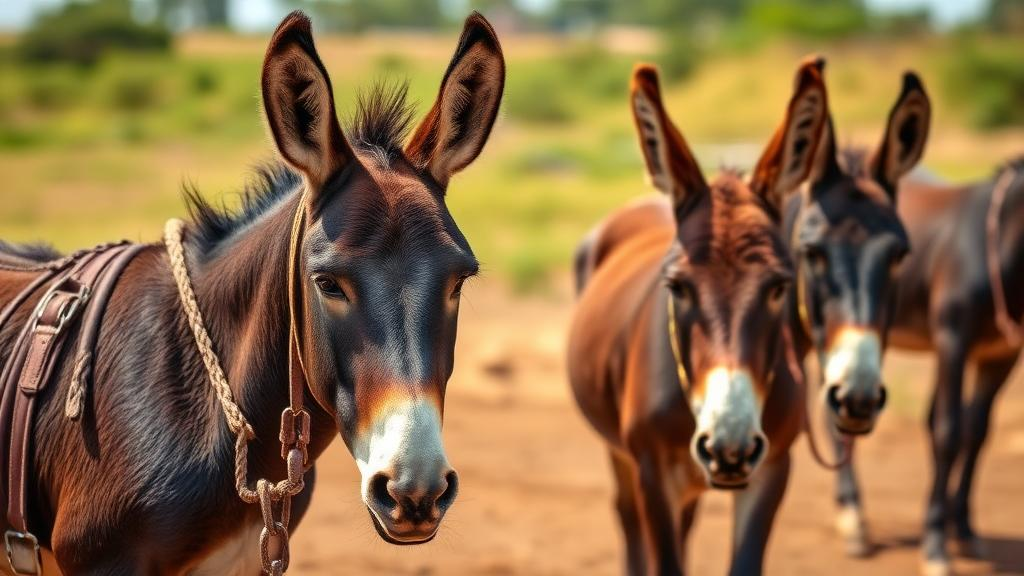
In the rolling plains and mountains of central Malawi, donkeys haul water, firewood, crops and farm inputs for thousands of rural households, yet the animals that make this daily labor possible have vanished from the country’s agricultural policy radar. A new study of donkey-keeping farmers in the Dowa, Lilongwe and Dedza districts reveals a sector surviving almost entirely on its own: not a single surveyed farmer had ever received formal training in donkey production, and none used modern breeding techniques, relying instead on uncontrolled mating that researchers warn could trigger a genetic crisis within the national herd. The findings, published in BMC Agriculture, offer the most detailed picture yet of how one of Africa’s most overlooked livestock species is actually managed on the ground.
The research team, led by Zondiwe Mabilabo Jere of Mzuzu University, surveyed 168 donkey farmers across five Extension Planning Areas in the country’s Central Region, the zone where most of Malawi’s estimated 17,104 donkeys are concentrated. Donkeys first arrived in the country in 1957, when the colonial government introduced them to boost agricultural mechanization. Since then they have become embedded in rural life, pulling carts between farms and markets, carrying sick family members to clinics, and performing tillage work that would otherwise fall entirely to hand tools. Yet the 2021 National Livestock Development Policy does not mention donkeys at all, and the animals are absent from the Ministry of Agriculture’s statistical records, leaving planners without even basic population data.
The survey painted a detailed demographic portrait of who keeps donkeys. The average household head was 42.3 years old, with ages ranging from 8 to 83, and the average household contained 5.4 members. An overwhelming 92.2 percent of donkey-keeping households were headed by men, a pattern the authors attribute to the widespread perception that livestock management is a male domain. Most farmers were married, farmed as their primary occupation, and had limited formal education: 66.1 percent had never progressed beyond primary school. Interestingly, 65.5 percent of farmers participated in credit activities, with nearly half borrowing through village savings and loan groups rather than mainstream banks, reflecting the limited reach of formal financial institutions in rural Malawi.
How farmers acquired their animals tells its own story about policy neglect. Some 93.2 percent of donkey owners bought their animals from fellow farmers, while the remaining 6.8 percent inherited them. Unlike cattle, goats and chickens, which benefit from government and non-governmental pass-on and distribution programs, donkeys receive no such interventions anywhere in the country. The trade is entirely informal: there are no organized donkey markets, no auction systems and no industrial buyers. When farmers do sell, 89.2 percent sell to other farmers, creating a closed circular market in which prices are set by local negotiation rather than any broader value chain.
The breeding picture is perhaps the most technically alarming finding. Farmers keep three types of animals: local breeds dominate at 95.5 percent, with small numbers of exotic and crossbred donkeys. But 70.2 percent of farmers practice inbreeding, the mating of related individuals, because herds graze together freely and no controlled mating system exists. All farmers rely solely on natural mating, and none use artificial insemination, a technique that is now well established for donkeys elsewhere in the world, including practical protocols for timed insemination of jennies using cooled or frozen semen. The authors warn that continued inbreeding depression could ultimately drive local donkey populations toward extinction, and they call for a formal stud breeding program to introduce controlled genetic management before a genetic bottleneck becomes irreversible.
Housing practices offered a rare bright spot. Every single donkey in the study area was housed, a striking contrast to findings from Ethiopia, Ghana and Botswana, where donkeys are often tethered in the open or left to roam without shelter. Farmers explained that they house their donkeys because they regard them as valuable household assets. The quality of housing varies considerably, however: 72 percent of floors were made of mud, only 23.3 percent of walls were built of bricks, and 72 percent of roofs were thatched with grass that must be replaced annually. Mud floors do allow drainage during leaks and cleaning, but the temporary wall and roof materials impose recurring maintenance costs on already resource-constrained households.
Feeding followed an extensive pattern. Nearly all farmers, 94.6 percent, used a free-range system in which donkeys graze natural pasture, supplemented with maize bran by 80.4 percent of households and crop residues by 64.3 percent. Feed availability follows a pronounced seasonal cycle: it is abundant from May through July, when the harvest produces maize bran and crop residues in quantity, and scarce from December through February, the early rainy season when pasture grass has not yet established and donkeys are tethered to keep them out of growing crops. The authors argue that closing this seasonal feed gap, potentially through hay and silage production from local materials, is essential for sustainable year-round donkey nutrition.
Health problems clustered in the same rainy-season months. Body sores affected 88 percent of donkeys, mud-related conditions 34 percent and weight loss 23.1 percent, with most cases reported in December, January, February and March. Some of these sores stem directly from welfare deficits documented elsewhere in Malawi, including the use of carts designed for oxen, which wound donkeys’ shoulders and necks. On the preventive side, 60 percent of farmers vaccinated their animals and 30 percent practiced hygiene in the donkey houses, while only 8 percent took no preventive measures at all. Assistant Veterinary Officers interviewed for the study confirmed that many farmers still provide no preventive health care, leaving a substantial gap in parasite and disease control.
The economics of donkey ownership remain modest. Foals sold for between 50,500 and 80,000 Malawian Kwacha, roughly 29 to 46 US dollars at the exchange rate cited in the study, while colts fetched 130,000 to 250,000 Kwacha and mature jennies or jacks around 180,000 Kwacha. Only 49.6 percent of farmers sold donkeys at all, which the authors attribute to small herd sizes and the time needed to build stock. Without commercialization, formal markets or industrial buyers, farmers cannot capture better prices, and the sector cannot attract the investment needed to improve genetics, nutrition and welfare.
The study’s recommendations are directed at a specific coalition of institutions: the Department of Animal Health and Livestock Development, the Department of Agricultural Extension Services, Mzuzu University, Lilongwe University of Agriculture and Natural Resources, Mikolongwe College of Veterinary Sciences, and the Lilongwe Society for the Protection and Care of Animals. The authors propose training programs for donkey farmers, organizing farmers into groups, establishing a stud breeding program to halt inbreeding, commercializing the sector to attract industrial buyers, and strengthening extension services so farmers can adopt modern techniques in breeding, feeding, and parasite and disease control. For an animal that transformed ancient transport systems across Africa and Asia and now quietly underpins rural livelihoods across Malawi, the message of the research is blunt: donkeys have survived decades of institutional neglect, but survival is not the same as sustainability, and without deliberate policy attention the country’s hardest-working livestock may face a future shaped by shrinking genetics, seasonal hunger and markets that never matured.
Subject of Research: Donkey production management and marketing practices among smallholder farmers in central Malawi
Article Title: Surviving amidst neglect: management and marketing practices of donkeys (Equus asinus) in Central Region of Malawi
Article References: Jere, Z. M., Zidana, R., Chatambalala, J., Mwafulirwa, S., & Nyirenda, Z. (2025). Surviving amidst neglect: management and marketing practices of donkeys (Equus asinus) in Central Region of Malawi. BMC Agriculture, 1(1), Article 3. https://doi.org/10.1186/s44399-025-00003-z
Image Credits: AI Generated
DOI: 10.1186/s44399-025-00003-z
Keywords: donkeys, Malawi, livestock, animal breeding, inbreeding, agricultural mechanization, smallholder farming, animal welfare, livestock markets, rural livelihoods, veterinary health, feed management
Cite Scienmag News
William Thompson. (October 4, 2026). Malawi’s Neglected Donkeys Face Inbreeding Crisis as Farmers Lack Training and Markets. Scienmag. https://scienmag.com/malawis-neglected-donkeys-face-inbreeding-crisis-as-farmers-lack-training-and-markets/
William Thompson. "Malawi’s Neglected Donkeys Face Inbreeding Crisis as Farmers Lack Training and Markets." Scienmag, 4 October 2026, https://scienmag.com/malawis-neglected-donkeys-face-inbreeding-crisis-as-farmers-lack-training-and-markets/. Accessed 4 October 2026.
William Thompson. "Malawi’s Neglected Donkeys Face Inbreeding Crisis as Farmers Lack Training and Markets." Scienmag. October 4, 2026. https://scienmag.com/malawis-neglected-donkeys-face-inbreeding-crisis-as-farmers-lack-training-and-markets/


