


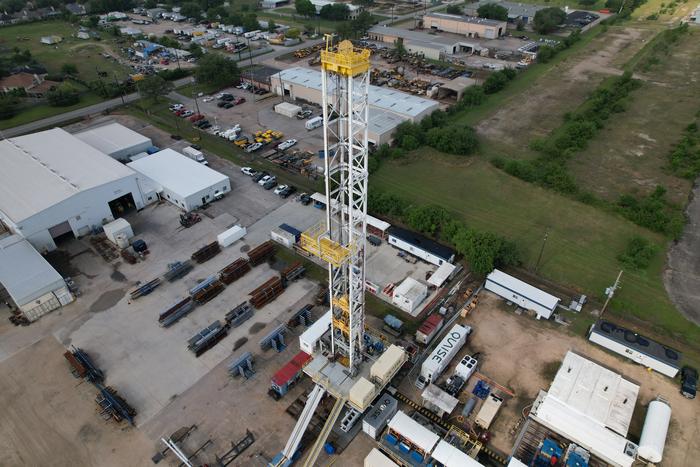
In a landmark achievement for geothermal energy, Quaise Energy has transitioned from laboratory experiments to real-world application by successfully demonstrating its groundbreaking drilling technology on a full-scale oil rig just outside Houston, Texas. Founded only seven years ago, the company is on a mission to tap into the earth’s nearly inexhaustible store of geothermal heat, a resource that experts believe could eclipse all other energy sources combined. Carlos Araque, CEO and co-founder of Quaise, emphasized the magnitude of this untapped power, stating that the thermal energy stored beneath the Earth’s crust surpasses the combined potential of all fossil fuels, nuclear power, and other renewable energy forms manyfold. His vision points to an era where clean energy is derived from depths between two and twelve miles underground, effectively unlocking a truly global and sustainable power source.
The most promising geothermal resource lies in what is known as the supercritical zone, found deep beneath the surface where extreme temperatures and pressures transform water into a supercritical fluid—a state distinct from familiar liquid water, steam, or ice. Supercritical water possesses unique physical properties that allow it to carry five to ten times more energy than conventional geothermal steam, making it an extraordinarily efficient medium for heat transfer and power generation. However, accessing this zone has long eluded engineers, as traditional drilling technologies prove inadequate beyond a few miles due to the intense heat and pressure conditions that degrade drill bits rapidly and exponentially increase operational costs.
Quaise Energy’s solution leverages millimeter-wave energy, a sophisticated form of electromagnetic radiation akin to the microwaves used in household appliances but operating at much higher frequencies. Rather than mechanically grinding and breaking rock, Quaise’s approach involves directing focused millimeter waves to literally melt and vaporize the granite and basalt that compose the hard rock layers deep underground. This thermal ablation technique not only circumvents the mechanical wear problems associated with conventional drills but also enables the creation of deeper and wider boreholes more efficiently. The innovation stems from foundational work at MIT, where scientists demonstrated that gyrotrons—high-powered millimeter-wave generators originally developed for nuclear fusion research—could successfully drill into hard rock like basalt, setting the stage for industrial-scale applications.
The recent demonstration held at the Nabors-operated oil rig showcased the integration of Quaise’s millimeter-wave drill with conventional rig infrastructure. Engineers created an artificial granite core approximately 80 feet long inside a metal casing embedded with sensors to monitor temperature, pressure, and other key parameters. During the event, the team succeeded in extending an existing 10-foot, four-inch diameter hole within this granite core to a new depth of 30 feet, marking a significant milestone in the scalable implementation of this technology. The demonstration utilized a gyrotron capable of producing 100 kilowatts, roughly one-tenth of the power needed for commercial operations, but serving as a crucial proof-of-concept for the technology’s viability under operational conditions.
Looking ahead, Quaise plans to further escalate power delivery with the imminent arrival of a one-megawatt gyrotron, representing a leap into true commercial relevance. This advancement will facilitate deeper drilling and significantly higher throughput, bringing the company closer to realizing its goal of economically viable superdeep geothermal energy production. Concurrently, preparations are underway for a subsequent demonstration in Marble Falls, Texas, where the team aims to drill into actual granite rock formations up to 130 meters (approximately 425 feet) deep. This site, equipped with a smaller and more mobile rig, will enable rapid transitions between boreholes, thereby accelerating data collection and refining drilling protocols.
Beyond advancements in drilling technology, Quaise is addressing the complex challenges associated with harnessing the extreme heat and pressure conditions characteristic of superdeep geothermal environments. Collaborations with academic institutions and industry partners have yielded valuable insights into thermal rock-water interactions, phase transitions within supercritical fluids, and the design requirements for resilient materials and power plant configurations capable of withstanding these harsh environments. Notably, research supported by Quaise at the École Polytechnique Fédérale de Lausanne recently validated models for heat transfer in supercritical zones, findings published in the journal Nature Communications.
Complementing these scientific advances, the company’s internal engineering teams are developing next-generation geothermal power plants optimized for superhot rock formations. Detailed studies have informed design innovations aimed at maximizing heat extraction efficiency and plant longevity under severe operating conditions. These efforts build on the expertise of a multidisciplinary team with backgrounds in oil and gas, nuclear fission, and nuclear fusion industries, all contributing to the robust maturation of this revolutionary energy sector.
Quaise’s strategy for commercialization involves a tiered approach to site development based on geological and geothermal characteristics worldwide. Tier 1 sites represent the “low-hanging fruit,” where traditionally accessible superhot rock can be tapped with existing technology and infrastructure. These initial deployments are expected to occur in geothermally active regions such as the American West, with early projects likely near the Newberry Volcano in Oregon, a focal point for geothermal research and development. Tier 3 sites, representing the true frontier, will involve drilling as deep as 12 miles to access supercritical zones globally, potentially supplying clean power to over 90% of humanity.
The team’s confidence stems not only from technological innovation but also from its provenance. Many scientists and engineers at Quaise have track records of invention and patents, including contributions to advanced oil and gas reservoir management solutions such as Schlumberger’s Manara technology. This collective experience underpins a pragmatic yet ambitious pathway toward establishing superdeep, superhot geothermal energy as a cost-competitive and scalable alternative to fossil fuels and other energy sources.
Ultimately, Quaise Energy’s milestone demonstration symbolizes a bold step toward redefining the global energy landscape. By harnessing millimeter-wave drilling technology developed over decades of fundamental research and integrating it into existing drilling infrastructure, the company is charting a route to limitless, carbon-free power extracted from the Earth’s hidden heat reservoirs. As the world grapples with the imperatives of climate change and energy security, innovations like those from Quaise offer a tantalizing glimpse into a future where geothermal energy fulfills its long-held promise as a cornerstone of sustainable energy systems.
News Publication Date: May 22, 2024
Web References:
https://www.quaise.energy/
https://news.mit.edu/2022/quaise-energy-geothermal-0628
https://www.nabors.com/our-company/
https://www.energy.gov/eere/geothermal/geothermal-technologies-office
https://www.epfl.ch/en/
https://www.quaise.energy/news/deep-geothermal-energy-lifes-origin-future
https://www.quaise.energy/news/mining-the-heat-below-our-feet-could-unlock-clean-energy-for-the-world
https://www.quaise.energy/news/from-lab-to-field-testing
https://www.quaise.energy/news/millimeter-wave-drilling-the-key-to-clean-energy-abundance
https://www.quaise.energy/news/international-multidisciplinary-collaborations-key-to-bringing-superhot-clean-geothermal-energy-to-the-world-2
https://www.quaise.energy/news/lab-data-confirm-potential-of-geothermals-holy-grail-superdeep-superhot-rock-as-important-renewable-energy-source
https://www.quaise.energy/news/quaise-energy-reports-new-insights-into-designing-superhot-geothermal-plants
https://events.offsnet.com/GTSNA2025-GeothermalandOilGasConference-HoustonUS
References:
Cladouhos, T., et al. (2023). "Thermal dynamics of supercritical geothermal reservoirs." Nature Communications.
MIT Energy Initiative. (2022). "Millimeter-wave drilling for superdeep geothermal energy."
Keywords
Supercritical geothermal energy, millimeter-wave drilling, gyrotron technology, superdeep drilling, renewable energy innovation, geothermal power plant design, thermal rock ablation, advanced drilling techniques, clean energy technology, superhot rock extraction, energy transition, geothermal resource development
Cite Scienmag News
Bethany Barker. (June 3, 2025). Major Demonstration Advances Quaise Energy’s Mission to Power the World with Clean, Renewable Geothermal Energy. Scienmag. https://scienmag.com/major-demonstration-advances-quaise-energys-mission-to-power-the-world-with-clean-renewable-geothermal-energy/
Bethany Barker. "Major Demonstration Advances Quaise Energy’s Mission to Power the World with Clean, Renewable Geothermal Energy." Scienmag, 3 June 2025, https://scienmag.com/major-demonstration-advances-quaise-energys-mission-to-power-the-world-with-clean-renewable-geothermal-energy/. Accessed 4 September 2026.
Bethany Barker. "Major Demonstration Advances Quaise Energy’s Mission to Power the World with Clean, Renewable Geothermal Energy." Scienmag. June 3, 2025. https://scienmag.com/major-demonstration-advances-quaise-energys-mission-to-power-the-world-with-clean-renewable-geothermal-energy/


