

Monday, July 13, 2026
Science
No Result
View All Result
  • Login
  • HOME
  • SCIENCE NEWS
  • CONTACT US
  • HOME
  • SCIENCE NEWS
  • CONTACT US
No Result
View All Result
Scienmag
No Result
View All Result
Home Science News Earth Science

Mainshock Locations Influence Earthquake Size Patterns

July 13, 2026
in Earth Science
Reading Time: 2 mins read
0
Mainshock Locations Influence Earthquake Size Patterns

Mainshock Locations Influence Earthquake Size Patterns

65
SHARES
587
VIEWS
Share on FacebookShare on Twitter
ADVERTISEMENT

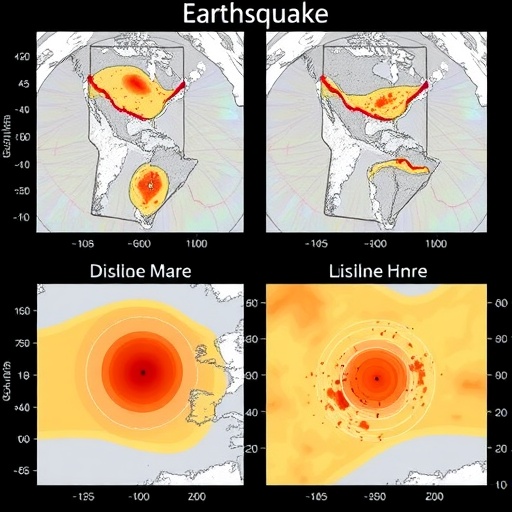
A new study investigating earthquake size distributions in Japan challenges existing assumptions about seismic forecasting, revealing that the location of a large earthquake’s mainshock plays a decisive role in earthquake patterns rather than temporal fluctuations in seismicity parameters. Researchers from Kyoto University and ETH Zurich analyzed extensive earthquake data spanning 25 years, uncovering critical insights into the enigmatic “b-value” — a statistical measure long used to gauge the relative frequency of small versus large earthquakes.

The b-value, derived from the Gutenberg-Richter relationship, effectively characterizes earthquake size distributions. High b-values signal predominance of smaller quakes, while low b-values indicate a relatively greater likelihood of larger events. Prior research debated whether b-values notably decrease before major earthquakes or rebound afterward, potentially reflecting stress accumulation and release in the Earth’s crust.

The collaborative study scrutinized the Japan Meteorological Agency’s comprehensive earthquake catalog from 2000 to 2025, focusing on seismic sequences of magnitude 6 and above. By applying stringent spatial, depth, and temporal filters, the team ensured data reliability while minimizing confounding effects from overlapping seismic events. Contrary to expectations, their results showed no systematic change in b-values preceding or following large earthquakes.

Instead, the key finding is spatially grounded: large earthquakes predominantly occur in regions exhibiting slightly lower b-values relative to surrounding areas. This suggests that the inherent geological and stress conditions at specific fault zones shape the earthquake size distribution more fundamentally than any temporal patterns around individual events. In other words, where a mainshock originates strongly influences its seismic characteristics, rather than when it happens in relation to previous activity.

“This research shifts our understanding of earthquake predictability metrics,” says lead co-author Bogdan Enescu. “It highlights the importance of local tectonic environment and rock mechanics in controlling earthquake magnitudes, rather than relying on time-dependent variations of seismicity parameters.”

While the findings do not enable short-term earthquake prediction, they provide a refined statistical framework with implications for long-term seismic hazard assessment. Recognizing that b-values encapsulate local geological realities rather than transient precursory signals enhances the interpretive power of seismic catalogs globally.

These insights pave the way for more nuanced seismic risk models that integrate spatial variation in crustal properties and stress regimes. The researchers emphasize that ongoing improvements in instrumentation and data analysis will further unravel the complex mechanisms governing earthquake occurrence.

The study, titled “b-Values of Large Earthquake Sequences Depend on Their Mainshock Location,” was published in Geophysical Research Letters and represents a significant advance in seismology, bolstering efforts to comprehend and mitigate earthquake hazards in tectonically active regions worldwide.


Subject of Research: Not applicable
Article Title: b-Values of Large Earthquake Sequences Depend on Their Mainshock Location
News Publication Date: 12-Jul-2026
Web References: http://dx.doi.org/10.1029/2025GL121450
Image Credits: Aron Mirwald
Keywords: b-value, earthquake size distribution, seismicity, Japan, mainshock location, earthquake prediction, tectonics, seismic hazard

Tags: b-value analysisearthquake catalog analysisearthquake magnitude patternsearthquake mainshock influenceearthquake size distribution patternsGutenberg-Richter relationshipJapan seismic activityseismic forecastingseismic hazard assessmentseismicity parameter fluctuationsspatial distribution of large earthquakesstress accumulation and release
Share26Tweet16
Previous Post

Vitamin K Prevents Bleeding Risks in Newborns and Infants

Next Post

China Advances Strategies for Managing Earthquake Risks

Related Posts

New AI Model Aids Water Management Amid Worsening National Drought
Earth Science

New AI Model Aids Water Management Amid Worsening National Drought

July 13, 2026
Latitudinal Manganese Patterns Linked to Earth’s Major Ice Ages
Earth Science

Latitudinal Manganese Patterns Linked to Earth’s Major Ice Ages

July 13, 2026
Human Activities Intensify Hydrometeorological Drought Across North Africa Over Time
Earth Science

Human Activities Intensify Hydrometeorological Drought Across North Africa Over Time

July 13, 2026
Indian Ocean Could Influence Mediterranean Climate Amid Super El Niño Event
Earth Science

Indian Ocean Could Influence Mediterranean Climate Amid Super El Niño Event

July 13, 2026
Urban Sulfate Aerosols Transported from Boundary Layer to Higher Altitudes
Earth Science

Urban Sulfate Aerosols Transported from Boundary Layer to Higher Altitudes

July 13, 2026
Southern Ocean phytoplankton show divergent surface community changes through pigment analysis
Earth Science

Southern Ocean phytoplankton show divergent surface community changes through pigment analysis

July 13, 2026
Next Post
China Advances Strategies for Managing Earthquake Risks

China Advances Strategies for Managing Earthquake Risks

  • Mothers who receive childcare support from maternal grandparents show more

    Mothers who receive childcare support from maternal grandparents show more parental warmth, finds NTU Singapore study

    27656 shares
    Share 11059 Tweet 6912
  • University of Seville Breaks 120-Year-Old Mystery, Revises a Key Einstein Concept

    1061 shares
    Share 424 Tweet 265
  • Bee body mass, pathogens and local climate influence heat tolerance

    682 shares
    Share 273 Tweet 171
  • Researchers record first-ever images and data of a shark experiencing a boat strike

    546 shares
    Share 218 Tweet 137
  • Groundbreaking Clinical Trial Reveals Lubiprostone Enhances Kidney Function

    531 shares
    Share 212 Tweet 133
Science

Embark on a thrilling journey of discovery with Scienmag.com—your ultimate source for cutting-edge breakthroughs. Immerse yourself in a world where curiosity knows no limits and tomorrow’s possibilities become today’s reality!

RECENT NEWS

  • New Imaging Technology Reveals Cellular Origins of Alzheimer’s, Parkinson’s, and ALS
  • Pregnancy Could Indicate Future Heart and Metabolic Health Risks
  • Scientists and Citizens More Effective Than Government in Driving Action, Study Shows
  • New AI Model Aids Water Management Amid Worsening National Drought

Categories

  • Agriculture
  • Anthropology
  • Archaeology
  • Athmospheric
  • Biology
  • Biotechnology
  • Blog
  • Bussines
  • Cancer
  • Chemistry
  • Climate
  • Earth Science
  • Editorial Policy
  • Marine
  • Mathematics
  • Medicine
  • Pediatry
  • Policy
  • Psychology & Psychiatry
  • Science Education
  • Social Science
  • Space
  • Technology and Engineering

Subscribe to Blog via Email

Enter your email address to subscribe to this blog and receive notifications of new posts by email.

Join 5,146 other subscribers

© 2025 Scienmag - Science Magazine

Welcome Back!

Login to your account below

Forgotten Password?

Retrieve your password

Please enter your username or email address to reset your password.

Log In
No Result
View All Result
  • HOME
  • SCIENCE NEWS
  • CONTACT US

© 2025 Scienmag - Science Magazine

Discover more from Science

Subscribe now to keep reading and get access to the full archive.

Continue reading
