


WASHINGTON, April 23, 2024 — Neural stimulation is a medical technique used to treat many illnesses affecting the nervous system. It involves applying energy to neurons to encourage them to grow and make connections with their neighbors. Treatments for epilepsy can often include neural stimulation, and similar treatments exist for Parkinson’s disease, chronic pain, and some psychiatric illnesses.

Credit: Saha et al.
WASHINGTON, April 23, 2024 — Neural stimulation is a medical technique used to treat many illnesses affecting the nervous system. It involves applying energy to neurons to encourage them to grow and make connections with their neighbors. Treatments for epilepsy can often include neural stimulation, and similar treatments exist for Parkinson’s disease, chronic pain, and some psychiatric illnesses.
In the Journal of Vacuum Science & Technology A, by AIP Publishing, researchers from the University of Minnesota deployed an array of microscopic coils — microcoils — to create a magnetic field and stimulate individual neurons.
Existing devices are effective, but lack the necessary precision needed for some applications, such as cochlear implants or vagus nerve stimulators.
“There are several neurostimulation devices on the market – some are already FDA-approved for patient trials, some are pending approval,” said author Renata Saha. “But each of them has one caveat – they stimulate a large population of neurons, including neighboring cells that are not supposed to be stimulated. The medical device industry is in search of a device or technique that can stimulate neurons at a single-cell resolution.”
Instead of using an electrode, Saha and her team turned to magnetic coils of wire. Over two centuries ago, physicist Michael Faraday described how electric current running through a coil of wire can create a magnetic field. This magnetic field can then induce an electric field in any nearby neurons — the same effect created by an electrode but much more precise. However, this technique comes with a major downside.
“To achieve the desired threshold of electric field capable of stimulating neurons, the amount of current these microcoils need to drive is extremely high,” said Saha. “It is almost three times the amount of current that needs to drive an electrode to achieve the same threshold.”
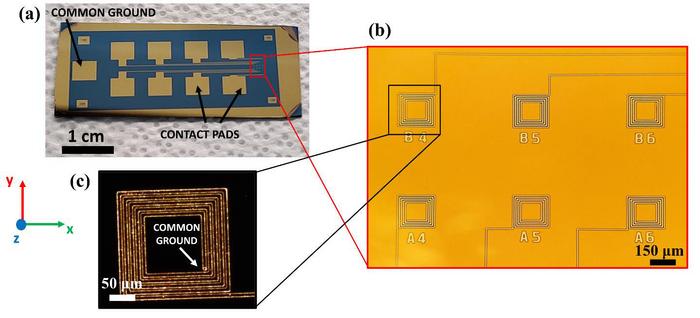
To solve this problem, the team made two improvements. First, rather than a single microcoil, they used an array of eight coils, which combined can induce electric fields using much less current per coil. The authors made further improvement to these microcoil arrays by employing soft magnetic materials, which boost the magnetic strength of the coils.
“Adding these soft magnetic materials at the core of the microcoils increases the electric field without the need to increase the current through the microcoils,” said Saha.
The researchers constructed a prototype of their coil array, called MagPatch, and encapsulated it within a biocompatible coating. They then tested it with human neuroblastoma cells to demonstrate its effectiveness. The cells were affected by the magnetic fields without being harmed by the coating, suggesting the potential to use this device in clinical settings.
The authors plan to continue developing and testing the MagPatch device to ensure its safety and utility. They hope it helps to improve the next generation of cochlear implants.
###
The article “Planar microcoil arrays for in vitro cellular-level micromagnetic activation of neurons” is authored by Renata Saha, Onri Jay Benally, Sadegh Faramarzi, Robert P. Bloom, Kai Wu, Denis Tonini, Maple Shiao, Susan A. Keirstead, Walter C. Low, Theoden I. Netoff, and Jian-Ping Wang. It will appear in Journal of Vacuum Science & Technology B on April 23, 2024 (DOI: 10.1116/6.0003362). After that date, it can be accessed at https://doi.org/10.1116/6.0003362.
ABOUT THE JOURNAL
Journal of Vacuum Science & Technology B, an AVS journal published by AIP Publishing, is devoted to publishing reports of original research, letters, and review articles covering multiple disciplines with a focus on microelectronics and nanotechnology. See https://avs.scitation.org/journal/jvb.
ABOUT AVS
AVS is an interdisciplinary, professional society with some 4,500 members worldwide. Founded in 1953, AVS hosts local and international meetings, publishes five journals, serves members through awards, training and career services programs, and supports networking among academic, industrial, government, and consulting professionals. Its members come from across the fields of chemistry, physics, biology, mathematics, engineering, and business and share a common interest in basic science, technology development and commercialization related to materials, interfaces, and processing. https://www.avs.org.
###
Journal
Journal of Vacuum Science & Technology B Microelectronics and Nanometer Structures Processing Measurement and Phenomena
Article Title
Planar microcoil arrays for in vitro cellular-level micromagnetic activation of neurons
Article Publication Date
23-Apr-2024
Cite Scienmag News
Cassandra Pierce. (April 23, 2024). Magnetic microcoils unlock targeted single-neuron therapies for neurodegenerative disorders. Scienmag. https://scienmag.com/magnetic-microcoils-unlock-targeted-single-neuron-therapies-for-neurodegenerative-disorders/
Cassandra Pierce. "Magnetic microcoils unlock targeted single-neuron therapies for neurodegenerative disorders." Scienmag, 23 April 2024, https://scienmag.com/magnetic-microcoils-unlock-targeted-single-neuron-therapies-for-neurodegenerative-disorders/. Accessed 3 September 2026.
Cassandra Pierce. "Magnetic microcoils unlock targeted single-neuron therapies for neurodegenerative disorders." Scienmag. April 23, 2024. https://scienmag.com/magnetic-microcoils-unlock-targeted-single-neuron-therapies-for-neurodegenerative-disorders/

