


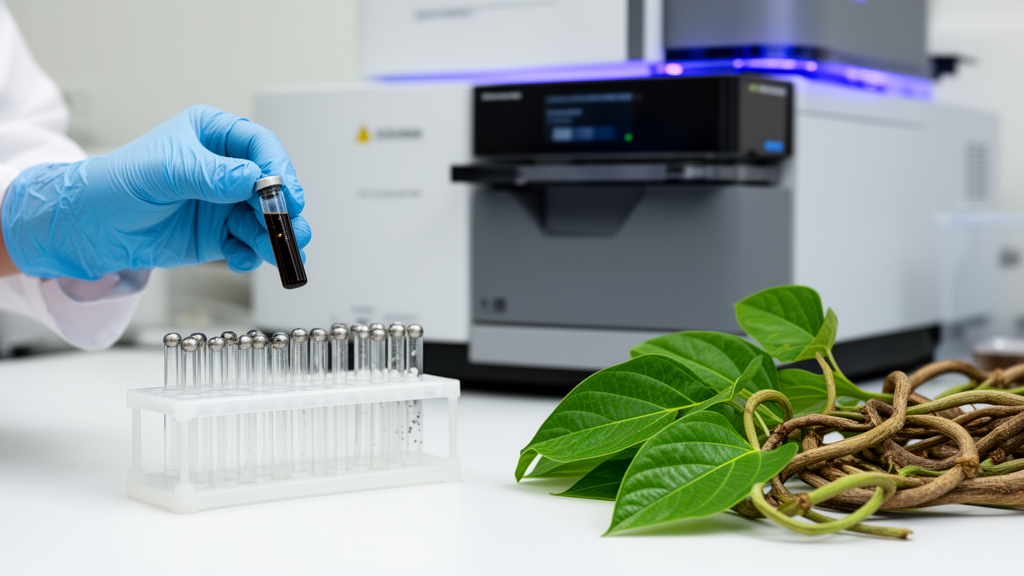
Deep in the Adolpho Ducke Forest Reserve near Manaus, Brazil, grows a liana whose relatives have been woven into hunting poisons and paralytic preparations for centuries. Now, a team of Brazilian chemists has used a clever analytical trick—magnetic beads coated with a key nervous-system enzyme—to fish out fourteen molecules from an aqueous extract of Strychnos peckii that bind directly to acetylcholinesterase (AChE), the enzyme that breaks down the neurotransmitter acetylcholine. The study, published in Frontiers in Natural Products, demonstrates how affinity selection mass spectrometry (AS-MS) can rapidly prioritize enzyme-binding metabolites from complex natural matrices without any labeling or extensive fractionation.
The genus Strychnos is famous for producing a wide array of structurally diverse indole and quinoline alkaloids. Several members of this genus have long been associated with compounds capable of modulating cholinergic pathways, and classical ethnopharmacological studies report their use in the northwestern Amazon Biome since 1548. Given this rich neuroactive chemistry, the researchers suspected that S. peckii—already known to harbor strictosidine-derived monoterpene indole alkaloids—might contain molecules that interact with AChE, a validated drug target in the management of neurodegenerative disorders.
To find out, the team turned to AS-MS, a label-free platform that avoids the artifacts associated with colorimetric or fluorescence assays and preserves native interaction profiles. The workflow is conceptually simple but technically demanding. First, 200 micrograms of eel AChE was immobilized on 10 milligrams of amino-functionalized magnetic beads via Schiff-base chemistry using glutaraldehyde as a linker. Control samples were prepared under identical conditions, with the enzyme inactivated using 100% methanol for 60 minutes. Enzymatic activity was monitored by choline formation, confirming that the immobilized enzyme remained functional.
The assay itself unfolds in four stages: incubation of the extract with the enzyme-coated beads, magnetic separation of bound from unbound species, dissociation of the ligand–enzyme complex, and liquid chromatography–high-resolution mass spectrometry (LC-HRMS) identification of the released ligands. To optimize the protocol, the researchers used galantamine—a known AChE ligand—as a reference compound, establishing an affinity ratio (AR) cut-off of 1.2. Any metabolite whose peak area in the active-enzyme desorbate exceeded 1.2 times its peak area in the inactivated-enzyme control was classified as an AChE ligand.
Once the desorbates were collected, the raw mass spectrometry data were processed in MZmine for ion alignment, deconvolution, and peak-area calculation. Metabolites with AR values above the cut-off were then annotated based on MS/MS fragmentation data, interpretation of a molecular network generated on the GNPS platform, in silico tools such as SIRIUS, and manual curation guided by biosynthetic pathway analysis. Four compounds—5-carboxystrictosidine, strictosidine, desoxycordifoline, and kaempferol-3-O-rhamnoside—were further confirmed at confidence level I through orthogonal chromatographic comparison with previously isolated and spectroscopically characterized reference materials.
The results revealed a clear chemical signature. The strongest binders were lyaloside (AR 3.73) and 10-hydroxygeissoschizol (AR 3.69), both monoterpene indole alkaloids commonly reported in Rubiaceae species. They were followed by alkaloid A (AR 2.51), 5-carboxystrictosidine (AR 2.05), corynantheol (AR 2.04), dolichantoside/isodolichantoside (AR 1.90), alkaloid B (AR 1.68), strictosidine (AR 1.66), corynantheidal (AR 1.63), desoxycordifoline (AR 1.57), kaempferol-3-O-rhamnoside (AR 1.36), kaempferol (AR 1.35), alkaloid C (AR 1.29), and harman-3-carboxylic acid (AR 1.27). Overall, the ligand set was heavily enriched in monoterpene indole alkaloids and related scaffolds, consistent with the known neuroactive chemistry of the genus.
The molecular network organized the detected ions into three main clusters. Cluster A, the most populated, included lyaloside, 5-carboxystrictosidine, strictosidine, and desoxycordifoline—compounds arising from a Mannich-type condensation between tryptamine and secologanin that yields strictosidine as a central biosynthetic intermediate. The mass differences between connected nodes told a coherent biosynthetic story: a 14.014 Da gap between strictosidine and dolichantoside/isodolichantoside corresponds to a methylation, while a 43.989 Da gap between strictosidine and 5-carboxystrictosidine reflects carboxylation. Cluster B comprised the lactone-type alkaloids corynantheol, corynantheidal, 10-hydroxygeissoschizol, and ajmalicine, while Cluster C included alkaloids A and B alongside eleven additional ions that could not be fully annotated.
Notably, three ligands—alkaloids A, B, and C—resisted complete structural assignment even after in silico dereplication and database searching. Only molecular formulas could be proposed for their protonated molecules, and they were tentatively designated as alkaloids combining indole and quinoline cores. Except for these three, all other metabolites had been previously reported in the same aqueous extract, highlighting the ability of AS-MS to uncover overlooked metabolites in complex matrices. The researchers also observed that the higher standard errors for the top binders are an analytical consequence of high target selectivity rather than an experimental flaw: retention on the inactivated control is minimal, producing very low-intensity signals close to the instrument’s limit of detection.
The structural logic behind AChE binding is well understood. Ligand recognition is commonly associated with π–π interactions and hydrogen bonding within the enzyme’s active-site gorge, which comprises the catalytic active site and the peripheral anionic site. Studies on monoterpene indole alkaloids from Rauvolfia species indicate that structural features such as N-methylation may influence AChE inhibitory activity, with docking analyses suggesting π–π and hydrophobic interactions with residues such as Trp86 and Trp133. Similarly, geissospermine has been reported to establish hydrogen bonds with residues of the catalytic triad. The coexistence of MIAs and β-carboline-type alkaloids in the S. peckii ligand set suggests complementary interaction profiles within the enzyme gorge.
Importantly, the assay revealed that ligand capture is not influenced by relative abundance in the crude extract. For example, 5-carboxystrictosidine demonstrated a greater affinity ratio than desoxycordifoline even though its ionization intensity was lower, underscoring the assay’s effectiveness in identifying genuine target–ligand interactions. This selectivity is precisely what makes AS-MS attractive for natural products research: it can prioritize bioactive molecules directly from complex matrices without extensive fractionation, reducing the time and resources typically required for bioassay-guided isolation.
The study provides the first systematic overview of AChE ligands in S. peckii, validating the AS-MS approach and expanding the chemical space associated with AChE binders. Several of the identified ligands have been previously reported as AChE inhibitors, corroborating the platform’s reliability. The researchers argue that AS-MS is a robust and efficient strategy for prioritizing enzyme-binding metabolites from natural product libraries, particularly suited for exploring species whose traditional uses suggest defined pharmacological activities. In the case of S. peckii, the technique connected centuries of ethnopharmacological knowledge—paralytic preparations documented since the sixteenth century—with modern high-resolution mass spectrometry, revealing a coherent set of indole-rich molecules that interact with one of the nervous system’s most important enzymes.
For drug discovery, the implications are significant. AChE inhibition remains a validated strategy in the management of neurodegenerative disorders, and natural product collections are particularly valuable for ligand discovery owing to their metabolic versatility and stereochemical complexity. By coupling affinity selection with LC-HRMS and dereplication, the Brazilian team has shown that a rapid, label-free workflow can expand the AChE-interacting chemical space of a single Amazonian species in a matter of days rather than months. As the platform matures, it could be applied across the Strychnos genus and beyond, systematically connecting traditional knowledge with the molecular interactions that underpin neuroactive chemistry.
Subject of Research: Affinity selection mass spectrometry (AS-MS) for identification of acetylcholinesterase ligands in Strychnos peckii B.L. Rob
Article Title: Affinity selection mass spectrometry (AS-MS) for identification of acetylcholinesterase ligands in Strychnos peckii B.L. Rob
Article References: Cassas, F., Santos, C. L. G., Silva, F. M. A. D., & Cass, Q. B. (2026). Affinity selection mass spectrometry (AS-MS) for identification of acetylcholinesterase ligands in Strychnos peckii B.L. Rob. Frontiers in Natural Products, 5, Article 1928435. https://doi.org/10.3389/fntpr.2026.1928435
Image Credits: AI Generated
DOI: 10.3389/fntpr.2026.1928435
Keywords: Affinity, selection, mass, spectrometry, AS-MS, identification, acetylcholinesterase, ligands, Strychnos, peckii, scientific research
Cite Scienmag News
Cassandra Pierce. (October 15, 2026). Magnetic Beads and Mass Spectrometry Reveal Brain-Targeting Alkaloids in Curare Plant Strychnos peckii. Scienmag. https://scienmag.com/magnetic-beads-and-mass-spectrometry-reveal-brain-targeting-alkaloids-in-curare-plant-strychnos-peckii/
Cassandra Pierce. "Magnetic Beads and Mass Spectrometry Reveal Brain-Targeting Alkaloids in Curare Plant Strychnos peckii." Scienmag, 15 October 2026, https://scienmag.com/magnetic-beads-and-mass-spectrometry-reveal-brain-targeting-alkaloids-in-curare-plant-strychnos-peckii/. Accessed 15 October 2026.
Cassandra Pierce. "Magnetic Beads and Mass Spectrometry Reveal Brain-Targeting Alkaloids in Curare Plant Strychnos peckii." Scienmag. October 15, 2026. https://scienmag.com/magnetic-beads-and-mass-spectrometry-reveal-brain-targeting-alkaloids-in-curare-plant-strychnos-peckii/


