


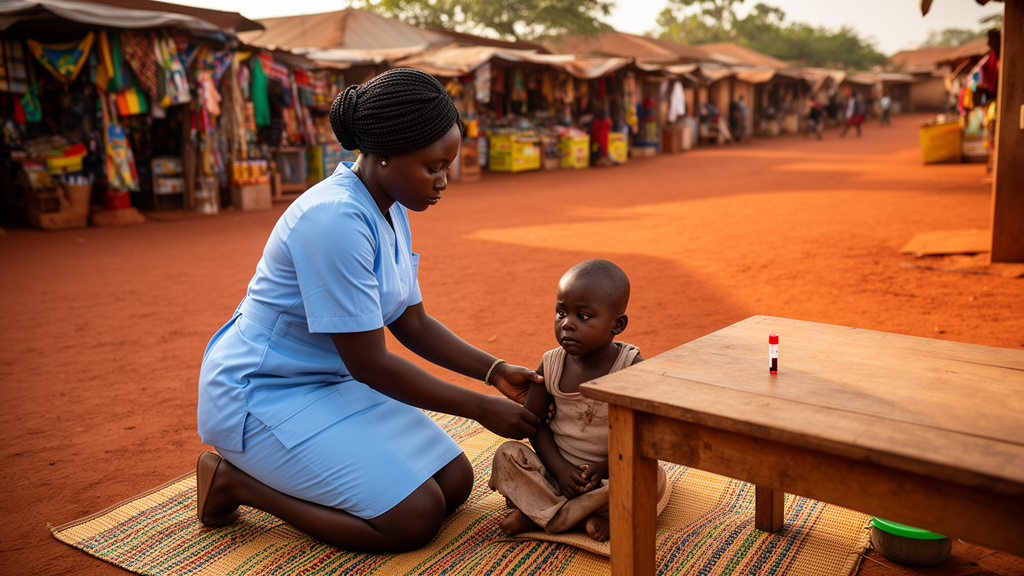
Roughly one in every two young children in Ghana is living with anemia, and a new analysis published in BMC Public Health argues that the country now has a sharper, more data-driven picture of why. Researchers Johnson Sam and Ivan Addae Mensah at the University of Cape Coast combined two very different statistical traditions, classical multilevel regression and modern machine learning, to mine the 2022 Ghana Demographic and Health Survey for the factors most confidently linked to anemia in children aged six to fifty-nine months. Their hybrid framework identified nine high-confidence predictors, ranging from a child’s age and sex to maternal anemia, stunting, and even the average temperature of the district where the child lives, while also flagging specific districts where the odds of anemia are highest.
The scale of the problem is stark. Out of 3,858 children whose records were analyzed, nested within 235 districts after the researchers excluded districts with fewer than two children, 49.0 percent were anemic, with a 95 percent confidence interval running from 46.4 to 51.6 percent. That figure means anemia affects nearly half of Ghana’s preschool-aged population, a burden the World Health Organization would classify as a severe public health problem. Anemia in early childhood is not a benign condition; it is associated with impaired cognitive development, weakened immunity, and reduced school readiness, which is why pinpointing its drivers has long been a priority for public health researchers across sub-Saharan Africa.
What makes the new study methodologically interesting is its parallel architecture. The authors fitted a two-level random-intercept logistic regression, a model that explicitly acknowledges that children are clustered within districts and that children in the same district share unobserved characteristics, from local food systems to health service coverage. At the same time, they trained three machine learning classifiers, Random Forest, XGBoost, and Elastic Net logistic regression, on the same data. To prevent information from leaking between the training and testing phases at the district level, they used a district-grouped 70/30 train-test split, ensuring that no district contributed children to both sets. This kind of grouped splitting is a subtle but crucial safeguard in clustered health data, where ordinary random splits can inflate apparent model performance.
To interpret the black-box models, the researchers computed SHAP values, shorthand for SHapley Additive exPlanations, a technique borrowed from cooperative game theory that assigns each feature a fair share of credit for every individual prediction. The headline importance rankings reported in the paper come primarily from the Random Forest model, with concordance against XGBoost and Elastic Net serving as a robustness check. That agreement was strong: Spearman correlation coefficients between the models’ SHAP rankings ranged from 0.79 to 0.87, all statistically significant at p less than 0.001. For predictors with multiple categories, such as maternal education or wealth quintile, the authors aggregated SHAP importance across category dummy variables before ranking, a detail that prevents a single category from artificially dominating the importance list.
The heart of the paper lies in how it defines a high-confidence predictor. A variable earned that label only if it was statistically significant in the multilevel model at p less than 0.05 and simultaneously ranked among the top 15 features by aggregated mean absolute SHAP value in the machine learning analysis. This dual threshold is designed to filter out variables that look important to only one analytical tradition, whether because of chance associations, confounding, or nonlinear effects that classical regression handles poorly. The authors also report how sensitive their classification is to the choice of the top-15 cutoff, an unusual and welcome transparency measure in a field where arbitrary thresholds often go unexamined.
Nine predictors cleared both bars: child age, mean temperature, child sex, maternal anemia, maternal age, birth order, population density, stunting, and fever. Several of these echo long-established findings in the anemia literature. Maternal anemia is one of the strongest known correlates of child anemia, reflecting shared household diets, genetic factors, and the intergenerational transmission of iron deficiency. Stunting, a marker of chronic undernutrition, and recent fever, often a proxy for malaria or other infections, both plausibly contribute through distinct biological pathways, one by depleting iron reserves over months and the other by triggering hemolysis and iron sequestration during acute illness. The appearance of mean temperature among the top predictors is more provocative, hinting at climate-linked mechanisms, from heat-driven malaria transmission to reduced dietary diversity in hotter regions, though the study design cannot disentangle these pathways definitively.
Perhaps the most intriguing result is what the two frameworks disagreed on. Six district-level contextual variables, nightlights, elevation, rainfall, the enhanced vegetation index, malaria prevalence, and travel time, were not statistically significant in the random-intercept model yet ranked among the top 15 in the SHAP analysis. The authors are refreshingly candid about this divergence, describing it as an unresolved finding that warrants further investigation rather than attributing it to any specific mechanism. Possible explanations include nonlinear or threshold effects that the logistic model cannot capture, interactions between environmental variables, or the modest district-level variance itself, measured at an intraclass correlation coefficient of just 6.2 percent, which limits the power of the multilevel model to detect contextual signals.
That 6.2 percent intraclass correlation is itself informative. It means that only a small fraction of the total variation in childhood anemia is attributable to differences between districts, with the vast majority of the variation occurring between individual children and households within districts. Nevertheless, the district-level clustering was statistically meaningful, and the authors used the model’s random effects, visualized in a caterpillar plot, to rank districts by the odds of anemia. Four districts emerged with the highest odds: Ho Municipal in the Volta region, Ahanta West in the Western region, Nkwanta South in the Oti region, and Wa West in the Upper West region. These geographically dispersed hotspots span the country’s southern coastal belt, eastern highlands, and northern savannah, suggesting that no single regional narrative explains Ghana’s anemia burden.
On pure predictive performance, the three machine learning models were closely matched. Elastic Net achieved the highest area under the receiver operating characteristic curve, at 0.727 with a 95 percent confidence interval of 0.702 to 0.755, followed by Random Forest at 0.707 and XGBoost at 0.685. These are respectable but not spectacular figures, reflecting the reality that anemia is shaped by a diffuse web of dietary, genetic, infectious, and socioeconomic factors that no single survey can fully capture. The modest AUC values also underscore why the authors focused on interpretability and confidence in predictors rather than on maximizing predictive accuracy alone; a model that explains who is at risk is more actionable for policymakers than one that merely ranks children by risk score.
The practical implications are considerable. By fusing epidemiological inference with machine learning interpretability, the study offers Ghanaian health authorities a shortlist of modifiable targets, maternal anemia treatment, childhood nutrition interventions to address stunting, and fever management among them, alongside a map of high-burden districts where geographically targeted programs could be deployed. The authors argue that their findings support climate-resilient and multisectoral interventions, an acknowledgment that anemia is not solely a nutrition problem but one entangled with environment, infrastructure, and disease ecology. As machine learning methods continue to spread through public health research, this study offers a template for how to use them responsibly: not as replacements for classical inference, but as complementary lenses whose agreement, and whose disagreements, both carry scientific meaning.
Subject of Research: Predictors of childhood anemia among children aged 6 to 59 months in Ghana using multilevel regression and machine learning analysis of the 2022 Demographic and Health Survey
Article Title: High-confidence predictors of childhood anemia in Ghana: a parallel multilevel and machine learning analysis of the 2022 demographic and health survey
Article References: Sam, J., & Mensah, I. A. (2026). High-confidence predictors of childhood anemia in Ghana: a parallel multilevel and machine learning analysis of the 2022 demographic and health survey. BMC Public Health. https://doi.org/10.1186/s12889-026-29968-5
Image Credits: AI Generated
DOI: 10.1186/s12889-026-29968-5
Keywords: childhood anemia, Ghana, machine learning, multilevel modelling, SHAP, Demographic and Health Survey, Random Forest, XGBoost, Elastic Net, maternal anemia, stunting, public health
Cite Scienmag News
Ophelia Keating. (October 18, 2026). Machines and Maps Converge on the Drivers of Ghana’s Childhood Anemia Crisis. Scienmag. https://scienmag.com/machines-and-maps-converge-on-the-drivers-of-ghanas-childhood-anemia-crisis/
Ophelia Keating. "Machines and Maps Converge on the Drivers of Ghana’s Childhood Anemia Crisis." Scienmag, 18 October 2026, https://scienmag.com/machines-and-maps-converge-on-the-drivers-of-ghanas-childhood-anemia-crisis/. Accessed 18 October 2026.
Ophelia Keating. "Machines and Maps Converge on the Drivers of Ghana’s Childhood Anemia Crisis." Scienmag. October 18, 2026. https://scienmag.com/machines-and-maps-converge-on-the-drivers-of-ghanas-childhood-anemia-crisis/


