A machine learning model can predict when a laboratory rock sample will fracture under hydraulic loading more than a thousand seconds before it breaks, according to a new open-access study published in GeoEnergy Communications. Researchers Madeleine P. Hooper, Arnold Yuxuan Xie and Bing Q. Li trained a random forest algorithm on acoustic emission signals recorded during fourteen hydraulic fracturing experiments on Barre Granite, achieving a coefficient of determination of 0.97 on held-out test data using half of the dataset for training. The work marks the first application of machine-learning-based time-to-failure forecasting to hydraulic fracturing of intact rock, rather than to stick-slip sliding on pre-existing faults.
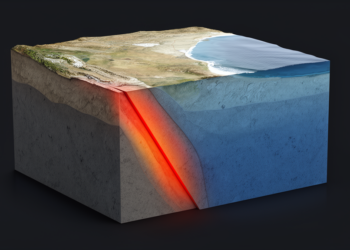
The motivation comes from a persistent hazard in geothermal energy development. Enhanced geothermal systems inject cold water into hot rock to create permeable fracture networks, and that injection can trigger earthquakes. The authors point to the 2017 event in Pohang, South Korea, where injection into an enhanced geothermal system produced a magnitude 5.4 earthquake that injured 90 people and caused an estimated 75.8 million US dollars in damage. Accurate forecasting of when fractures and associated seismicity will occur could inform hazard mitigation strategies in situations where traditional methods fall short, the researchers write.
Traditional earthquake forecasting often relies on recurrence intervals of past characteristic earthquakes, an approach with a well-documented record of failure. In Parkfield, California, an analysis of site stratigraphy yielded a forecast recurrence interval of 21.9 years with a 3.1-year error bound, yet the predicted earthquake did not arrive by 1993 and no similar event occurred until 2004. When applied to laboratory data, the recurrence interval method achieves coefficients of determination of only up to 0.49, where 0.0 indicates no linear correlation and 1.0 indicates perfect correlation. Machine learning approaches have fared considerably better on laboratory faults: a random forest model forecasting time to failure in double-direct shear experiments reached 0.89, and a deep neural network later reached 0.97.
Those earlier successes, however, all involved stick-slip experiments in which rock specimens were loaded in double-direct shear devices and multiple slip events occurred along a predefined plane of weakness, producing mode II in-plane shear cracks. Hydraulic fractures behave differently. They propagate as mixed-mode I/II cracks, creating new fractures and reactivating existing natural ones, and they are central to operations ranging from enhanced geothermal systems to mining and oil and gas stimulation. Among approximately two million wells recently drilled in the United States, 95 percent involve hydraulic fracturing, the authors note, underscoring the value of forecasting the time to a large event during stimulation.
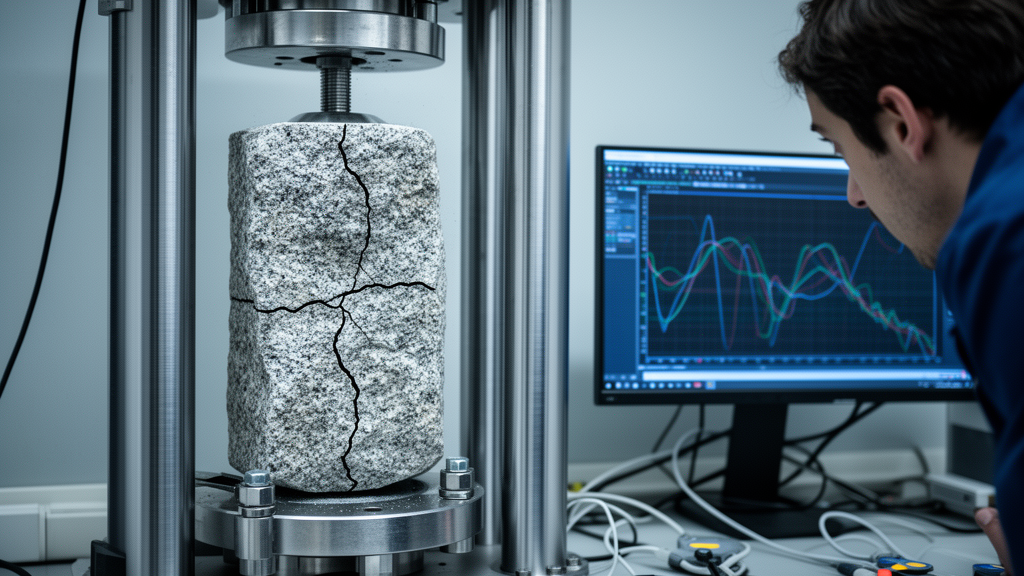
The experimental foundation for the new model was a series of fourteen hydraulic fracturing tests on Barre Granite specimens containing internal flaws of various geometries. Each specimen, cut to dimensions of 25.4 by 76.2 by 152.4 millimeters, was instrumented with eight Physical Acoustics Micro30 sensors and subjected to pressurized water injected in 0.5 MPa increments, with some specimens pre-loaded under a vertical confining pressure of 0 or 5 MPa. Acoustic emission signals were pre-amplified by 20 dB and recorded continuously at a sampling rate of 5 MHz. Failure was defined as a large pressure drop marking the propagation of unstable macro-scale hydraulic fractures to the edges of the specimen.
To turn the raw waveforms into model inputs, the team calculated 64 statistical features from the acoustic emission signals using a 10-second rolling window, applied to both the signal voltage and the first finite difference of that voltage. Features included the mean, variance, kurtosis and skewness, their max-min normalized versions, extreme percentiles, time over several voltage thresholds, and minimum and maximum values. The data were cleaned by removing rows with non-numeric values, replacing infinite values, and discarding outliers identified by Modified Z-Scores of 10 or greater. Times to failure were transformed into logarithmic space to weight intervals close to failure more heavily, and inputs and outputs were normalized with a standard scaler.
The random forest, implemented in Python’s Scikit-Learn package and tuned by five-fold cross-validated grid search over tree counts of 50, 100 and 150 and maximum depths of 5, 10 and unlimited, achieved a test R2 of 0.97 with a 50/50 training-testing split. Individual experiments showed R2 values ranging from 0.93 to 0.99, with the lowest performance attributed to a poor signal-to-noise ratio in one experiment, likely from inappropriate amplification or sensor coupling. The model predominantly underestimated time to failure, forecasting fracture on average 9 seconds earlier than it actually occurred. Feature importance analysis revealed that the first 20 statistical features accounted for 100 percent of the forecast contribution, with the top four features, the mean, minimum and kurtosis of the first finite difference and the skewness of the signal voltage, together accounting for 48 percent of total importance. The model was also robust: removing the mean voltage feature dropped test R2 only from 0.97 to 0.965.
The physical interpretation of these features is telling. Mean amplitude generally increases monotonically toward failure, reflecting the rising average energy of the system as water pressure builds. The minimum of the first finite difference implies a baseline entropy that increases as the rock approaches accelerated seismic release. Kurtosis of the first finite difference exhibits a stepwise drop roughly 300 seconds before failure, then rises as bursts of unrelated microfractures give way to a dominant population of large-amplitude events, while the decrease in skewness of amplitude before that 300-second mark indicates a growing proportion of high-amplitude events consistent with macrofracture formation. Because mean voltage alone shows periods of high activity unrelated to impending failure, the combination of features is what makes the forecast reliable.
Benchmarked against an established technique, the advantage is stark. The inverse acoustic emission rate method, which applies the inverse velocity approach used for rock slope instability forecasting by treating the acoustic emission hit rate as an analogue to velocity, only converges onto a clear linear or concave trend on the order of tens of seconds before failure, between 18 and 69 seconds in advance across the experiments. The random forest model, by contrast, accurately forecast failure 1000 to 1800 seconds before the event at the given injection rate, though with a larger error over that extended window. The authors attribute this to the model’s use of subtle information in the raw signal, which reflects the stress state at the scale of individual mineral grains, whereas the inverse rate method relies only on specimen-scale averages. A support vector machine comparison underscored the difficulty of the problem: using a radial basis function kernel with the same data, it achieved an R2 of only 0.22, suggesting that time-to-failure forecasting of hydraulic fracturing is a highly non-linear, discontinuous problem well suited to the discrete classifications averaged across a forest of decision trees.
The authors are careful to frame the scope of the result. The threshold defining the earliest reliable forecast was arbitrarily set at 75 seconds of prediction-band exceedance, and its generalization requires further investigation. The trained model would likely not transfer to other loading regimes such as direct shear, tension or triaxial setups, to other rock types such as sandstone, limestone or schist, or to larger length scales where signal amplitudes and statistical features would differ from the training data. Nevertheless, the demonstration that failure of an intact rock specimen can be forecast before the onset of accelerated seismic release, using signals that are readily available in large quantities, opens a path toward earlier warning of induced seismicity. The data, models and code needed to reproduce the work are publicly available through Mendeley Data, offering other researchers a starting point for extending the approach beyond the granite specimens and laboratory conditions tested here.
Subject of Research: Machine learning forecasting of time to failure in laboratory hydraulic fracturing of granite using acoustic emission signals
Article Title: Random forest forecasting of time to failure for Granite hydraulic fracturing using acoustic emission signals
Article References: Hooper, M. P., Xie, A. Y., & Li, B. Q. (2025). Random forest forecasting of time to failure for Granite hydraulic fracturing using acoustic emission signals. GeoEnergy Communications, 1(1), Article 7. https://doi.org/10.1007/s44421-025-00005-2
Image Credits: AI Generated
DOI: 10.1007/s44421-025-00005-2
Keywords: random forest, hydraulic fracturing, acoustic emission, time to failure forecasting, Barre Granite, machine learning, induced seismicity, geothermal energy, rock mechanics, inverse AE rate, feature importance, laboratory experiments
Cite Scienmag News
Teresa Odom. (October 30, 2026). Machine Learning Forecasts Rock Fracture Minutes Ahead in Lab Experiments. Scienmag. https://scienmag.com/machine-learning-forecasts-rock-fracture-minutes-ahead-in-lab-experiments/
Teresa Odom. "Machine Learning Forecasts Rock Fracture Minutes Ahead in Lab Experiments." Scienmag, 30 October 2026, https://scienmag.com/machine-learning-forecasts-rock-fracture-minutes-ahead-in-lab-experiments/. Accessed 30 October 2026.
Teresa Odom. "Machine Learning Forecasts Rock Fracture Minutes Ahead in Lab Experiments." Scienmag. October 30, 2026. https://scienmag.com/machine-learning-forecasts-rock-fracture-minutes-ahead-in-lab-experiments/