


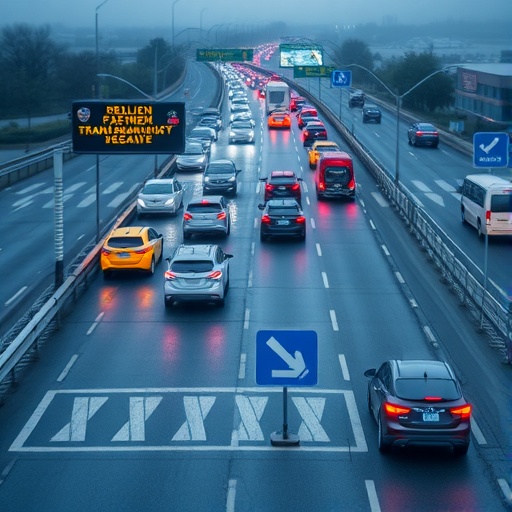
Traffic congestion may soon become less a problem of reacting to stalled roads and more a problem of seeing the jam before it forms. A new review published in the International Journal of Data Science and Analytics examines how machine learning and deep learning are reshaping traffic-flow forecasting, bringing together evidence from models that analyse vehicle counts, speed, occupancy, road-network structure, weather, incidents, social-media activity and other sources of transport data. The review argues that the most promising systems are moving beyond simple predictions based on historical averages. Instead, they are learning how traffic changes across time and space, how neighbouring roads influence one another, and how sudden disruptions can transform an ordinary commute into a city-wide bottleneck.
The study, conducted by researchers from the University of the Free State and the University of KwaZulu-Natal in South Africa, focuses on the growing role of intelligent transportation systems. These systems use connected sensors, cameras, GPS devices, mobile networks and computational models to observe and manage transport conditions. Accurate forecasting is essential because it allows traffic authorities to adjust signal timings, issue warnings, redirect vehicles and plan interventions before congestion reaches its worst stage. It can also help drivers choose better routes and reduce fuel consumption, travel delays and emissions. At the heart of this transformation is machine learning, in which algorithms identify patterns in data and use them to make predictions without being explicitly programmed for every possible traffic situation.
Traditional machine-learning methods remain useful, particularly when datasets are relatively small or when traffic conditions can be described by a limited number of features. The review discusses techniques including K-means clustering, K-nearest neighbours, support vector machines, Naïve Bayes, logistic regression, random forests and artificial neural networks. K-means can divide historical traffic records into groups representing recurring patterns, such as weekday rush hours, weekends or unusual disruptions. A forecasting model can then select the pattern most similar to current conditions. K-nearest neighbours makes predictions by comparing a new traffic situation with previously observed situations, while support vector regression maps complex relationships between traffic variables and future flow. These methods can be comparatively fast and easier to interpret, but they often struggle when traffic behaviour becomes highly nonlinear, geographically interconnected or unpredictable over long periods.
Deep-learning models approach the problem differently by using multilayer neural networks capable of learning complex representations from large quantities of data. Convolutional neural networks, or CNNs, are particularly effective at detecting local spatial patterns. In traffic applications, a road network can be represented as a grid or as structured relationships among intersections, allowing a CNN to identify congestion patterns spreading across nearby locations. Recurrent neural networks, or RNNs, are designed for sequential data and retain information from earlier time steps. Their descendants, long short-term memory networks, or LSTMs, use input, forget and output gates to decide which information should be stored, discarded or passed forward. This architecture helps the model retain important long-term traffic trends while reducing the loss of information that can affect conventional RNNs.
The review highlights a rapid expansion of hybrid architectures that combine the strengths of several deep-learning systems. CNN–LSTM models use convolutional layers to extract spatial features and recurrent layers to model temporal changes, making them suitable for city-wide forecasting. Other systems use gated recurrent units, attention mechanisms and graph convolutional networks. Graph-based models represent roads and intersections as nodes connected by edges, allowing the model to learn how traffic conditions at one location affect others. Attention mechanisms assign greater weight to the most relevant parts of the traffic history or network. The gated recurrent graph convolutional attention network, known as GRGCAN, is one example of this approach. On public PeMSD4 and PeMSD8 datasets, the review reports that GRGCAN achieved mean absolute percentage errors of 15.97 and 12.13 percent for one-hour forecasting, while also outperforming several baseline methods in accuracy and computational efficiency.
Several studies reviewed in the paper demonstrate how specialised designs can improve prediction under particular conditions. A K-means-LSTM system first groups daily traffic profiles and then uses an LSTM to forecast the next traffic value, reducing the influence of abnormal observations. Another K-means-GRU model combines clustering with nearest-neighbour classification to identify the historical pattern most similar to the target day. A time-slot recurrent neural network separates historical data into groups based on recurring time intervals, removing less relevant records and making online prediction more efficient. Transformer-based systems, including CNNformer, use attention to identify important temporal relationships while CNN layers extract spatial information from multiple intersections. These models reflect a broader shift toward architectures that can process traffic as a dynamic network rather than as isolated measurements from individual roads.
One of the most important conclusions is that external information can make forecasts more realistic. Traffic is not controlled only by the number of vehicles recorded a few minutes earlier. Rain, temperature, visibility, roadworks, crashes, public events, holidays, land-use changes and major disruptions can all alter travel behaviour. A spatial-temporal fusion graph convolutional network that incorporated weather variables improved prediction accuracy for 15-, 30- and 60-minute horizons, with reported gains of 3.94, 3.54 and 4.09 percent. Other work has extracted traffic conditions from online videos, combined vehicle movements with meteorological measurements, and used social-media activity to anticipate next-morning traffic. However, the review finds that the integration of such contextual information remains inconsistent. Many models still rely almost entirely on historical traffic records, limiting their ability to respond to rare or rapidly developing events.
Data quality is another major obstacle. Modern forecasting systems may consume millions of records from road sensors, cameras, GPS probes, mobile devices and social platforms, but these sources are frequently incomplete, noisy or unevenly distributed. Sensors can fail, cameras can be obstructed, probe vehicles may be concentrated on major routes, and social-media activity can vary dramatically between communities. High-resolution trajectory datasets can reveal detailed driving behaviour but often cover only a small area. Large sensor networks provide extensive time-series data but may contain missing values and measurement errors. The review describes hybrid methods that use clustering, attention-optimised LSTMs and AdaBoost to reconstruct missing traffic-flow data. Although these methods can substantially improve imputation accuracy, their computational complexity may prevent rapid deployment, particularly in regions with limited hardware and connectivity.
The gap between laboratory performance and real-world operation is a central concern. Deep models often produce impressive results on a specific dataset, yet their accuracy may decline when they are transferred to another city with different road layouts, driving cultures, weather patterns and transport policies. More complex models also demand substantial computing power, while their internal decision-making can be difficult for traffic engineers and the public to interpret. A system that predicts severe congestion should ideally explain whether the forecast was driven by a growing queue, a weather event, an incident or a pattern learned from similar days. The researchers also note that many studies concentrate on freeways and signalised intersections, leaving unsignalised intersections comparatively neglected. These locations involve right-of-way decisions, variable driver behaviour and irregular vehicle interactions, making them especially challenging but highly relevant to rapidly expanding urban areas.
The review ultimately points toward adaptive, multimodal and locally informed traffic-intelligence systems. Future models will need to combine historical and real-time observations with weather reports, incident feeds, public-event schedules, land-use information, public-transport movements and perhaps connected-vehicle data. They will also need to learn continuously as traffic patterns change, while remaining efficient enough to operate at the roadside or on edge-computing devices. For South Africa, the authors identify a particular need for models designed around non-signalised intersections in Gauteng and Johannesburg, where congestion, safety risks and data limitations intersect. The broader message is that no single algorithm will solve urban traffic. The most effective forecasting systems will be those that balance accuracy with speed, explainability, resilience and transferability. By predicting congestion before it becomes visible to most drivers, intelligent transportation networks could turn traffic management from a reactive emergency response into a proactive, data-driven service.
Cite Scienmag News
Blake Davidson. (August 26, 2026). Machine and Deep Learning Advance Traffic Congestion Forecasting in Intelligent Transportation Systems. Scienmag. https://scienmag.com/machine-and-deep-learning-advance-traffic-congestion-forecasting-in-intelligent-transportation-systems/
Blake Davidson. "Machine and Deep Learning Advance Traffic Congestion Forecasting in Intelligent Transportation Systems." Scienmag, 26 August 2026, https://scienmag.com/machine-and-deep-learning-advance-traffic-congestion-forecasting-in-intelligent-transportation-systems/. Accessed 3 September 2026.
Blake Davidson. "Machine and Deep Learning Advance Traffic Congestion Forecasting in Intelligent Transportation Systems." Scienmag. August 26, 2026. https://scienmag.com/machine-and-deep-learning-advance-traffic-congestion-forecasting-in-intelligent-transportation-systems/


