


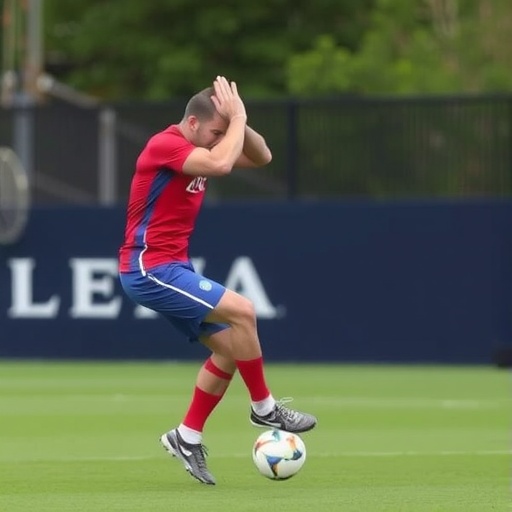
In the realm of sports science, the intersection of safety and performance continues to garner significant attention, particularly in contact sports like association football, commonly known as soccer. A groundbreaking study, spearheaded by researchers England, Liverseidge, Miyazaki, and their team, has made strides in understanding the implications of ball inflation pressure on head impact dynamics. The findings, published in the Annals of Biomedical Engineering, seek to illuminate a significant concern: could a reduction in ball inflation pressure lead to decreased head impact kinematics? The implications of this research could redefine training protocols and safety measures within the sport.
The focal point of the study was to investigate if modifying the air pressure within footballs can minimize the severity of head impacts sustained by players during matches and training sessions. With an increased emphasis on minimizing brain injuries attributed to head collisions in sports, understanding the mechanics of these impacts is essential. The researchers implemented a comprehensive analysis, utilizing advanced biomechanical techniques to measure head impacts when using balls inflated to various pressures.
One of the critical innovations of this study was the use of high-speed cameras and motion analysis software to capture and quantify head impact events accurately. By examining players who took headed shots, the researchers could measure the forces exerted upon the head under different inflation pressures. The key finding suggested that lower inflation pressures led to reduced peak impact forces. This promising outcome suggests that softening the ball’s contact might mitigate the risks associated with concussive and sub-concussive impacts.
The research team also conducted a thorough literature review, consolidating existing data on head injuries and the mechanics of impact in football. Data indicated that a substantial number of head injuries in the sport arise from aerial challenges and unintentional collisions. By potentially altering the characteristics of the ball, their analysis contributes a fresh perspective to the ongoing debate about player safety. The implications are profound: if the reduction of ball inflation indeed decreases the incidence of head injuries, this simple modification could become a fundamental tenet of training and match preparation—ultimately promoting player welfare.
In light of the findings, the discussion around equipment standards in football is likely to gain momentum. Governing bodies such as FIFA and UEFA may need to re-evaluate the protocols surrounding match equipment and consider introducing regulations pertaining to ball inflation pressures. Ensuring that footballs are not only designed for optimal performance but also for health and safety should be a priority for all stakeholders involved in the sport.
Furthermore, the potential for engaging with players, coaches, and sports organizations on this topic is crucial. The findings should be disseminated through educational programs that underline the importance of head safety in football. Players at all levels—from youth leagues to professional ranks—must be informed about the risks associated with head impacts, as well as potential preventive measures. The combination of knowledge and simply adjusted equipment could lead to a significant reduction in sport-related brain injuries.
Additionally, the study could prompt more extensive research into other areas of football equipment, such as the design of headgear or protective padding. Historically, the football community has been apprehensive regarding adding more gear, stemming from the sport’s deeply rooted identity. However, as awareness grows about the long-term consequences of head trauma, innovative solutions that respect the sport’s heritage while prioritizing player safety must be pursued.
One compelling aspect of this research is its suggestion that engaging with players’ experiences can lead to actionable insights into head trauma. Surveys or interviews could provide qualitative data that complements the quantitative findings. Understanding how players perceive head impacts and their attitudes towards changes in equipment could yield a more holistic view of player safety in the sport.
As the investigation continues into various inflation levels, a robust dialogue around alternative measures to safeguard athletes’ health—such as enhanced training environments, awareness programs, and psychological support—must be opened. Collaboration between cientists, sports professionals, and regulatory bodies is essential to ensure that initiatives benefit players holistically.
There is also a broader social component that can’t be overlooked. In recent years, public scrutiny surrounding sports injuries has increased, with many advocacy groups demanding comprehensive safety protocols. As football grapples with its image, studies like this one serve as crucial stepping stones towards a more responsible future for the sport.
In conclusion, the research led by England and his team not only provides valuable insights into head impact kinematics in association football, but it also sets in motion a series of critical discussions about player safety, equipment standards, and the future of the game. If the trend of reducing inflation pressure in footballs proves to be effective, it could lead to widespread changes in how the sport is played and perceived, ensuring that the game evolves to safeguard the health of its athletes while maintaining its thrilling nature.
The innovative nature of this research signifies an urgent call for the football community to rethink its approach to player safety while simultaneously pushing for progressive changes in how the sport is administered. As head impacts continue to be a paramount concern, ongoing research in this field will be crucial to ensuring that football remains not only a beloved pastime but a safe one as well.
England, R., Liverseidge, S., Miyazaki, Y. et al. Does Reduced Ball Inflation Pressure in Association Football Decrease Head Impact Kinematics?. Ann Biomed Eng (2025). https://doi.org/10.1007/s10439-025-03804-0
Cite Scienmag News
Ophelia Keating. (August 28, 2025). Lowering Ball Pressure: Impact on Head Kinematics? Scienmag. https://scienmag.com/lowering-ball-pressure-impact-on-head-kinematics/
Ophelia Keating. "Lowering Ball Pressure: Impact on Head Kinematics?" Scienmag, 28 August 2025, https://scienmag.com/lowering-ball-pressure-impact-on-head-kinematics/. Accessed 4 September 2026.
Ophelia Keating. "Lowering Ball Pressure: Impact on Head Kinematics?" Scienmag. August 28, 2025. https://scienmag.com/lowering-ball-pressure-impact-on-head-kinematics/


